In mundo pressuram habetis: Mary and Peace in Tribulation
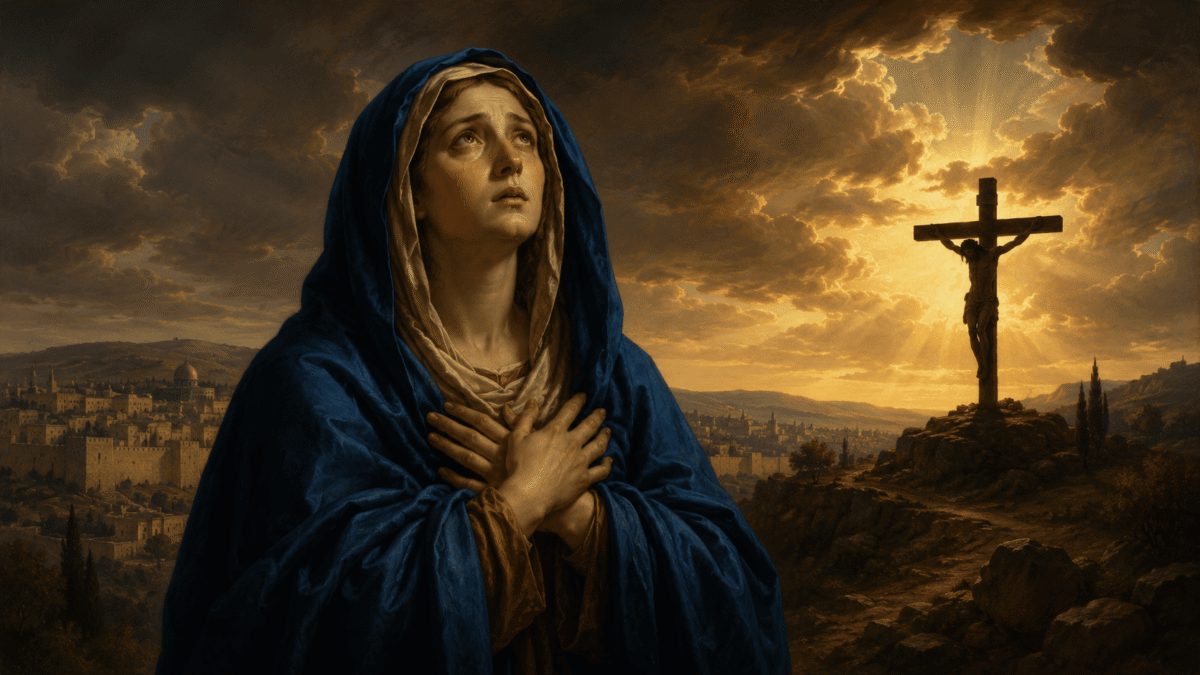
In mundo pressuram habebitis: sed confidite, ego vici mundum.
Jn 16:33
“In the world you will have tribulation. But have confidence, I have overcome the world.” This closing sentence of the farewell discourse (Jn 13-16) is a synthesis of the Gospel of John: the tribulation of the world is real, but Christ’s victory is definitive. Mariology finds in this statement its deepest foundation for the experience of suffering: Mary, who lived “tribulation” more radically than any other human being—at the foot of the Cross, in persecution, in exile—knew that the Son’s victory was certain, and this certainty transformed her tribulation into a peace that the world could neither give nor take away.
I. “Tribulation” and “Victory”: The Johannine Tension
The Greek word thlipsis—“tribulation,” “pressure,” “distress”—carries a specific weight in John: it is not suffering in general, but the pressure exerted by the “world” on the disciples of Jesus. It is the consequence of “not being of the world” (Jn 17:16): whoever follows Jesus necessarily lives in tension with the logic of the world, and this tension manifests itself as tribulation. It is not a punishment; it is the sign of fidelity to the Gospel.
Against this tribulation, Jesus sets His victory: “I have overcome the world” (ego nenikêka ton kosmon). The verb is in the perfect tense and indicates a victory already accomplished whose effects persist in the present. Jesus does not say “I will overcome the world”; He says “I have overcome,” with the authority of one who anticipates, even before the Cross, what the Cross and the Resurrection will definitively accomplish. This confidence in the victory already won is the foundation of the “confidence” that Jesus asks of His disciples: “have confidence” (tharseite)—not a confidence based on present evidence, but one based on the victory already won by the Risen One.
The theology of the Cross and the Resurrection finds here its most concise formulation: tribulation is real, but the victory is more real. The Christian tradition, particularly monasticism and martyrdom, lived this tension more intensely than ordinary Christian life. Saint Paul, who listed his tribulations in 2 Cor 11:23-28 in an impressive catalog, concludes: “I can do all things in him who strengthens me” (Phil 4:13). The “confidence” that Jesus asks for in Jn 16:33 is precisely this one: that of Paul, that of the martyrs, that of Mary at the foot of the Cross.
The social dimension of Christian tribulation—persecution by the authorities, discrimination, marginalization—is a reality that the twenty-first century confirms more and more: over 300 million Christians live in situations of severe persecution or discrimination (Open Doors data, 2023). The message of Jn 16:33 is directly relevant to these brothers and sisters: their tribulation is real, but the victory of the Risen One is more real. “Have confidence.”
II. Mary and the “Pressuram”: Tribulation without Surrender
Mary’s life is punctuated by moments of “tribulation” in the Johannine sense: Joseph’s incomprehension (Mt 1:19), the birth in conditions of poverty (Lk 2:7), Herod’s persecution (Mt 2:13-15), the “loss” of Jesus in the Temple (Lk 2:44-50), the apparent rejections during the public ministry (Mk 3:21, 31-35), and Calvary, the definitive tribulation. This sequence is not accidental: it is the concrete expression of what Jn 16:33 announces as the destiny of Jesus’ disciples.
What is distinctive about Mary’s “tribulation” is that she shares the Son’s tribulation: she does not merely suffer “because of” Jesus, but “with” Jesus. The sword that Simeon foretold “pierces the soul” of Mary (Lk 2:35) precisely because she is so close to the Son that her tribulation is the Son’s tribulation. This co-participation in the suffering of Christ is what the tradition has called compassio—“suffering with”—and it is one of the deepest forms of Mary’s participation in the redemptive work, always subordinate to the one saving mediation of Christ (cf. LG 60-62).
The iconography of the Pietà, Mary holding her dead Son in her arms, visually captures this co-participation. Michelangelo, in the Vatican Pietà, portrayed a Mary biologically too young for the scene, a deliberate choice that the interpretive tradition has symbolically associated with the purity and spiritual youthfulness of the Immaculate Mother, and with her participation in the victory over death. The Pietà is not merely a scene of lament; it is a declaration of faith: she who holds her dead Son knows that tribulation is not the last word.
The medieval Stabat Mater, the liturgical sequence of Good Friday, expresses Mary’s tribulation with a poetic intensity that has no parallel. But the tradition never left the contemplation of the sorrowful Mary without its glorious counterpart: the Mary of the Passage (Stabat Mater) is the same one who appears in the glorious mysteries of the Rosary as the Assumed One and as Queen. Mary’s tribulation always points to her glory. Her glory does not cancel her tribulation; it transfigures it.
III. “Ego vici mundum”: Christ’s Victory and Mary’s Hope
“I have overcome the world”: this statement of Jesus, made before the Cross, has in Mary its most eloquent living testimony. She who lived the most radical tribulation, the death of her Son, and was the first to experience the joy of the Resurrection, is the living witness that Christ’s victory is real and definitive. Her Assumption in body and soul is the extension of this victory to the whole human being: the flesh that suffered tribulation is the flesh that was glorified.
Christian hope, which Paul defines as “the hope of what is not seen” (Rom 8:24), has in Mary its most solid anchor. Not because she is a “guarantee” in the sense of scientific evidence, but because she is the testimony of one who passed through the most radical tribulation and whose final victory is the sign that Christ’s victory is effective for humanity. “Have confidence, I have overcome the world”: Mary is the living confirmation of this confidence.
The Marian title Auxilium Christianorum, Help of Christians, has a concrete historical dimension. At Lepanto (1571), the Christian victory was attributed to Mary’s intercession and gave rise to the feast of the Rosary. In besieged Vienna (1683), the victory was likewise attributed to Mary’s intercession. At Fatima (1917), Mary’s message was received as guidance for passing through the historical tribulation that was approaching. In all these cases, the invocation of Mary as “Auxilium” expressed faith in the victory that Christ promised: “I have overcome the world,” and Mary intercedes so that her children may share in this victory in their concrete tribulations.
Kazan in Russia, Guadalupe in Mexico, Częstochowa in Poland: these Marian places are “anchor points” of Christian hope in situations of national and historical tribulation. They are not places of resignation (“God willed it so”); they are places of “active confidence”: knowing that Christ has overcome the world, the Christians who invoke Mary do not resign themselves to tribulation, but combat it with the confidence grounded in the victory of the Risen One.
IV. “Peace in Me”: The Peace That Accompanies Tribulation
Jn 16:33 begins: “I have said these things to you, that in me you may have peace.” The peace that Jesus promises is not the absence of tribulation; it is peace “in me” (en emoi), that is, the peace that comes from dwelling within Christ, from the relationship with Him that no external tribulation can destroy. It is the “peace which passes all understanding” of which Paul speaks (Phil 4:7): the peace that coexists with tribulation, that does not deny it but “contains” it within a wider horizon.
Mary is the model of this “peace in tribulation.” She who was “standing” at the foot of the Cross—standing, not fallen; present, not having fled—possessed this peace “in Christ” that no tribulation could destroy. Her “stabat” was not insensitivity to suffering; it was the fruit of decades of life “in Christ,” of abiding in the love of the Son, which that anchoring made unshakable even at the moment of greatest suffering.
The spirituality of peace-in-tribulation has a very concrete devotional expression in devotion to the Sacred Heart and to the Immaculate Heart of Mary. The “Heart,” in the biblical sense, is the center of the person, the place from which fundamental decisions and affections flow. The “Heart of Mary” is the place where peace-in-tribulation has its center: a heart pierced by the sword (Lk 2:35) that nevertheless “abides” in the love of the Son. This heart is the image of the peace that Jn 16:33 promises: not the peace of the sword’s absence, but the peace of a love that the sword cannot destroy.
Mary, who lived the most radical tribulation “standing” at the foot of the Cross, is the living testimony that Christ’s victory is real: “I have overcome the world,” and she is its living confirmation in glorified body and soul.
References
- John Paul II, Redemptoris Mater, nos. 44-47 (1987).
- Second Vatican Council, Gaudium et Spes, no. 39 (1965).
- Saint John of the Cross, Spiritual Canticle, stanzas 1-4.
- Open Doors, World Watch List (2023).
- H. U. von Balthasar, Heart of the World (1979).
Postgraduate Program in Mariology
Would you like to deepen your formation in Mariology? Discover the Postgraduate Program in Mariology of Locus Mariologicus, an academic formation that unites theological rigor, spiritual life, and the living tradition of the Church.
Would you like to study Mariology seriously?
This article grows out of the works in the Locus Mariologicus library. The Postgraduate Program in Mariology takes you to the same source, with academic guidance: Scripture, the Fathers of the Church, and the Magisterium, from the first dogma to contemporary questions.





Responses