Quae est Mater mea: “Who is my mother?” and the Spiritual Motherhood of Mary
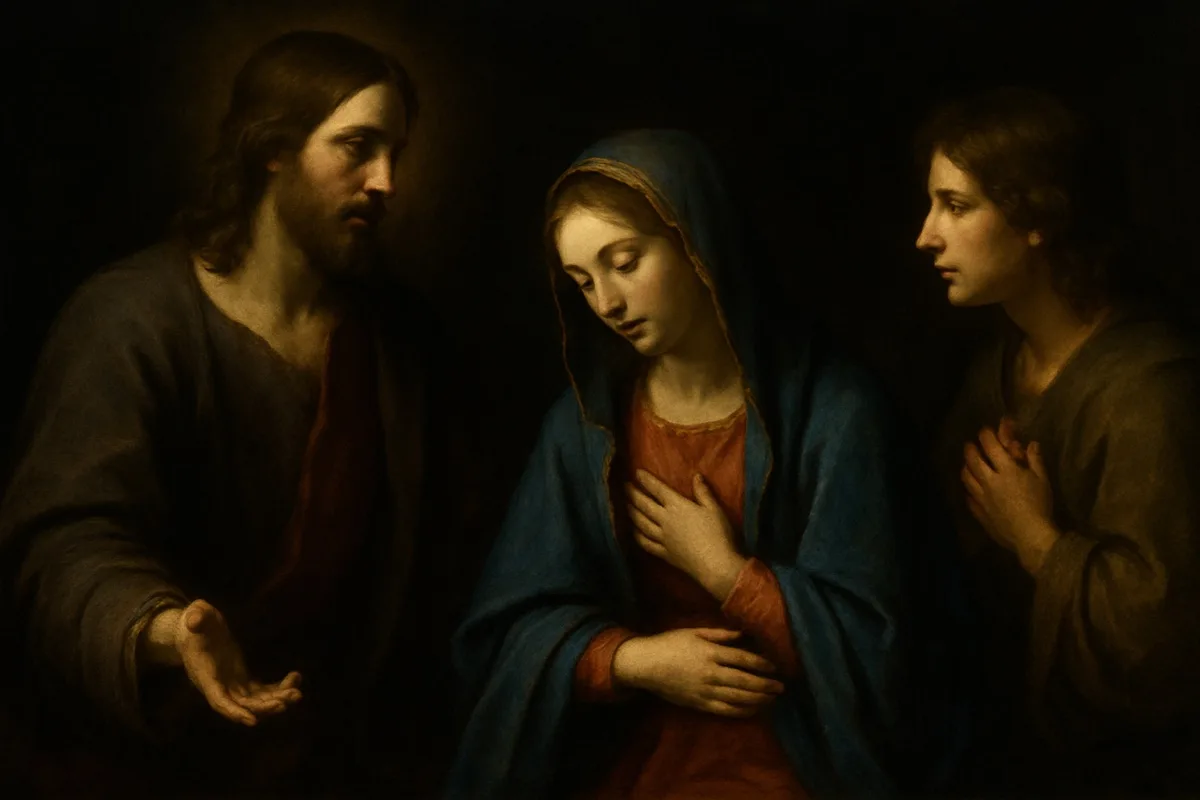
Quis est mater mea, et qui sunt fratres mei? Et extendens manum in discipulos suos dixit: Ecce mater mea et fratres mei. Quicumque enim fecerit voluntatem Patris mei qui in caelis est, ipse meus frater et soror et mater est.
Mt 12:48-50
Mt 12:46-50 is one of the texts that anti-Marian apologetics frequently uses to “devalue” Mary’s motherhood: Jesus, informed that His mother and His brothers are outside waiting, refuses to go out to meet them and points to the disciples as “my mother and my brothers.” A hasty reading sees in this gesture a rejection of the ties of blood in favor of the spiritual family of the Kingdom. An attentive reading of Matthew’s text reveals a richer theology: Jesus does not reject Mary; He defines what the foundation of His relationship with her and with any disciple is.
“Whoever does the will of my Father who is in heaven, he is my brother, and sister, and mother” (Mt 12:50): the criterion of the family of the Kingdom is not blood but obedience to the will of the Father. Jesus’ question (“who is my mother?”) is not the rhetoric of rejection; it is the rhetoric of revelation: He is revealing the deepest foundation of the relationship with Him. And that foundation, in Mary’s case, was precisely what set her apart: “Behold the handmaid of the Lord. Let it be done to me according to your word” (Lk 1:38). Mary was the first to “do the will of the Father,” and for this reason she is the “mother” of Jesus in the most radical sense: in the sense that Jesus Himself defines as the foundation of the family of the Kingdom.
I. “Your Mother and Your Brothers Are Outside”: The Context of the Scene
“While He was still speaking to the crowds, behold, His mother and His brothers were outside, wanting to speak with Him” (Mt 12:46): the immediate context is the discourse on the “sign of Jonah” and the confrontation with the Pharisees. The arrival of Jesus’ family “from outside,” while He is “inside” with the disciples, creates a spatial contrast that Matthew uses theologically: “inside/outside” is a metaphor for belonging to the group of the disciples (cf. Mk 4:11: “to you has been given the mystery of the Kingdom of God. But for those who are outside, everything comes in parables”).
“Someone said to Him: Look, your mother and your brothers are outside waiting for you” (Mt 12:47): the messenger presents the situation as an appeal to social convention: Jesus’ mother and brothers have a right to priority of access. Jesus’ answer subverts the convention: “Who is my mother and who are my brothers?” is not ignorance of the family of blood but a question about the true foundation of the family bond. The family of blood is not enough; the bond of the “will of the Father” is necessary.
The reference to the “brothers” of Jesus (Mt 12:46-47; cf. Mt 13:55-56) is one of the most debated points in New Testament exegesis and in dogmatic theology. The three main positions (carnal brothers of Jesus, the common Protestant reading; half-brothers, sons of Joseph by an earlier marriage, the position of Epiphanius; cousins of Jesus, the position of Jerome and of the Catholic majority) have different implications for Mariology, but none of them affects the central theological argument of Mt 12:50: the criterion of the family of the Kingdom is the fulfillment of the will of the Father, independently of the ties of blood.
II. “Behold My Mother and My Brothers”: The Eschatological Family
“Stretching out His hand toward His disciples, He said: Behold my mother and my brothers” (Mt 12:49): Jesus’ gesture is inclusive, not exclusive: He is not saying that the family of blood ceases to exist, but that the family of the Kingdom is equally real and equally binding. The “stretching out of the hand” toward the disciples is a gesture of adoption; those who do the will of the Father are incorporated into Jesus’ family with the same bond that unites Him to His family of blood.
The “eschatological family” that Jesus constitutes has roots in the prophetism of the Old Testament: Jeremiah was called not to marry and not to have children as a sign of the judgment that was drawing near (Jer 16:1-4). Jesus Himself has no biological children but has disciples as “children.” The family of the Kingdom does not annul the biological family; it transfigures it: the ties of blood are relativized (not eliminated) by the higher bond of the will of the Father.
The relationship between Jesus and Mary after this scene continues in the Gospels: Mary stands at the foot of the Cross (Jn 19:25-27), Mary is in the Cenacle with the apostles (Acts 1:14). The “rejection” of Mt 12:46-50 did not distance Mary from Jesus; on the contrary, the condition that Jesus stated (“whoever does the will of the Father”) describes precisely what Mary always was. The “behold my mother” that Jesus says of the disciples can also be said, with greater reason, of Mary, because she fulfilled the condition before any disciple.
III. Mary, the First Who “Did the Will of the Father”
“Whoever does the will of my Father who is in heaven” (Mt 12:50): the criterion of the family of the Kingdom is explicitly the fulfillment of the will of the Father. In Matthew’s theology, the “will of the Father” is not an abstract law but adherence to God’s plan of salvation, which takes concrete form in the person and mission of Jesus. “To do the will of the Father” is, in Matthew’s language, the equivalent of Mary’s Lucan “fiat.”
Patristic tradition explored this parallel with precision: Augustine (De sancta virginitate, 3,3) wrote that Mary’s spiritual motherhood, the fact that she did the will of the Father, is more important than her carnal motherhood: “Mary was more blessed in receiving the faith of Christ than in conceiving the flesh of Christ.” Not because carnal motherhood has no value (it has full and unique value), but because its value comes from its being the concrete realization of the will of the Father, the “fiat” that preceded the Incarnation and made it possible.
The Mariology that is born of Mt 12:50 is a Mariology of discipleship: Mary is the mother of Jesus not only biologically but as a disciple; she is the perfect disciple who “does the will of the Father” at every moment of her life. The “fiat” of the Annunciation, the “yes” of the Visitation, the “she kept these things in her heart” of the infancy, the “do whatever He tells you” of Cana, the “stabat” of Calvary, the “one at prayer” of the Cenacle: each of these acts is a concrete realization of the “doing of the will of the Father” that Mt 12:50 identifies as the foundation of the family of the Kingdom.
IV. “Mother of the Disciples”: The Extension of Mary’s Motherhood
Jn 19:26-27, “Behold your mother,” is the key that interprets Mt 12:46-50 in the light of the Cross: Jesus, in entrusting John to Mary and Mary to John, is not merely making practical provision for His widowed mother. He is giving concrete form to what Mt 12:50 stated as a principle: the family of the Kingdom has a mother, Mary. The “behold your mother” of Jn 19:27 is addressed to the “beloved disciple” as the representative of all the disciples. In this act, Mary becomes the “mother” of all those who “do the will of the Father.”
The “spiritual motherhood of Mary,” one of the central themes of contemporary Mariology, has its biblical foundation in the conjunction of Mt 12:50 and Jn 19:27: the criterion of the family of the Kingdom (Mt 12:50) and the extension of Mary’s motherhood to all the disciples (Jn 19:27). Mary is the “mother of the disciples” because they are “brothers of Jesus” (Mt 12:50) and she is the mother of Jesus, both in the biological sense and in the deeper sense of “doing the will of the Father.”
Marian devotion understood as “learning from Mary how to do the will of the Father,” which Ignatian, Carmelite, and Dominican spiritualities developed in different but converging ways, has its root in Mt 12:50 read in the light of Lk 1:38. Mary is not only a model of “doing the will of the Father”; by her spiritual motherhood she is the “teacher” who can teach her spiritual children the way of the “fiat.” To have recourse to Mary is to have recourse to the mother who did the will of the Father in the most perfect way, and who, for this reason, can teach the way.
Postgraduate Program in Mariology
Would you like to deepen your formation in Mariology? Discover the Postgraduate Program in Mariology of Locus Mariologicus – an academic formation that unites theological rigor, spiritual life, and the living tradition of the Church.
Would you like to study Mariology seriously?
This article grows out of the works in the Locus Mariologicus library. The Postgraduate Program in Mariology takes you to the same source, with academic guidance: Scripture, the Fathers of the Church, and the Magisterium, from the first dogma to contemporary questions.

Responses