Ego sum resurrectio et vita: Martha, Mary, and Lazarus and the faith that raises to life.
By Prof. Dr. Daniel C. Afonso · Updated
Dixit ei Iesus: Ego sum resurrectio et vita. Qui credit in me, etiam si mortuus fuerit, vivet. Et omnis qui vivit et credit in me, non morietur in aeternum. Credis hoc?
Jn 11:25-26
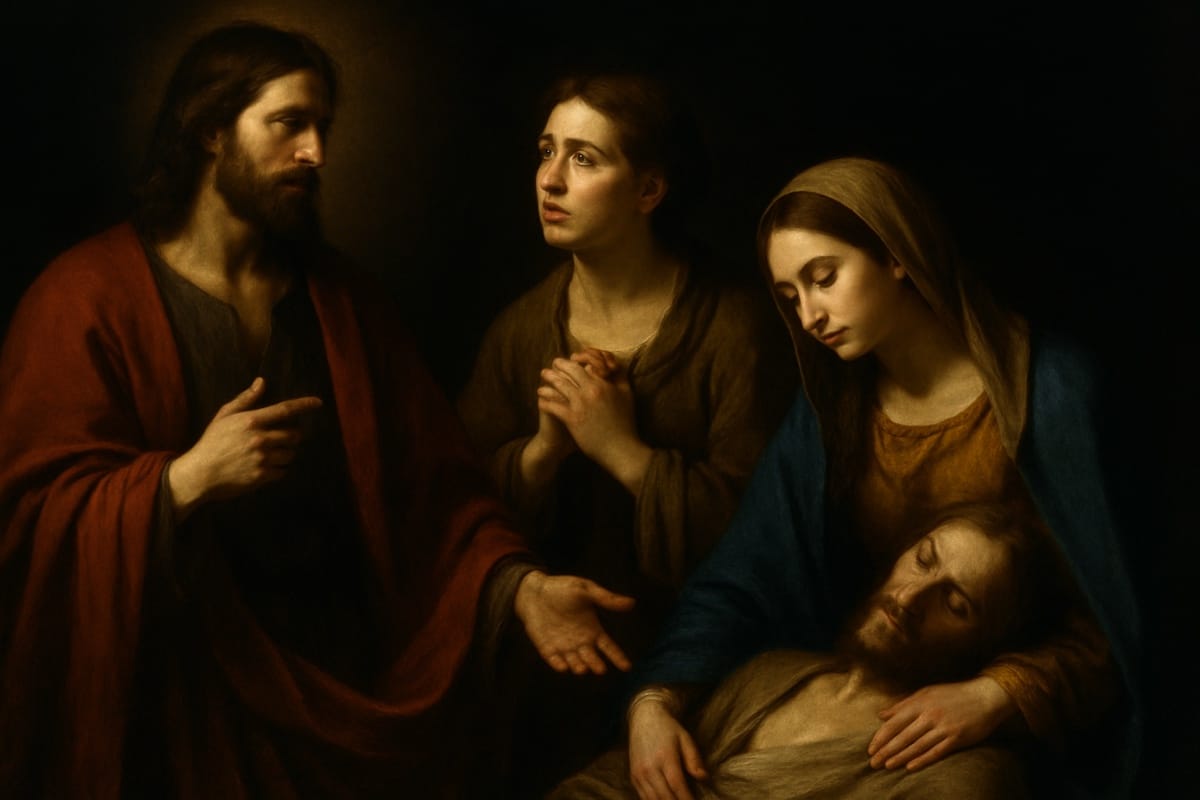
The Feast of Saints Martha, Mary, and Lazarus, celebrated on July 29, was raised from a memorial to a feast by Pope Francis in 2021, in recognition of the singular role of this family of Bethany in the life and in the mystery of Jesus. The Gospel of John (Jn 11:1-27) recounts the arrival of Jesus after the death of Lazarus, the meeting with Martha, and the most solemn self-revelation of the fourth Gospel: “I am the Resurrection and the Life” (Jn 11:25). The scene brings together three fundamental theological axes: the faith that challenges (“Lord, if you had been here, my brother would not have died”), the self-revelation of Jesus as “Ego sum,” and Martha’s Christological confession (“I believe that You are the Christ, the Son of God who was to come into the world,” Jn 11:27).
The family of Bethany holds a unique place in the Gospels: Jesus “loved Martha and her sister and Lazarus” (Jn 11:5), the only time John uses the verb “loved” (ἠγάπα) with reference to Jesus’ relationship with particular persons who were not disciples. For Jesus, Bethany was a place of welcome, of rest, of intimacy, the house where He found not the crowd that demanded signs but friends who received Him as a person. Jesus’ relationship with Martha, Mary, and Lazarus is a model of spiritual friendship: deep, demanding, transforming.
I. “Domine, si fuisses hic”: the faith that challenges
“Domine, si fuisses hic, frater meus non fuisset mortuus” (Jn 11:21): Martha’s challenge to Jesus is the model of the faith that does not silence sorrow but presents it to God. “If you had been here”: the sentence contains at once faith (the confidence that Jesus could have prevented the death) and lament (why were you not here when we needed you?). This tension between faith and lament is not a contradiction; it is the interior of biblical faith which, from the psalms of supplication (“How long, O Lord?”) to Job, presents the painful reality to God without false resignation.
Martha did not stay at home when she learned that Jesus was arriving; she went out to meet Him (Jn 11:20). This movement is theologically significant: the faith that challenges is not passive but active: it goes out to meet Jesus even with sorrow in the heart. Martha’s “faith in movement” contrasts with the sister who remained seated at home (Jn 11:20), not for lack of faith but from paralyzing grief. Both forms of reaction are human. Jesus welcomes them both: He goes out to meet Martha who comes and He goes out to meet Mary who weeps (Jn 11:33).
Martha’s “but even now I know that God will grant you whatever you ask of Him” (Jn 11:22) is the moment of hope that shines in the midst of the lament: she does not know what is going to happen, she does not explicitly ask for the resurrection of Lazarus, but she trusts that the presence of Jesus opens possibilities that death seemed to have closed. This trust without an agenda, “without knowing what is going to happen but trusting that Jesus can do something,” is the model of the prayer of intercession: not the imposition of a solution upon God but the presentation of sorrow with confidence in God’s freedom to act.
II. “Ego sum resurrectio et vita”: the self-revelation of Jesus
“Ego sum resurrectio et vita” (Jn 11:25), one of the seven “Ego sum formulas” of the fourth Gospel (cf. Jn 6:35; 8:12; 10:7; 10:11; 14:6; 15:1), is the most directly Christological and eschatological. Jesus does not say “I have the power to raise the dead,” He says “I am the Resurrection.” The Resurrection is not a capacity that Jesus possesses but a reality that Jesus is: eternal life is not something external to Jesus that He distributes, but His own life, which He communicates to the faithful.
“Qui credit in me, etiam si mortuus fuerit, vivet” (Jn 11:25): the promise has a paradoxical structure: “whoever believes in Me, even if he dies, will live.” Physical death does not destroy the life that the believer has received through faith, because that life is the life of Jesus, which is not subject to death. And “omnis qui vivit et credit in me, non morietur in aeternum” (Jn 11:26): whoever lives the life of faith will not die eternally; physical death is no more than a passage to the fullness of life. The twofold promise embraces the two aspects of the human condition: those who have already died (they will rise) and those who are still alive (they will not die eternally).
The question of Jesus, “Credis hoc?” (Jn 11:26), turns the self-revelation into a personal challenge: it is not enough to hear the affirmation; the response of faith is necessary. Martha’s answer (“Credo quod tu sis Christus, Filius Dei, qui in hunc mundum venturus erat,” Jn 11:27) is the most complete confession of the fourth Gospel, parallel to Peter’s confession in Mt 16:16. Martha, the woman who serves (Lk 10:40), formulates the most complete confession of faith of the Johannine Gospel: “I believe that You are the Christ, the Son of God who was to come into the world.”
III. “Credo quod tu sis Christus”: the confession of Martha and the faith of Mary of Nazareth
Martha’s confession, “I believe that You are the Christ, the Son of God who was to come into the world” (Jn 11:27), is, in the structure of the fourth Gospel, the exemplary response to the self-revelation of Jesus as “Ego sum resurrectio et vita.” Martha does not wait to see the proof of Lazarus’ resurrection in order to confess; she confesses before any miracle, on the basis of the word of Jesus. This faith that precedes the proof is the Johannine model of Christian faith: “beati qui non viderunt et crediderunt” (Jn 20:29).
Martha’s confession is structurally parallel to the confession of Mary of Nazareth at the Annunciation: both receive an impossible word (the one, that her dead brother will rise; the other, that she will conceive the Son of God while being a virgin), and both respond by accepting the word. The “fiat” of Mary of Nazareth (Lk 1:38) and the “I believe” of Martha of Bethany (Jn 11:27) are two forms of the same response of faith: the acceptance of the word of God that surpasses the limits of human experience.
The Marian devotion that associates Mary of Nazareth with this scene is not forced: Mary of Nazareth may have been with Jesus in Bethany (which is plausible given the context of Jn 11-12), and Martha’s confession is the confession that Mary had been living since the Annunciation. The “faith in the Resurrection” that Martha confesses before the tomb of Lazarus is the same faith that Mary lived on Holy Saturday before the tomb of the Son, the faith of one who says “I believe that You are the Resurrection and the Life” when everything empirically points to the contrary.
IV. Martha, Mary, Lazarus: service, contemplation, and Resurrection
In the spiritual tradition, the family of Bethany represents three complementary dimensions of the Christian life: Martha, active service; Mary of Bethany, contemplation; Lazarus, the death and resurrection that every Christian experiences through Baptism. The scene of Lk 10:38-42 (Mary at the feet of Jesus; Martha serving) was interpreted by Augustine and by the monastic tradition as a figure of the tension between the active life and the contemplative life, not as opposition but as complementarity.
The elevation of the memorial of Martha, Mary, and Lazarus to a liturgical feast in 2021 recognizes that the three figures are inseparable: there is no authentic contemplation without service (Martha without Mary would be empty activism), there is no authentic service without contemplation (Mary without Martha would be quietist passivity), and both need the experience of death and resurrection that Lazarus symbolizes (without the experience of the tomb, faith remains theory). In this sense, the family of Bethany is an icon of the integrated Christian community.
Mary of Nazareth integrates these three dimensions: she served (the Visitation to Elizabeth, the thirty years of Nazareth, the wedding at Cana), she contemplated (“kept and pondered in her heart,” Lk 2:19, 51), and she passed through the tomb (Holy Saturday, between the death of the Son and the Resurrection). The feast of Martha, Mary, and Lazarus is, indirectly, a meditation on Mary of Nazareth, she who, like Martha, served and confessed. Like Mary, she contemplated and listened. And like Lazarus, she was called by the name of the Son who rose from the tomb and called her to a new life.
Postgraduate Program in Mariology
Would you like to deepen your formation in Mariology? Discover the Postgraduate Program in Mariology of Locus Mariologicus – an academic formation that unites theological rigor, spiritual life, and the living tradition of the Church.
Would you like to study Mariology seriously?
This article is born from the works of the Locus Mariologicus library. The Postgraduate Program in Mariology takes you to the same source, with academic guidance: Scripture, the Fathers of the Church, and the Magisterium, from the first dogma to contemporary questions.
Responses