“There is no prophet without honor: the prophet without honor and Mary, mother of the rejected prophet.”
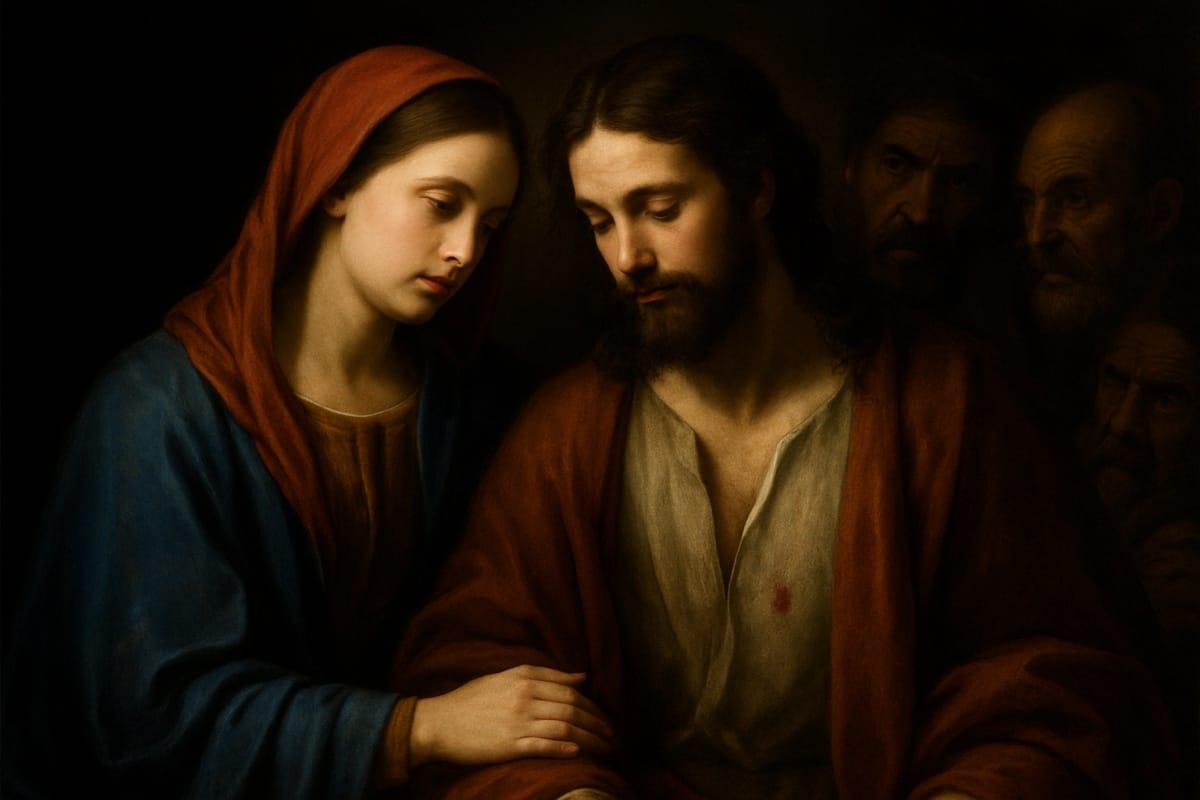
“A prophet is without honor except in his own land and among his own kin” (Matthew 13:57), Jesus’ axiom about the rejected prophet in his homeland, is confirmed by the history of Israel’s prophets: Jeremiah was rejected by his fellow citizens from Anathot (Jeremiah 11:21), Ezekiel by the people he was sent to (“they hear your words but do not practice them,” Ezekiel 33:31-32), and Elijah fled to the desert from Jezebel’s persecution. The prophet’s rejection in his homeland is not a historical exception but a pattern revealing something about the nature of prophesy: the prophet proclaims a new thing that familiarity blocks.
The Christological application of this axiom has a tragic dimension: Jesus’ closest associates, the Nazarenes, his relatives, and fellow citizens, are the ones most scandalized. In John 1:11: “He came to what was his, and his own did not receive him.” The rejection in one’s homeland foreshadows the rejection in Jerusalem, the same pattern of unbelief by “his own” that culminates in the Passion. Jesus’ journey from Nazareth to Jerusalem is the path of a prophet who meets the rejection he himself foretold.
Mary experienced this rejection from within: she was the mother of a prophet rejected in his homeland. When the Nazarenes say, “Isn’t he the carpenter’s son, and isn’t his mother named Mary?” they indirectly reject Mary, the mother of someone who should not be extraordinary. Mary’s participation in her Son’s humiliation begins not only on Calvary but in Nazareth: the rejection from one’s homeland is already a form of Simeon’s sword piercing Mary’s soul (Luke 2:35).
III. Mary in Nazareth: The Mother of the Prophet in His Homeland
Thirty years in Nazareth, most of Jesus’ life, are the thirty years of silence that theology calls the “hidden life.” During these thirty years, Mary lived in Nazareth as the mother of a carpenter, without visible extraordinary signs, without the recognition promised by the Annunciation (“You will be great and will be called the Son of the Most High,” Luke 1:32). The contrast between the promise of the Annunciation and the reality of Nazareth is the longest form of “faith in expectation” that Mary lived.
The thirty years in Nazareth are the life of faith for Mary without visible confirmation: she knew who her Son was, but his fellow citizens did not recognize him, and public ministry had not yet begun. This situation, knowing and not being able to show, believing and not seeing confirmation, is the model of ordinary faith that waits without spectacular signs. Devotion to the “Holy Family of Nazareth” has its foundation here: not the Holy Family of miracles and theophanies, but the Holy Family of everyday life, work, silence, and faithful waiting.
When the Nazarenes reject Jesus by citing his family (“his mother Mary”), they, without realizing it, confirm the theology of the Incarnation: God’s Son incarnated so radically that his humanity is indistinguishable from that of his fellow citizens. The Incarnation that Mary made possible with her “fiat” was so radical that the Nazarenes could not see beyond it. Mary, who welcomed the Incarnation in its radicality, also endured the consequences of that radicality, including the unbelief of those who could not see the Son of God in a carpenter’s son.
IV. “He did not perform many miracles there”: Faith that enables miracles
“And he did not perform many miracles there because of their unbelief” (Mt 13:58) is a theologically surprising statement: Jesus’ ability to perform miracles is conditional on the faith of those to whom they are directed. Not because Jesus needs human faith to act (his power is absolute), but because the miracle is not a one-sided spectacle, it is an act of communion between God’s power and human openness. Unbelief does not block Jesus’ power but makes the miracle impossible as an encounter.The theology of “miracles conditional on faith” runs through the Gospels: “Be done with your faith” (Mt 9:29), “Your faith has saved you” (Mk 5:34, Lk 7:50, 17:19). Faith is not the efficient cause of the miracle (God is the cause), but the condition of possibility for the encounter through which the miracle happens. The Nazarenes who do not believe “do not receive” miracles, they prevent the very encounter that would make them possible.Mary as a model of “faith that enables miracles”: at Cana, Mary’s intercession with Jesus (“They have no wine”, Jn 2:3) did not oblige Jesus to act (he responded “What do we have to do with this?”, Jn 2:4), but created the space for the encounter that would make the miracle possible. “Do whatever he tells you” (Jn 2:5) is the formula of faith that enables the miracle: not through pressure, but by creating conditions of welcome. Where the Nazarenes closed their hearts and prevented miracles, Mary at Cana opened the servants’ hearts and made the first sign possible.Post-Graduate in Mariology
Would you like to deepen your formation in Mariology? Discover the Post-Graduate Program in Mariology by Locus Mariologicus – an academic formation that combines theological rigor, spiritual life, and the living tradition of the Church.
Would you like to study Mariology seriously?
This article draws on the works of the Locus Mariologicus library. The Postgraduate Programme in Mariology takes you to the same sources with academic guidance: Scripture, the Church Fathers and the Magisterium, from the first dogma to contemporary questions.





Responses