“Ave, gratia plena”: the Queen of Heaven and the Foundations of Mary’s Queenship
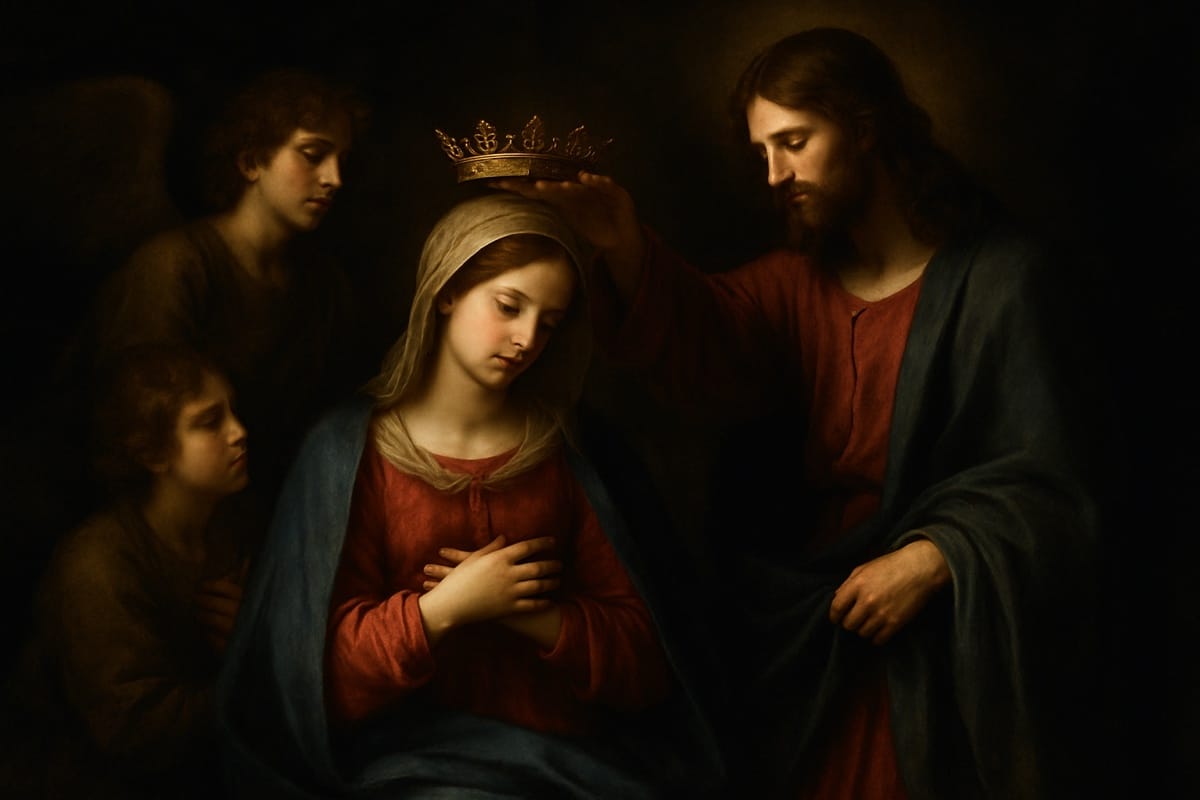
Hic erit magnus et Filius Altissimi vocabitur, et dabit illi Dominus Deus sedem David patris eius. Et regnabit in domo Iacob in aeternum, et regni eius non erit finis.
Lk 1:32-33
The Memorial of the Blessed Virgin Mary, Queen, celebrated on August 22, the octave day of the Assumption, was instituted by Pius XII in 1955. The Gospel of the Mass is Lk 1:26-38, the Annunciation, because Mary’s Queenship is founded, in the last analysis, on her divine motherhood: the Mother of the King is Queen. The promise made to Mary, “the Lord God will give him the throne of David his father” (Lk 1:32), refers directly to Jesus, but the Mother of the King shares in the kingship of her Son as, in the Davidic monarchy, the gebirah (the queen mother) was the great lady of the court. Today’s Gospel invites us to contemplate the Annunciation not only as the announcement of motherhood but as Mary’s royal investiture.
The encyclical Ad Caeli Reginam of Pius XII (October 11, 1954), published on the centenary of La Salette and in the context of the celebrations of the dogma of the Assumption (1950), is the magna carta of Marian Queenship. Pius XII founds Mary’s Queenship on two pillars: (1) the divine motherhood, the Mother of the King of kings is necessarily Queen. (2) her association with the redeeming sacrifice of Christ, Mary who shared in the work of redemption shares in the kingdom that redemption establishes. Mary’s Queenship is not an honorific title but a participation in Christ’s sovereignty over all creation.
I. Gebirah: The Queen Mother in the Davidic Tradition
In the Davidic monarchy, the queen was not the king’s wife but his mother, the gebirah (גְּבִירָה, great lady, powerful lady). The gebirah had the role of intercessor before the king: 1 Kgs 2:19 describes Bathsheba going to King Solomon and sitting “at his right hand”, the place of honor. Solomon rose to receive her, bowed down before her, and said, “make your request, my mother, for I will not refuse you”. The gebirah had privileged access to the king, and her requests were considered with special respect. This biblical institution is the cultural background that illuminates Mary’s title of “Queen” as intercessor.
The typological application to the Virgin Mary was developed by the patristic and medieval tradition: Mary is the gebirah of the definitive Davidic King, Jesus. Jn 2:1-11, the Wedding at Cana, carries out precisely this pattern: Mary intervenes with Jesus (“they have no wine”), Jesus answers with the image of the “hour” that has not yet come, but grants His Mother’s request. Mary’s intercession succeeds not because it forces Jesus’ hand but because, as gebirah, she knows the heart of her Son and knows when and how to present the needs of others.
The prophecy of Lk 1:32-33, “the Lord God will give him the throne of David”, is quoted in the context of the Annunciation. Jesus is the “Son of David” (Mt 1:1) and the “Son of the Most High” (Lk 1:32), the Davidic descendant who is at the same time the Son of God. The Mother of this Son is therefore at once the gebirah of the restored Davidic monarchy and the “Mother of the Most High”, in a dignity that surpasses every human comparison. Mary’s Queenship is the necessary consequence of her divine motherhood.
II. Ad caeli reginam: The Theology of Marian Queenship
Pius XII in Ad Caeli Reginam (1954) structures the theology of Mary’s Queenship around the principle of association: Mary is associated with the King of kings in a derived and subordinate participation. The encyclical distinguishes clearly: “the Blessed Virgin Mary is to be called Queen, not only because she is the Mother of God but also because, as the new Eve, she was associated with the new Adam” (n. 38). This association with the redeeming sacrifice of Christ, which constitutes the foundation of her kingdom, is what distinguishes Mary’s Queenship from a merely honorific queenship.
Pius XII also grounds Mary’s Queenship in her excellence among creatures: “among creatures, Mary stands out with a dignity greater than that of all men and angels” (n. 35). This excellence is not autonomous merit but a gift of grace: Mary is the richest in grace because she was prepared to be the Mother of the Son of God. The grace that fills Mary, “full of grace” (Lk 1:28: κεχαριτωμένη), is the grace that founds her royal dignity. Queenship is, in the last analysis, the ontological consequence of the grace that Mary possesses in fullness.
The title “Queen” applied to Mary in the liturgical tradition is very ancient: the Sub Tuum Praesidium (3rd century) invokes Mary as “Theotókos” and implies her royal dignity. The antiphon Regina Caeli (10th century), acclaimed at Easter, is one of the oldest Marian texts of the West. The Salve Regina (11th-12th century) invokes “our life, our sweetness and our hope” and “Queen”. Mary’s Queenship was not invented by scholasticism, it emerged spontaneously from the praying experience of the Church, which recognized in the Mother of God a dignity that no human title could capture.
III. “Regnabit in aeternum”: Mary’s Queenship and Universal Mediation
Mary’s Queenship has a mediating dimension that the encyclical Ad Caeli Reginam develops: just as the unique mediation of the Redeemer does not exclude but rather calls forth in creatures a shared cooperation, so Mary’s Queenship is not autonomous sovereignty but royal service. Mary the Queen is Mary the Mediatrix: her reign is a reign of intercession and maternal care, not of power parallel to that of Christ.
Mary’s Queenship contrasts with every worldly kingship by its structure of service: the Queen who sang “he has put down the mighty from their thrones and exalted the humble” (Lk 1:52) exercises her Queenship according to the logic of the Magnificat, not the logic of power but the logic of the grace that overturns the human order. Mary reigns “at the right hand” of her Son (Ps 45:10: “the queen stands at your right hand”) not because she has won power but because she was “made great” through humility, “He who is mighty has done great things for me” (Lk 1:49).
Devotion to the Queen of Heaven is not incompatible with the centrality of Christ, it is its specific expression: where Mary reigns, Christ reigns. Where Mary intercedes, it is the grace of Christ that flows. Where Mary stands “at the right hand” of her Son, it is the victory of the Son that is made manifest in the first of the redeemed creatures. The “Queen” whom the faithful invoke in the Litany of Loreto is the one who, exalted above all the angels and saints, still defines herself as “ancilla Domini”, the handmaid who received her Queenship as a gift, not as a conquest.
IV. The Annunciation as Royal Investiture: “Fiat” and Crown
Lk 1:26-38, the Gospel of the Mass of the Queen, can be read as Mary’s royal investiture: the angel who announces not only the conception of Jesus but the throne of David (v. 32), the eternal kingdom (v. 33), and divine sonship (v. 35) is announcing at the same time Mary’s motherhood and her Queenship. Mary’s question, “how shall this be, since I know not man?” (v. 34), reveals that the investiture is not automatic but passes through human freedom: God waits for Mary’s “fiat” so that the kingship of Jesus in the world may begin.
The “fiat mihi secundum verbum tuum” (v. 38) is, in this sense, the acceptance of the royal investiture: Mary accepts being the Mother of the King and, in accepting, becomes Queen. Her Queenship does not precede her motherhood, it is a consequence of it. And her motherhood does not precede her “fiat”, it is a consequence of it. The chain is clear: fiat → motherhood → Queenship. Mary’s freedom at the Annunciation is the starting point of all Mariology, including the Mariology of Queenship. Without the “fiat”, there is no Mother. Without the Mother, there is no Queen.
On August 22, the octave day of the Assumption and the Memorial of the Queen, the Church contemplates Mary at the summit of her glorification, the “fiat” of the Annunciation come to its fullness. The Mary who said “yes” at Nazareth is now crowned in Heaven. The Mary who served in obscurity is exalted before the angels and the saints. The Mary who said “ancilla Domini” is proclaimed “Regina Caeli”. The Magnificat has not ceased, it has reached its last stanza: “from now on all generations will call me blessed, for He who is mighty has done great things for me” (Lk 1:48-49). Mary’s Queenship is the last of those great things.
Postgraduate Program in Mariology
Would you like to deepen your formation in Mariology? Discover the Postgraduate Program in Mariology of Locus Mariologicus — an academic formation that unites theological rigor, spiritual life, and the living tradition of the Church.
Would you like to study Mariology seriously?
This article grows out of the works in the Locus Mariologicus library. The Postgraduate Program in Mariology takes you to the same source, with academic guidance: Scripture, the Fathers of the Church, and the Magisterium, from the first dogma to contemporary questions.




Responses