Mother of God: The Foundational Title of Mariology
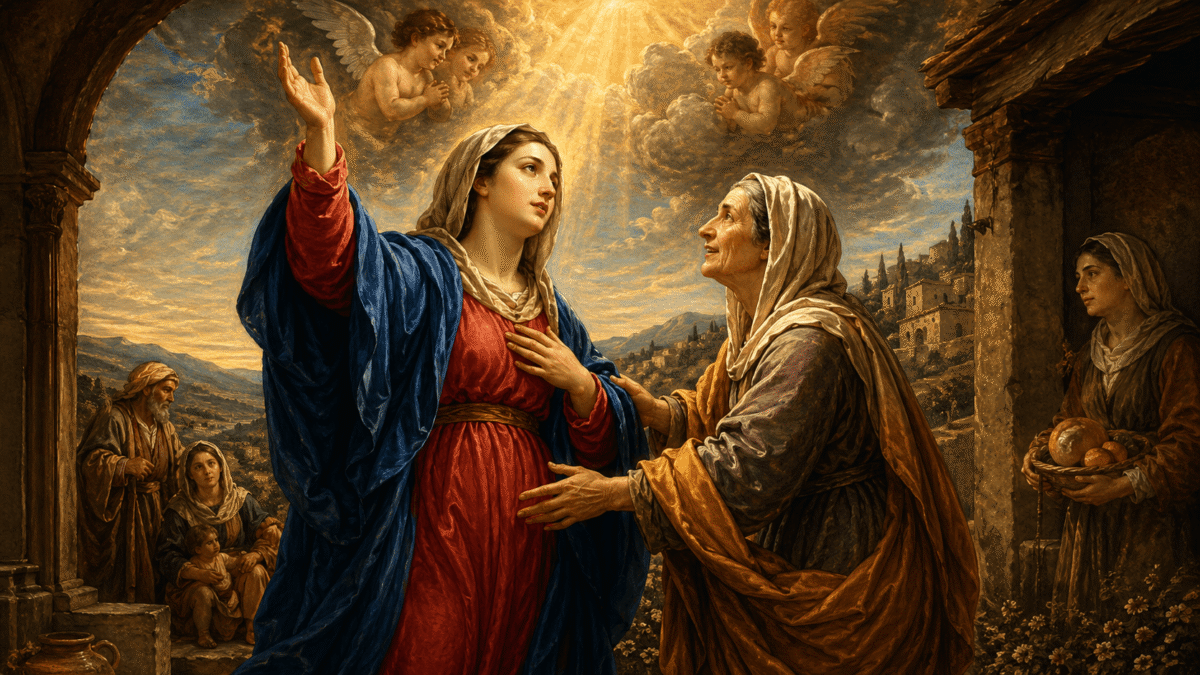
Mother of God, the Foundational Title of Mariology
Mother of God (Theotokos in Greek) is the most important Marian title and the foundation of all Mariology. Defined at the Council of Ephesus (431), it affirms that Mary is truly the Mother of the Son of God made man. It is the first of the four Marian dogmas. For the full article: Theotokos, Mother of God.
Biblical Foundations
The biblical texts affirm together the motherhood of Mary and the divinity of the Son who takes flesh from her. In Gal 4:4, Paul writes: “When the fullness of time had come, God sent His Son, born of a woman, born under the law.” The expression “born of a woman” (genomenon ek gynaikos) underscores the abasement of the Son of God, who becomes man in all human frailty. But as the “Son sent by God,” He is a preexistent Being of divine nature who “emptied Himself, taking the condition of a servant” (Phil 2:7). In Mt 1:23, the evangelist applies to Mary the prophecy of Is 7:14: “Behold, the virgin shall conceive and bear a son, and they shall call His name Emmanuel, which means: God-with-us.” In Lk 1:35, the angel’s greeting presents remarkable parallels with Ex 40:34-35: as the cloud of God overshadowed the Tent of Meeting in the desert, filling it with His glory, so the Holy Spirit overshadows Mary, making her the new Tent of the Covenant. Mary is the new ark: in Lk 1:39-56, the parallels with 2 Sam 6 (the ark going up to Judah) illuminate Mary’s visit to Elizabeth. In Lk 1:43, Elizabeth herself, filled with the Holy Spirit, proclaims: “And how does this happen to me, that the mother of my Lord should come to me?” This acclamation, prior to any conciliar definition, is the first explicit profession of Mary’s divine motherhood.
The Nestorian Controversy
Nestorius, Patriarch of Constantinople (428-431), rejected the title Theotokos, preferring Christotokos (“Mother of Christ”): Mary would be the mother of the human nature of Jesus, not of the divine Person. Cyril of Alexandria replied that such a division destroyed the unity of Christ. If Jesus is one single Person, and that Person is divine, then His mother is truly the Mother of God. The question was not about Mary in herself, but about the unity of the Person of Christ: to divide Christ in two was to destroy salvation. To deny that Mary is the Mother of God entailed denying that the Son of God truly became man in her womb.
Ephesus (431) and Chalcedon (451)
The Council of Ephesus (431) defined that Mary is truly Theotokos. The people of Ephesus, on learning of the decision, went through the streets of the city in procession with torches, acclaiming: “Theotokos! Theotokos!” This popular acclamation shows how the title was already rooted in the faith of the people before the definition. The Council of Chalcedon (451) confirmed and deepened the doctrine: Jesus Christ is one single Person in two natures, divine and human, without confusion, without change, without division, without separation. Within the context of this Christological doctrine, Mary is the mother of the one Person of Christ, who is a divine Person. Divine motherhood is thus a direct corollary of faith in the Incarnation of the Word.
Vatican II and Mariology
Vatican II (LG 53) integrates the title Theotokos into a Christological and ecclesiological perspective: “The Virgin Mary, who at the message of the angel received the Word of God in her heart and in her body, and brought life to the world, is acknowledged and venerated as the true Mother of God and of the Redeemer.” The Council stresses that Mary’s divine motherhood is the foundation of all her singular dignity and of all Mariology. From the Theotokos Mary is understood as the Immaculate Conception, as perpetually virgin, as assumed into heaven: all of this because she is the Mother of God. The title also grounds Mary’s maternal mediation in relation to the Church: being the Mother of the Head of the mystical Body, she is the Mother of the members.
Deepen your studies: explore Mariology, Marian dogmas, Marian Theology, and the Postgraduate Program in Mariology.
Magisterium of the Church
Si quis non confitetur proprie et secundum veritatem Dei Genitricem esse sanctam virginem… anathema sit.
Concilium Ephesinum, Canon 1 (A.D. 431), apud Denz.-Hün. 252
📚. Literal translation: If anyone does not confess that the Holy Virgin is truly and in the proper sense the Mother of God… let him be anathema.
Postgraduate Program in Mariology
Would you like to deepen your formation in Mariology? Discover the Postgraduate Program in Mariology of Locus Mariologicus – an academic formation that unites theological rigor, spiritual life, and the living tradition of the Church.
Would you like to study Mariology seriously?
This article grows out of the works in the Locus Mariologicus library. The Postgraduate Program in Mariology takes you to the same source, with academic guidance: Scripture, the Fathers of the Church, and the Magisterium, from the first dogma to contemporary questions.





Responses