Our Lady of Akita, the statue that wept for the sins of the world
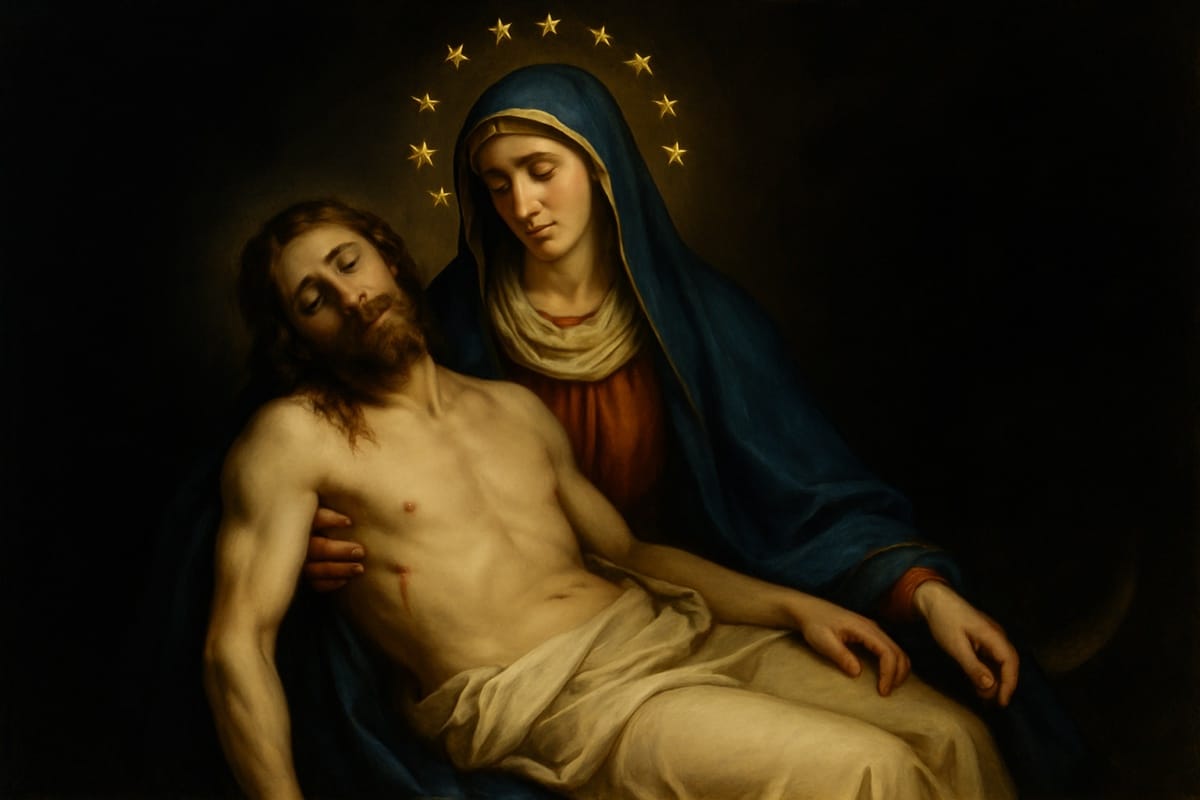
“For as wickedness increases, the love of many will grow cold. But he who endures to the end will be saved.” (Mt 24:12-13), “As iniquity abounds, the love of many shall wax cold. But he that shall endure unto the end, the same shall be saved.”
I. The Woman of Revelation: The Great Sign in Heaven and the Church’s Battle
Chapter eleven of Revelation concludes with a vision that continues into chapter twelve, forming one of the most dense theological representations of the relationship between Mary and the Church. “The temple of God in heaven was opened, and the ark of his covenant appeared in his temple” (Rev 11:19). And then follows: “A great sign appeared in heaven: a woman clothed with the sun, with the moon under her feet and on her head a crown of twelve stars.” She was pregnant and cried out in labor pains (Rev 12:1-2). Christian exegesis recognized in this woman a simultaneously Marian and ecclesiological figure: Mary giving birth to the Messiah, and the Church giving birth to God’s children throughout all ages. However, what is significant for Akita is what follows: the dragon that pursues the woman and her offspring, the flight into the desert, and the ongoing cosmic battle between good and evil throughout history. The Church always lives under the sign of the woman and the dragon. And when the Woman of Revelation cries out in labor pains, the Church also cries out, because she is still giving birth to those who will be saved.
II. Akita, 1973-1981: The Lady’s Messages and Verified Tears by Science
In 1973, at a Servants of the Eucharist convent in Yuzawadai, near Akita in northern Japan, Sister Agnes Katsuko Sasagawa, deaf since childhood, began receiving communications from the Mother of God. The central messages were transmitted on three dates: July 6th, August 3rd, and October 13th, 1973, the latter coinciding with the anniversary of the “sun miracle” in Fátima fifty-six years earlier. The content of the messages was grave and sober: an invitation to prayer, penance, and sacrifice for the salvation of sinners, a warning that humanity will face severe consequences if it does not convert. However, what made Akita one of the most documented scientifically apparitions of the 20th century was a material phenomenon: a wooden statue of the Virgin, carved by artist Saburo Wakasa, began shedding human tears on January 4th, 1975. Between that date and September 15th, 1981, the statue wept 101 times, observed by dozens of witnesses including medical personnel. Laboratory analyses conducted by Professor Sagisaka from Akita University (non-Catholic) confirmed that it was human blood, sweat, and tears, with distinct blood types. Bishop Shojiro Ito of Niigata officially recognized the apparition on April 22nd, 1984, after consulting the Congregation for Doctrine of the Faith then headed by Cardinal Joseph Ratzinger. The affirmation by the Holy See in 2019, under Pope Francis’ pontificate, confirmed Akita as one of the approved Marian apparitions of the latter half of the 20th century.
III. The increasing iniquity and the perseverance that saves: The Gospel as the key to Akita
The Gospel of Matthew accompanying this celebration presents Jesus’ eschatological discourse to his disciples on the Mount of Olives, where he describes the signs preceding the end. “You will see wars and hear talk of wars… Nation will rise against nation, and kingdom against kingdom” (Mt 24:6-7). And the central verse that illuminates the Akita message: “As iniquity increases, the love of many will grow cold. But whoever perseveres to the end will be saved” (Mt 24:12-13). This word from Jesus offers the theological key to interpreting Akita without alarmism or naivety. The Akita messages are not a sensationalist announcement of imminent catastrophes; they are a reminder of a constant evangelical that Church history has always known. When iniquity increases, love grows cold. When love grows cold, the very sense of human reality begins to slip away. And when this happens, the only possible Christian response is perseverance to the end, which is not stoic resistance but loving fidelity to the Lord who comes. The tears of the Akita statue, shed for over six years in front of hundreds of witnesses, are the extreme form of Mary’s motherhood: weeping, with real human tears, for her children whose perseverance is at risk.
IV. Akita and Marian theology of reparation: Collaboration on the Cross
The Marian theology of reparation, which Akita puts center stage, has deep patristic and mystical roots. Mary is not merely the mother who gives birth; she is the mother who suffers with her Son in the work of redemption, who stands at the foot of the Cross as a cooperator in the paschal mystery, offering with Christ her own heart pierced by the sword prophesied by Simeon (cf. Lk 2:35). Devotion to the Immaculate Heart of Mary, spread by Fatima throughout Catholic activism in the 20th century, found in Akita an extension and dramatic confirmation: the statue that weeps does not ask for consolation; it asks for reparation. It calls on the faithful to associate themselves with Mary’s pain for her children who stray, offering prayers, sacrifices, lives entirely transformed into a reparative oblation. Vatican Council II stated that Mary “associated herself with a mother’s heart” in the sacrifice of her Son on the Cross (Lumen Gentium, 58). Akita proposes to contemporary Mariology precisely this dimension: Mary continues to associate herself with the paschal mystery through the pilgrim Church, and the faithful are invited to associate themselves with her as she associated herself with the Son. The tears of Akita are not the final chapter of Mary; they are an especially intense expression of what she does from the Cross onwards, and will continue to do while any of her children is in danger of losing their way.
Postgraduate Program in Mariology
Would you like to deepen your formation in Mariology? Discover the Postgraduate Program in Mariology from Locus Mariologicus – an academic formation that combines theological rigor, spiritual life, and the living tradition of the Church.





Responses