The origins of intercession in the iconography of the praying Virgin

By Prof. Dr. Daniel C. Afonso · Updated
The origins of intercession in the iconography of the praying Virgin
The praying Virgin
The possible variants concern the composition itself.
The praying Virgin may be represented on her own or in relation to a historical-salvific theophanic event:
autonomous representation: she appears alone or accompanied by other figures (angels, apostles, martyrs and/or saints).
an Old Testament theophany.
a New Testament theophany: the Ascension.
a timeless theophany of Christ.


Virgin Mother praying among the Eleven, Saint Matthias and Saint Paul, beneath an Old Testament theophany, apse, Monastery of Saint Apollo, Bawit, 6th century.

Virgin Mother praying among the apostles Peter and Paul, six martyrs and the donor, beneath a timeless theophany of Christ the Lord represented at half-length flanked by two angels. Apse, mosaic, chapel of St. Venantius (Baptistery of S. Giovanni in Laterano), Rome, mid-7th century.
Non-apsidal compositions related to the type in question
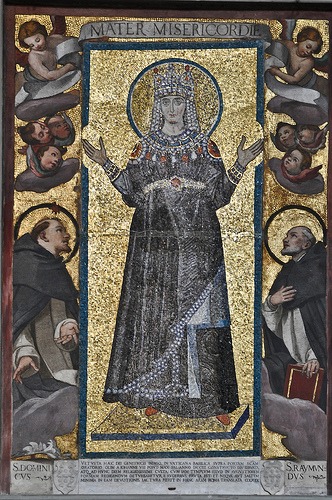
Virgin Mother praying (“Regina”), Oratory of John VII, from Old St. Peter’s, Museo di San Marco, Florence, 707 AD
Observations
The ancient gesture of raised hands with palms turned upward, symbolizing the attitude of the religious man and, once taken up by Christian iconography, that of the faithful, when applied to the Virgin Mary becomes an expression of the mystery of the Incarnation. Even when she is alone, with her arms raised toward heaven, she represents the Mother of God, for this gesture corresponds to the idea of grace in the act of descending upon her, that is, the conception and the beginning of the Incarnation.
The considerations to be made about the representation of the praying Virgin in the scene of the Ascension are interesting, starting from the observation that in this scene the Virgin Mother is portrayed at the center of the Apostles, whereas neither the Gospel nor the Acts refers to her presence. Now, the fact that such dignity belongs to Mary by virtue of her divine motherhood is not sufficient to justify her presence at the center of the Apostles. In fact, the iconography of the undivided Church does not proceed allegorically, but it is the iconography itself that suggests the meaning of this presence: by inserting into the composition the star of the Incarnation (represented as a sphere) or the dove of the Spirit (as happens in the Cave of the Pantocrator at Latmos), it points to a relationship between the mystery of the Ascension and that of the Epiphany. This connection is due to a historical fact: the celebration of the Vigils and of the Mass of the Ascension in the Basilica of the Nativity in Bethlehem, since, before the end of the 4th century, the feast in Jerusalem had been separated from Pentecost and moved forward to the 40th day. Thus the beginning and the conclusion of salvation history were ordered to each other in a single celebration.
The literary sources, for their part, confirm that the Fathers, such as Cyril of Jerusalem (Catechesis XIV) and John Chrysostom (In ascensionem Domini), liked to associate the two mysteries of the Incarnation and the Ascension. The combination of the theme of the Epiphany (expressed by the group of the Virgin Mother with the Child) with the theophany of glorification of the Ascension and, as often happens in Coptic apses, with the Old Testament theophanies reinterpreted Christologically or even with a timeless theophany, gave occasion to see that the figure of the praying Virgin is interchangeable with that of the enthroned Mother of God with the Child.
But the Ascension is not only the final terminus of that movement which, from the descent of the Incarnation, reaches the final elevation/glorification of the Son: it is also the moment of the birth of the Church. As the Fathers of the Church teach, when Christ returns gloriously to the Father, it is humanity as Church that is raised with Him to Heaven. Thus the mystery of the Ascension and the birth of the Church are intimately related to the Incarnation. All these elements are found together in a passage of Saint Irenaeus: “there is indeed one and the same Spirit of God, who announced to the apostles that the time of filial adoption had come [cf. Gal 4:4-5; that is, the birth of the Church], that the kingdom of heaven is at hand and dwells among men who believe in the Emmanuel born of the Virgin”.
In the iconography of the Ascension, the praying Virgin is the image of the earthly Church. Her gesture signifies the Incarnation and the Redemption of which she is the instrument, and at the same time symbolizes that function of the Church which consists in ensuring unceasing prayer to God on the part of the faithful. Here we come upon one of the most important ideal paths linking the historical figure of the Virgin Mother Mary to the sacramental figure of the Virgin Mother Church. This depth of meaning is preserved even when the praying Virgin appears alone outside a theophanic scene (fig. 3).
Virgin Mother of intercession, in profile, hands raised and face in 3/4 view
In monumental compositions, the standing module, with the body in profile, presupposes the presence of at least a second figure, Christ, toward whom the Virgin’s movement is directed. However, most often the Virgin in this posture is part of a trimorphic composition at the center of which is Christ the Lord, while the Mother, placed at His right, turns toward Him and another saint, symmetrically arranged, does the same as a pendant: often, but not necessarily, it is Saint John the Baptist. From the standpoint of compositional structure, the trimorphic module is a centered module, very balanced and therefore particularly solemn, with numerous precedents in late antique iconography: hence the success and frequency of its use in apses. Compositionally, in fact, the Mother-Son group flanked by two angels or the analogous group of Christ the Lord between Saint Peter and St. Paul also present the same structure.
The early date of the literary evidence concerning apsidal compositions containing this module allows us to regard it as the origin of the Byzantine composition called Deesis.

Virgin Mother interceding, apse, mosaic, Chapel of St. Zeno, Santa Prassede, Rome, 9th century.
Two literary testimonies
The church called La Daurade in Toulouse: the apse of the 5th-century church housed a representation of the Virgin before the Savior.
The church known as the Tetrapylon in Alexandria: Sophronius of Jerusalem (early 7th century) describes a composition that was found in this church located in the center of the city. From his description it can be inferred that it was an apsidal composition and that it was a mosaic: Christ the Lord occupies the center. He is flanked by the Holy Mother and by St. John the Baptist.
Non-apsidal compositions related to the type in question

Virgin Mother interceding, Monasterium Tetriput (Oratory of the Rosary on Monte Mario). 7th-8th century.
Conclusion
The intercessory function of the Virgin Mother is expressed through her simple being-beside-the-Son, in an immobility that the gesture of the forearm does not interrupt: therefore, the iconography is independent of any affective connotation. And it can be observed that this same immobility signifies at the same time the perennial relevance of the intercessory function of the Virgin Mother in the liturgical present.
In the Byzantine East, when it is part of the dimorphic composition of the same name, this type is called the Virgin of the Deesis: when, instead, the Virgin, standing or at half-length, as is most often the case with portable images, is represented alone or together with a supplicant, with or without a scroll in her hand containing the text of the supplication, she is called He Paraclesis, that is, the Intercession, or she is called Mother of God Aghiosoritissa. In the West, and particularly in Rome, where several icons of this type in which the Virgin appears alone are venerated, the name is Vergine Avvocata.
Postgraduate Program in Mariology
Would you like to deepen your formation in Mariology? Discover the Postgraduate Program in Mariology of Locus Mariologicus – an academic formation that unites theological rigor, spiritual life and the living tradition of the Church.
Discover the oldest Marian image in the Catacomb of Priscilla.
Would you like to study Mariology seriously?
This article grows out of the works in the library of Locus Mariologicus. The Postgraduate Program in Mariology takes you to the same source, with academic guidance: Scripture, Fathers of the Church and Magisterium, from the first dogma to contemporary questions.
Responses