“Deus incrementum dedit”: The Field of God, Service, and the Cooperation of Mary
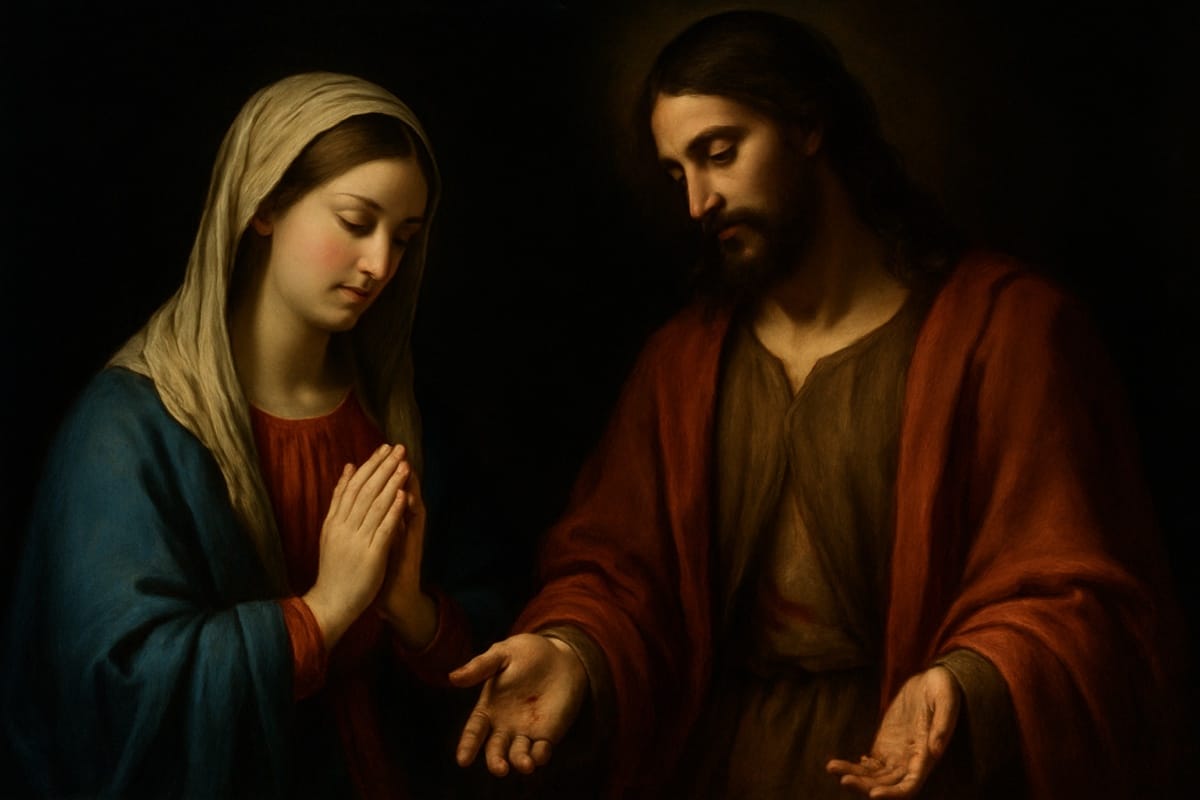
Ego plantavi, Apollo rigavit, sed Deus incrementum dedit. […] Illa autem continuo surgens ministrabat illis.
1 Cor 3:6 and Lk 4:39
Wednesday of the Twenty-Second Week in Ordinary Time brings together two lessons about the same thing, the exact place of human action within the work of God. Paul corrects a community that had turned its preachers into banners and reduces each of them to his real measure, “I planted, Apollos watered, but God gave the growth” (v.6). Luke shows Simon’s mother-in-law who, once healed, rises and serves, and Jesus who refuses to remain where He is wanted because He was sent to other towns. In both cases, the human is decisive and is not the origin.
I. The First Reading: 1 Cor 3:1-9
Paul continues to dismantle the factions of Corinth and now points to the root. The community divided between “I belong to Paul” and “I belong to Apollos” (v.4) does not have a problem of personal preferences, it has a problem of theological immaturity. Hence the metaphor of milk and solid food (v.2). Whoever gathers around a minister has not yet understood what a minister is.
The correction is made with an agricultural image of a brutal sobriety: “neither the one who plants nor the one who waters is anything, only God counts, for it is He who gives the growth” (v.7). The apostle is not practicing rhetorical humility, he is describing the structure of causality in the order of grace. The minister truly works, and for that reason “each will receive his reward according to the labor of his work” (v.8). But growth is of another order, and no amount of human effort produces it. The conclusion restores dignity without restoring the illusion: “we are God’s co-workers and you are God’s field” (v.9).
II. The Gospel: Lk 4:38-44
Luke links three brief scenes, and each one says something about the same theme. First the healing of Simon’s mother-in-law, told with a remarkable economy: Jesus “spoke sternly to the fever,” the fever left her, “she rose and immediately began to serve them” (v.39). The Greek verb Luke uses for that service is the same one that will give rise to the word diakonia. The healing does not end in relief. It flows immediately into a service, and it is that service which reveals that the healing was real.
Then, at sunset, the crowd brings the sick and Jesus lays His hands “on each one of them” (v.40). The detail is not decorative. There is no mass healing and no generic gesture, there is individual attention in a context of collective urgency. And finally, at daybreak, the flight to the deserted place and the refusal to stay: “I must proclaim the good news of the Kingdom of God to the other towns also, because for this I was sent” (v.43). The crowd wanted to hold Him back. Local success is presented as a real temptation, and prayerful solitude is what makes it possible to resist it.
III. Collaborating without Confusing
The two readings meet in a phrase that could sum up the whole of apostolic spirituality: first receive, then give. Simon’s mother-in-law did not serve in order to be healed, she served because she had been healed. The Corinthians did not make the Word grow, they were the field in which it grew. The order cannot be reversed, and to reverse it is the most precise definition of what the tradition called presumption.
From this follows a twofold demand that practice usually breaks in half. Whoever knows that growth is a gift tends to relax the effort, and whoever throws himself fully into the work tends to appropriate the result. Paul asks for both things at once, full work and full dispossession. The farmer who knows the limits of his action does not work less, he works without anxiety. This is why Jesus, at the height of His success in Capernaum, rises before dawn and goes out to the desert. A mission born of prayer does not need to be held back by anyone.
IV. Mary: The Field in Which What No One Planted Grew
If “you are God’s field” describes the Church, then Mary is the case in which the image ceases to be an image. In her, the growth that God alone gives took flesh. She did not generate the Son out of herself, she received Him from the Holy Spirit (Lk 1:35), and yet her cooperation was anything but passive. The Council is precise in saying that she was not a merely passive instrument in the hands of God, but cooperated in salvation by free faith and obedience (LG 56).
This is the exact formula of what Paul demands of the Corinthians, carried to its highest degree. Mary planted with the fiat, watered with the hidden years of Nazareth, and never confused her contribution with the result. The Magnificat is precisely that distinction put into prayer: “the Almighty has done great things for me” (Lk 1:49). She acknowledges that something great has happened, situates herself within the event, and names the one who brought it about.
And there is the service. Luke, who today shows Simon’s mother-in-law rising to serve, is the same one who shows Mary rising and setting out “in haste” for the hill country, to the house of Elizabeth (Lk 1:39). The movement is identical. She received, she rose, she served. The Church recognizes in her its own type in the order of faith, of charity, and of perfect union with Christ (LG 63), and that typology includes this elementary rhythm that Christian life never ceases to repeat.
Wednesday of the Twenty-Second Week therefore leaves a measure for the examination of conscience of everyone who works in the Church. The question is not how much I planted or how much I watered. It is whether I still know that it is not I who give the growth, and whether, knowing it, I continue to plant with the same commitment.
Postgraduate Program in Mariology
Would you like to deepen your formation in Mariology? Discover the Postgraduate Program in Mariology of Locus Mariologicus – an academic formation that unites theological rigor, spiritual life, and the living tradition of the Church.




Responses