The Gospels and Mary: The Presence of Our Lady in the Four Gospels
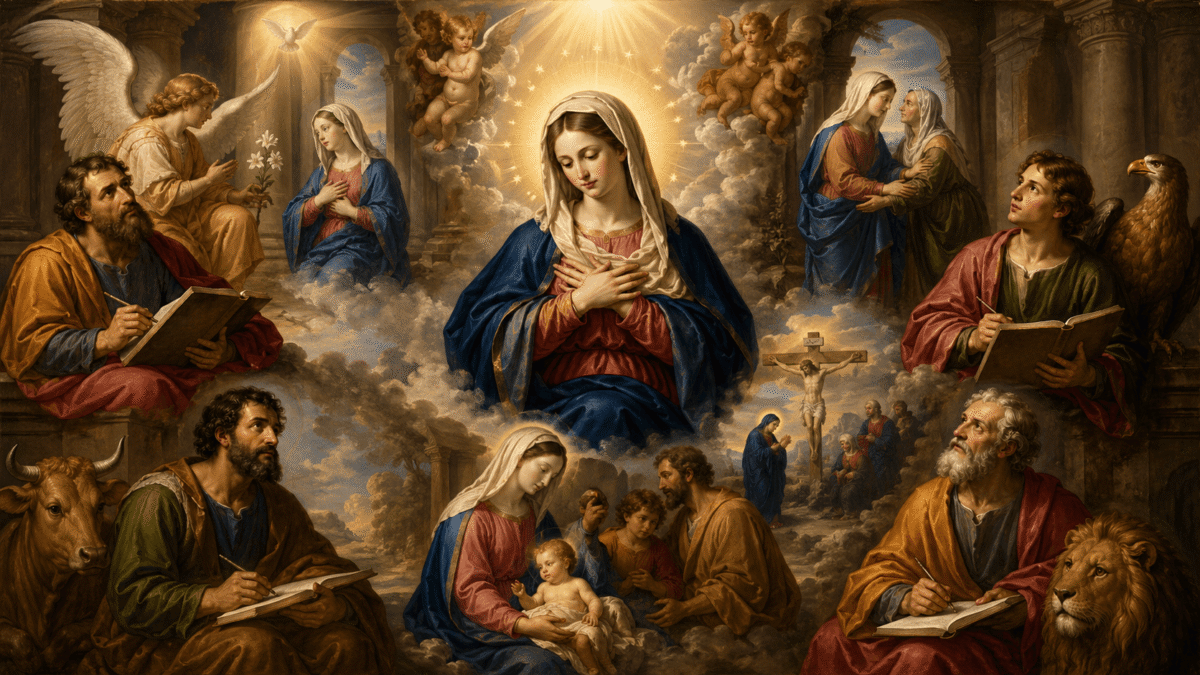
The Gospels and Mary: the presence of Our Lady in the four Gospels
The four Gospels portray Mary from diverse and complementary perspectives. Each evangelist underscored different aspects of the figure of Mary, together forming a many-sided portrait that Mariology has explored down the centuries.
Luke, the evangelist of Mary
Luke is the evangelist who devoted the most attention to Mary: the Annunciation, the Visitation, the Magnificat, the Nativity, the Presentation, the Finding in the Temple. It is likely that Luke had access to Mary’s memories. His style reveals a source close to the events narrated.
John, the theology of the woman
John does not name Mary: he calls her only Mother of Jesus or Woman. But the two Johannine episodes, Cana and Calvary, are the most theologically charged. John reveals Mary’s function in the economy of salvation: the intercessor who sets in motion the hour of Jesus, the spiritual Mother who welcomes the beloved disciple.
Matthew and Mark
Matthew centers on Joseph’s perspective and includes the genealogy of Jesus. The mention of Mary, “of whom Jesus was born,” is grammatically set apart in order to underscore her virginity. Mark, the briefest, mentions Mary in two tense contexts: the arrival of Jesus’ family, which tries to “bring him back” (Mk 3:31-35), and the reference at Nazareth to “the son of Mary” (Mk 6:3).
Deepen your studies: explore Mariology, Marian Theology, Marian apparitions, and the Postgraduate Program in Mariology.
Magisterium of the Church
Et videntes eum adoraverunt. Quidam autem dubitaverunt. Et accedens Iesus locutus est eis… Beata quae credidisti.
Lucas 1,45. Cf. Matthaeus 28,17-18
📚 Literal translation: And seeing him, they adored him. Some, however, doubted. […] Blessed is she who believed.
Quomodo Evangelistae de Maria scribunt: Matthaeus praesagium Isaiae implet, Marcus Matrem inter discipulos ponit, Lucas Mariam Spiritu Sancto plenam cantat, Ioannes Matrem sub Cruce et in Cana demonstrat.
Cf. S. Ioannes Paulus II, Enc. Redemptoris Mater, nn. 14-19
📚 Literal translation: How the evangelists write about Mary: Matthew fulfills the prophecy of Isaiah, Mark places the Mother among the disciples, Luke sings of Mary filled with the Holy Spirit, John shows the Mother beneath the Cross and at Cana.
Postgraduate Program in Mariology
Would you like to deepen your formation in Mariology? Discover the Postgraduate Program in Mariology of Locus Mariologicus — an academic formation that unites theological rigor, spiritual life, and the living tradition of the Church.
See also: Mary in the Bible: From Genesis to Revelation – The Complete Guide
See our complete guide to Catholic Angelology.
Would you like to study angelology and demonology in depth?
This article comes from the Locus Mariologicus library. The postgraduate specialisation in Angelology and Demonology (360 hours, fully online) studies angels and demons in Scripture, the Fathers and the Magisterium, with a whole area on practical demonology, exorcism and deliverance prayer. The new class begins on 18 January 2027. Classes are taught in Portuguese.





Responses