Mary in the pontificate of Benedict XVI

For Pope Benedict XVI, Mariology must always be seen within the “nexus mysteriorum“. Therefore, it can only be developed correctly in relation to the other theological disciplines, on pain of losing its role, value, identity and importance within the whole theological-Christian discourse. Mariology today, governed by the Word of God, schooled by the salutary lessons of history, vitally grafted into dialogue with other theological and anthropological-cultural disciplines, no longer follows the model, as in the past, of conflict, of narcissistic coexistence. But it places itself, taking as its historical, theological and exemplary model Mary of Nazareth, in a state of permanent service for the sake of the Kingdom of God and its inalienable and ever-present values, and therefore of joint pro-existence.
Referring to the title of chapter VIII of the dogmatic constitution Lumen gentium, Benedict XVI, at Castel Gandolfo, in September 2012, explains: “This is the nexus mysteriorum, the intimate connection between the mysteries of the Christian faith, which the Council indicated as the horizon for understanding the individual elements and the various affirmations of the patrimony of the Catholic faith”.
In other words, citing the Second Vatican Council, we can say that: “Mary, in fact, who entered intimately into the history of salvation, in some way brings together and reverberates the greatest data of faith”. In his book Mary: The Church at the Source, analyzing the place of Mariology in theology, J. Ratzinger states: “Discourse about Mary emphasizes the ‘nexus mysteriorum’, the intimate interweaving of the mysteries in their reciprocal standing-before one another as well as in their unity. If the close bond between Christ and the Church can be found in the conceptual pairs bridegroom-bride, head-body, in Mary this bond goes still further, because she certainly is not related to Christ first of all as bride, but as mother. One can glimpse here the function of the title Mother of the Church. In this way is expressed the transcending of the ecclesiological sphere in Marian doctrine and, at the same time, their reciprocal relationship”.
In reality, the “yes” of the Virgin of Nazareth was necessary for the incarnation of the Word. Indeed, without this response, true and freely given, the Word could not have entered the world. Joseph Ratzinger expresses this thought thus: “The body is prepared for the Son at the moment when Mary gives herself totally to the will of the Father and thus places her body at His disposal as the tent of the Holy Spirit”.
During his pontificate, Benedict XVI wrote three volumes entitled Jesus of Nazareth (2007, 2011, 2012). In presenting the first volume, the Italian cardinal and biblical scholar Carlo Maria Martini (d. 2012) wrote: “This book constitutes an ardent testimony of a great scholar […] about Jesus of Nazareth and about His significance for the history of humanity and for the perception of the true figure of God”.
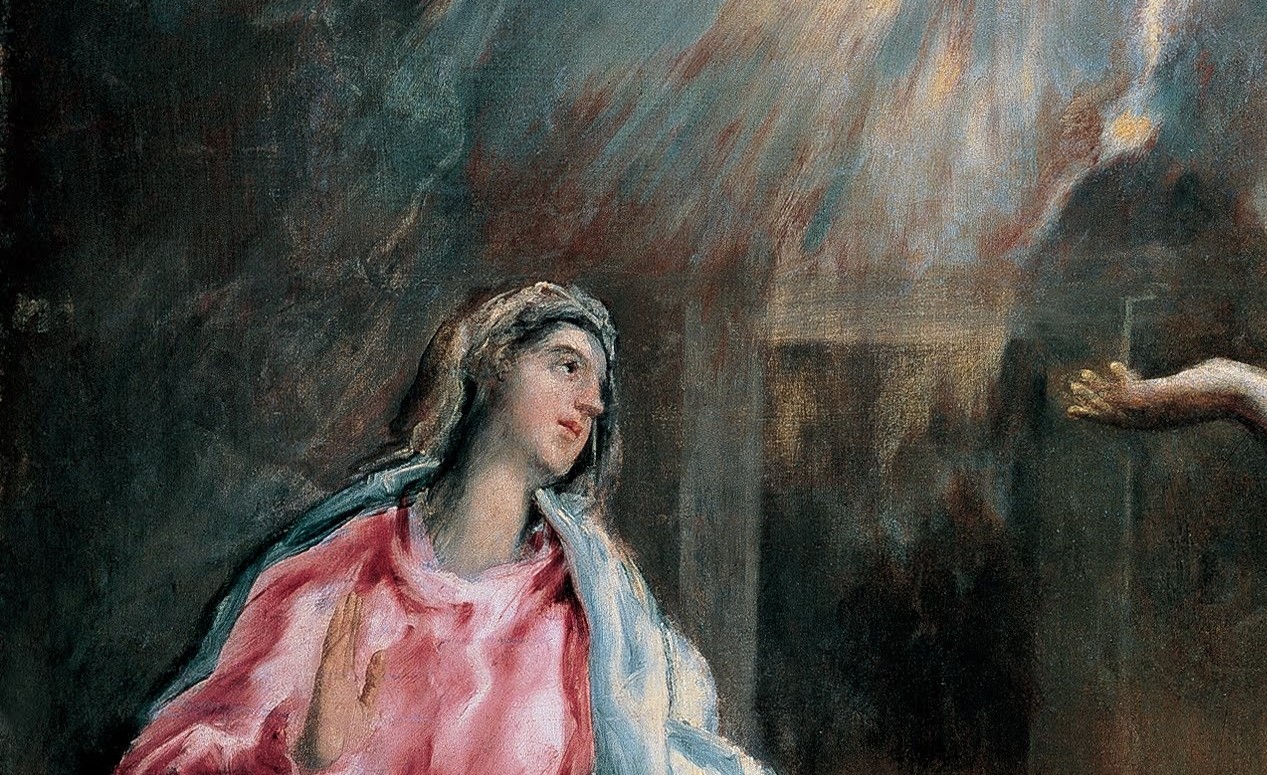
Three volumes that are not officially part of his Petrine magisterium. Nevertheless, in our context, they deserve to be mentioned, because they contain some wholly Marian passages. Speaking of the scene at the foot of the Cross (cf. Jn 19:25-27), Pope Ratzinger recalls the woman Mary-the Church, who was entrusted by Jesus to the beloved disciple, figure of the community of the faithful. The most significant texts are found in the third volume, the last to be published, devoted to the Gospels of the infancy of Jesus: Benedict XVI, speaking of Mary’s behavior at the Annunciation, states: “She does not stop at the first shock caused by the nearness of God through the angel, but seeks to understand. Mary thus appears as a courageous woman who, even in the face of the unprecedented, keeps her self-control. At the same time, she shows herself to be a woman of great interiority, who holds heart and reason together and seeks to understand the context, the whole message of God, thus becoming an image of the Church that reflects on the Word of God, seeks to understand it in its totality and keeps its gift in her memory”.
Pope Ratzinger has a particular Marian piety. In fact, after renouncing the Petrine ministry, in the book-interview entitled Last Testament he confessed:
“I was Catholic, and so the Marian devotions of the month of May and those of the season of Advent, the month of the rosary and simply love for the Mother of God were part of our religious sentiment. However, the cult of the Virgin was not so deeply rooted, it did not have the strong emotional connotation that characterizes it in typically Catholic countries such as Poland and Italy. Bavaria too is a typically Catholic land, but the emotional force was not as powerful as in other places. The veneration of Mary marked me, but never separated from that of Jesus Christ, rather within it […]. Marian devotion was very present in our family, it was part of my Catholicity: as children, for example, in the month of May we would set up the altar of Our Lady at home. However, our theological formation was of a Christological and ecclesiastical stamp, Mariology was present, but it did not possess an intrinsic force. Therefore, popular piety and the theological notions we had acquired had not yet been integrated”.
Analyzing the Mariology of Benedict XVI we can say that the salient trait of his Marian-Mariological teaching is that of grasping the theological exemplarity that Mary offers. Indeed, she teaches us to listen, she helps us to recognize Christ, the holy Revelation of the love of God the Father.
Mary as a pedagogy of evangelical proclamation: the Mariology of Benedict XVI in the nexus mysteriorum (Lumen gentium VIII)
Benedict XVI is convinced that we must return to Mary if we want to return to that truth about Jesus Christ, about the Church, about man. More than ever, Mary must be the pedagogy for proclaiming the Gospel to the people of today. For Pope Ratzinger, reflection and prayer are indivisible. Prayer to Mary and reflection on Mary always accompany the prayer and meditation we make about Jesus, which the Church pursues tirelessly through the centuries. Mary accompanies Christ with the warmth of the prayer of the Church and with the sobriety of her reflection.
A sober and ardent accompaniment. There is the melody and there is its accompaniment. What matters is the melody. Certainly the accompaniment also has its importance, but it is subordinate, in accordance with the melody. A musical accompaniment is never independent of its melody, but always related to it. This is how the Church has always understood things: she prayed to Mary, she formulated her greatness dogmatically, but always only as an accompaniment to prayer to Christ, to reflection and discernment in Christ. An accompaniment that is not arbitrary, but necessary. Mary must never be thought of alone. As in the Eastern icons, Mary is never alone: she holds the Child in her arms, she shows her Son, she gives the world her Son, the Son of God. The East is right! To know the Mother helps one to love the Son. Mary is in the direct service of faith in Christ. Therefore, it is in the light of Christ that the Church proclaimed the four Marian dogmas, that is, the truths of faith about Mary:
- 1. First, the divine motherhood (Mary is the Mother of God)
- 2. and she is the ever Virgin, the all-beautiful one, “tota pulchra”
- 3. After a long maturation, the Immaculate Conception of Mary, “full of grace”
- 4. The Assumption into heaven in body and soul.
Benedict XVI indicates that Mary, through her intimate participation in the history of her Son, brings together, as it were, and re-echoes the fundamental truths of faith.
The truths of faith about Mary:
- 1. protect authentic faith in Christ, as true God and true man: two natures in a single Person.
- 2. also protect the indispensable eschatological tension: in Mary assumed we see the immortal destiny that awaits us all
- 3. place in safekeeping the faith (now threatened) in God the creator who can intervene freely even in matter.
To go deeper into the Marian teaching of Benedict XVI, see the encyclical Redemptoris Mater of John Paul II, a fundamental document of Marian theology that Ratzinger deeply admired.
Deepen your studies: explore Mariology, Marian Theology, Marian apparitions and the Postgraduate Program in Mariology.
Postgraduate Program in Mariology
Would you like to deepen your formation in Mariology? Discover the Postgraduate Program in Mariology of Locus Mariologicus – an academic formation that unites theological rigor, spiritual life and the living tradition of the Church.
Would you like to study Mariology seriously?
This article is born from the works in the library of Locus Mariologicus. The Postgraduate Program in Mariology takes you to the same source, with academic guidance: Scripture, the Fathers of the Church and the Magisterium, from the first dogma to contemporary questions.


Responses