Our Lady of Copacabana, la morena of Titicaca
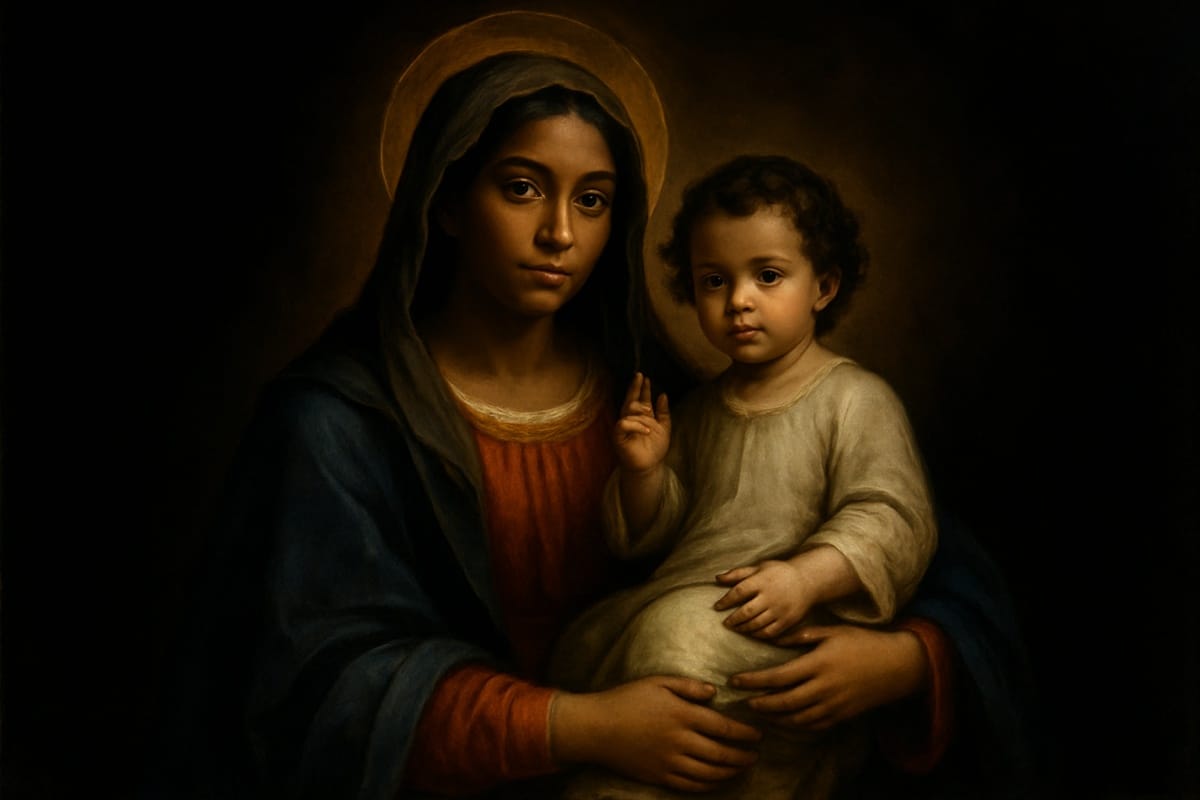
“Pulchra ut luna, electa ut sol, terribilis ut castrorum acies ordinata” (Song 6:10), “Beautiful as the moon, bright as the sun, imposing as an army in battle array”
I. Beautiful as the moon, bright as the sun: the nuptial beauty of the Song
The Song of Songs is the biblical book that Christian Marian tradition, from the earliest centuries, read as one of the richest poetic anticipations of the mystery of Mary. The nuptial images that describe the Bride, her unique beauty, her inexplicable mystery, were applied by the Fathers of the Church at once to Christ and to His Church, and at once to Mary as the perfect icon of this Church-bride. The central verse of chapter six synthesizes this beauty with words of extraordinary force: “Beautiful as the moon, bright as the sun, imposing as an army in battle array” (Song 6:10). This triad describes a beauty that is not merely aesthetic: it is a symbolically dense beauty. The moon reflects the light of the sun without being extinguished in it. The sun is a source of its own light. The army in battle array expresses strength, dignity, and victory. And it is precisely this threefold beauty, reflected from the Son who is Sun, herself a source of maternal light that illumines her children, and firm as an army that protects its own, that was manifested in an extraordinary historical way in the Bolivian shrine of Copacabana, on the sacred peninsula of Lake Titicaca, where a Marian image carved by a descendant of Inca nobility became the symbol of the spiritual identity of an entire Andean nation.
II. Copacabana, 1583: Tito Yupanqui, the Inca descendant who carved the Mother of the Andes
Francisco Tito Yupanqui was a noble Aymara Indian, a direct descendant of the Inca royal house of the Yupanqui, who lived in the region of Copacabana, on the sacred peninsula of Lake Titicaca, where before the arrival of the Spaniards stood the temple of the Sun and the most venerated pre-Columbian shrine of the whole Andean region. Converted to Christianity, Tito Yupanqui felt the desire to offer his native village an image of the Virgin Mary. But the first attempts he made, without artistic training, were so crude that the bishop forbade him to continue, judging them unworthy of public veneration. Tito Yupanqui did not give up. He went on foot, as an Aymara pilgrim, to the city of Potosí and then to Chuquisaca (present-day Sucre), and there, for years, he learned the art of polychrome sculpture from Spanish masters. In 1582, he finally finished an image carved in maguey wood, representing Mary with the Child Jesus in her arms. The image, carved according to the iconographic model of Our Lady of Candelaria, was carried in procession to Copacabana, where it was enthroned on February fourth, 1583. The Aymara Indians, who for decades had maintained a difficult syncretism between the ancient Inca devotions and the Christian faith, welcomed the dark-skinned Virgin of Tito Yupanqui as their definitive Mother. Around her grew the shrine that would become the spiritual heart of the Bolivian altiplano. Pope Pius XI authorized the canonical coronation in 1925, and Pope John Paul II visited Copacabana in 1988. Our Lady of Copacabana is today the Patroness of Bolivia.
III. The Annunciation at Nazareth: the Marian choice of peripheral places
The Gospel of Luke that accompanies this celebration presents the Annunciation, a paradigmatic reading for understanding the logic of the divine choice of places and of persons. “The angel Gabriel was sent by God to a city of Galilee called Nazareth, to a virgin betrothed to a man named Joseph” (Lk 1:26-27). Nazareth was a despised village of Galilee, Galilee was a despised region of Palestine, and Palestine was a despised province of the Roman Empire. And it was precisely in this threefold contempt that God chose to become flesh. This Old Testament and New Testament logic, in which God prefers the peripheries to the centers, finds in Copacabana a particularly eloquent spatial manifestation. Tito Yupanqui did not carve his image for a colonial cathedral: he carved it for his native Aymara village, on the sacred peninsula of a lake at an altitude of three thousand eight hundred meters, in the heart of the Andean altiplano. And it was precisely in this geographical and cultural periphery that the Mother chose to become Patroness of an entire nation. The logic of the Annunciation is repeated in the Andes as it was repeated in Nazareth: what is despised by men is chosen by God to manifest His glory.
IV. Copacabana and Andean Mariology: an Aymara-Christian synthesis
The devotion to the Virgin of Copacabana represents, in the religious history of the Andean altiplano, a theological and cultural synthesis of extraordinary importance. Before the arrival of the Spaniards, the peninsula of Copacabana was one of the principal religious centers of the Inca empire, dedicated to the cult of the Sun and to the sacredness of Lake Titicaca, held by the Aymara and the Quechua to be the place of the birth of the world. The abrupt imposition of Christianity by the colonizers did not manage to erase this ancestral religious rootedness. What it did achieve, over generations, was a more serene encounter mediated by the image that Tito Yupanqui carved: a dark-skinned Mother, with features that the Aymara recognized as their own, set in the place where formerly the Sun was invoked, and who made herself Mother of all the children of that altiplano. This inculturation is not syncretism in the pejorative sense: it is what the Second Vatican Council described as the capacity of the Christian faith to “take up the riches of the cultures of the various peoples and purify them, strengthen them, and elevate them” (Lumen Gentium, 13). Copacabana is the Andean version of this capacity. The dark-skinned Mother whom Tito Yupanqui carved more than four centuries ago did not destroy the Aymara religious memory: she redirected it toward its Christian fulfillment. And even today, millions of faithful from Bolivia, Peru, and northern Argentina climb to the three thousand eight hundred meters of the shrine of Copacabana to venerate the Mother who chose the geographical heart of the Andes for her permanent dwelling, a sign that the beauty of the Son continues to be reflected by the earthly mother who bore Him, in all the latitudes where His word is welcomed.
Postgraduate Program in Mariology
Would you like to deepen your formation in Mariology? Discover the Postgraduate Program in Mariology of Locus Mariologicus – an academic formation that unites theological rigor, spiritual life, and the living tradition of the Church.
Would you like to study Mariology seriously?
This article grows out of the works in the Locus Mariologicus library. The Postgraduate Program in Mariology takes you to the same source, with academic guidance: Scripture, the Fathers of the Church, and the Magisterium, from the first dogma to contemporary questions.


Responses