Is Our Lady Queen in the Bible?

Our Lady Queen in the Bible: biblical foundations of the Marian title

Today someone asked me, Daniel, why is Our Lady Queen? Is that in the Bible? As a Mariologist, I have a duty to seek an answer. So I decided to go and research, and the immensity of the Queenship of Mary that I found I will try to synthesize in this contribution.
First of all we must read Mt 2:2:
Where is the king of the Jews who has just been born?
This short verse contains a plurality of Old Testament prophecies that were fulfilled at that moment. The Magi came to adore the King. This Monarch, who is not Herod, would carry out God’s plan as head and shepherd of Israel, instead of ruling with violence over the weakest.
Sacred Scripture, recalling Micah, bears witness in favor of the child born in Bethlehem and also of the Magi who came to adore Him. We might say that Herod’s reaction is that of refuting and persecuting the King because that is what Jesus is. This is not a mere king, but the promised Messiah-Lord, as we see in the prophecy of Is 7:14 when it makes explicit the deep meaning of the term Emmanuel (1:23). In fact, in this passage we find adoration three times (Mt 2:2, 8, 11). If we look closely, the aim of the Magi is precisely this, for the divinity of the Child is already present in the prophecy of Hos 11:1 when it says:
When Israel was a child, I loved him: out of Egypt I rescued him.
The star too, however mysterious it may appear to our eyes, has the function of revealing the kingship of the figure. In this symbolism we find what was said in Num 24:17:
A star comes forth from Jacob: a scepter rises from Israel.
This star announces a messianic figure, as the King who will enlighten and free the people from their enemies.
All these elements have great repercussions for the Mother of Jesus, for the royal titles of the Child also correspond to the one who bore Him. To be the Mother of the King in the tradition of Israel and of the peoples of that region is a condition of particular privilege and dignity. The ‘Mother of the King’ was not a widow set aside, but one associated with the kingship of the Son and contributing to the government. From the few Old Testament texts in which we find the theme mentioned, we see that a deeper reading highlights this bond between Mother and Son on the Messianic Throne. Let us recall that, for biblical culture, the Mother of the King was even more exalted than the wife. Let us consider the case of Bathsheba who, prostrating herself before King David her husband and sitting down, finds Solomon prostrate before her, and they prepare a throne for her and have her sit at his right hand, as we find in I Kgs 2:19.
Bathsheba went to King Solomon to speak to him about Adonijah. The king rose and came to meet her, prostrated himself before her, and then sat down on his throne. They also placed a throne for the king’s mother, who sat at his right hand.
We cannot then be surprised to find in Hebrew culture a description of Mary as the one who gives life to the King. This importance is so great that in particular times the Queen can take the place of the throne and exercise her regency.
The importance of the mother of the King is further affirmed by the famous prophecy of Is 7:14.
Well then, the LORD himself will give you a sign. Behold, the young woman shall conceive and bear a son, and shall name him Emmanuel.
The sign given by God through the prophet has to do with the Mother who, conceiving, gave birth to the heir of David’s throne, who carries with Him the messianic hope and promise. Curiously, the center of Isaiah in the prophecy is the Mother and not the Father of the King! In the same sense we find the verse of Micah:
But you, Bethlehem of Ephrathah, little among the villages of Judah, from you shall come forth for me the one who is to be the ruler of Israel. His origin is ancient, from remote times. Therefore God will abandon them until the moment when she who is to give birth gives birth. Then the rest of his brethren shall return to the children of Israel.
In this passage, speaking of Bethlehem as the homeland of David, that King who will govern Israel is announced. The motherhood of the woman in labor implies the liberation of the people. These two oracles are recalled by Matthew when he sees in the Child and His Mother the God-with-us and the King of the Jews. The particularities that find no echo in the prophecies are the conception of Jesus by the work of the Holy Spirit and the virginal motherhood of the Mother of the King. In fact, the text does not speak of the Child and His parents but only of the Child and His Mother, in an allusion to the virginal condition of Mary.
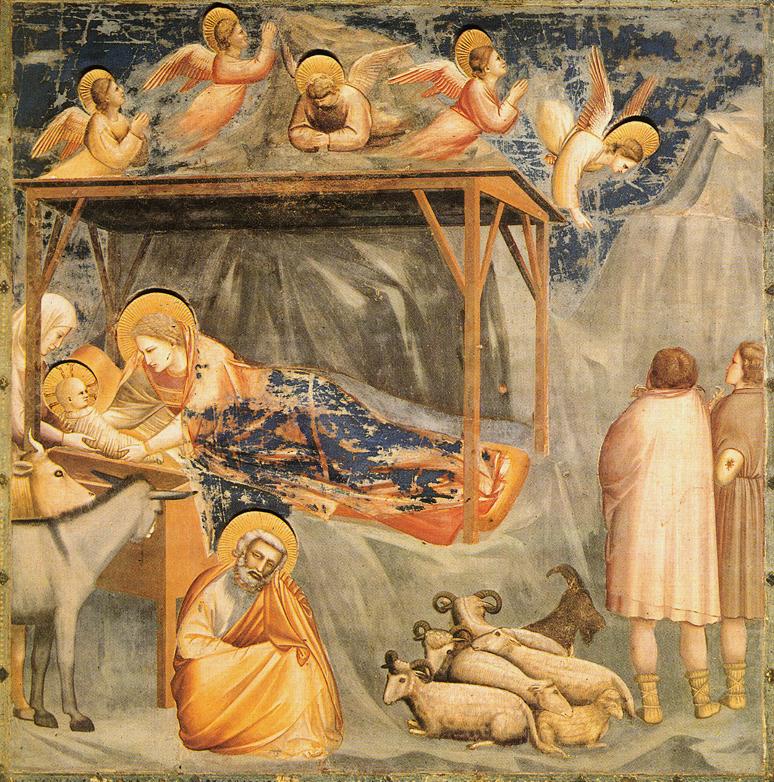
The union of the Queen Mother with the Son lies in the act of adoration of the Magi, as if including the Mother in the glory of the kingship of the Son. Matthew’s pericope does not narrate a contingent fact but an event of salvation in which the peoples make pilgrimage to find the Savior whose light opened the darkness of the world. God no longer hides within the walls of the Temple of Jerusalem but presents Himself begotten of a virgin, a Child, persecuted, in flight, exiled. Beside the child is the personification of ancient Israel in flight, oppressed, put to death by Pharaoh but set free by the powerful strength of God.
In this sense Our Lady is Queen because she is the mother of the King, image of the Church which, persecuted together with Christ by the rulers of the world, does not cease to accompany and even to govern this new people of whom only faith is asked.
To deepen the biblical theology of Mary Queen, consult the encyclical of John Paul II: Redemptoris Mater on Mary in the life of the pilgrim Church.
Deepen your studies: explore Mariology, Marian Theology, Marian apparitions, and the Postgraduate Program in Mariology.
Postgraduate Program in Mariology
Would you like to deepen your formation in Mariology? Discover the Postgraduate Program in Mariology of Locus Mariologicus – an academic formation that unites theological rigor, spiritual life, and the living tradition of the Church.
Would you like to study Mariology seriously?
This article is born of the works in the library of Locus Mariologicus. The Postgraduate Program in Mariology brings you to the same source, with academic guidance: Scripture, the Fathers of the Church, and the Magisterium, from the first dogma to contemporary questions.



Responses