Mary’s Childbirth: An Astronomical History

The Birth of Jesus (c. 7 BC): The Star of the Magi, the Census of Quirinius, and the Liturgical Date of December 25
As for the comet seen by the Magi, the year of the star is very probably 7 BC. In that period there were several striking astral phenomena: around 12 BC the Chinese sighted a comet, and in 5 BC, in the Celestial Empire, they saw the explosion of a nova in the sky. In Chinese wisdom, these phenomena were considered signs of the birth of a great King who would come from the West. But the stellar phenomenon that the Magi witnessed occurred in 7 BC, when Saturn and Jupiter came into conjunction against the backdrop of the constellation of Pisces three times: on May 29, September 29, and December 4. This phenomenon was confirmed by Johannes Kepler (1571-1630), and in Jewish tradition it was a prelude to the birth of the Messiah.
Considering that 7 BC coincides with the end of Quirinius’s term of office in Syria, where, according to Luke’s most precise chronological indication, there was a census in which Joseph and Mary took part, we can regard that year as the most suitable one in which to place the birth of Jesus. The Magi could have seen the star on May 29, waited for the summer to pass, set out in September, and arrived in Judea at the end of November, seeing the star for the last time on December 4, after leaving Jerusalem. This is the most widely accepted opinion.
However, considering that the Magi saw the star twice and not three times, and that when they arrived Jesus had already been born, and taking into account that shortly after their arrival the Holy Family had to flee, two things can be deduced. The first is that the Magi saw the first and the second conjunction, which was what led them to Jesus. The second is that He was conceived and born before the conjunctions. In fact, as Luke says, the Mother took Him to the Temple for the Purification and the Presentation of the Son, which took place at least forty days after the birth. Thus, combining the Census of Quirinius, cited in Luke, with the stellar conjunction, we find that Jesus was born before May 29, 7 BC, and received the visit of the Magi on September 29, and then fled into Egypt.
Although these Jewish concepts, including the idea of the Messiah as a warrior and interpreter of the Law, linked to starlight and to the crushing scepter, did not correspond exactly to the astronomical conceptions of the Magi and did not fully fit their sightings, they certainly allowed a very close intellectual correspondence between the signs interpreted by the two different, yet analogous, cultures.
As for the date of Mary’s childbirth, the Latin liturgy sets March 25 as the Annunciation to Mary, nine months before the birth of Jesus, that is, December 25. The angel appeared to Mary when Elizabeth was in the sixth month of her pregnancy (Lk 1:26). Consequently, the birth of John the Baptist is placed on June 24, three months after the Annunciation and six months before the Nativity of Jesus. The Byzantine East celebrates the announcement to Zechariah on September 25, obviously nine months before the birth of the Baptist. John Chrysostom believed, following the Protoevangelium of James, that Zechariah, the father of John the Baptist, was the high priest, and that the offering of incense mentioned by Luke was the offering of the Day of Atonement. Since the Day of Atonement fell on 10 Tishri (September-October), the nativity of John took place in June. These relationships between the dates are explained as a calculation based on the already established date of December 25.
In Lk 1:5-8 we read that Zechariah belonged to the class of Abijah and that, when the angel Gabriel appeared to announce his wife’s pregnancy, he “was exercising the priesthood in the turn of his group.” A. Ammassari believes that the indication of the turn of Abijah goes back to an ancient, recorded Jewish-Christian tradition: thus the Byzantine rite has preserved a precise historical date. In the Temple, David organized the priests into twenty-four classes, in Hebrew sebaot (1 Chr 24:1-19). These classes served for one week each, twice a year. Progress in the study of the calendars used by the Jews has made it possible to reconstruct the order of succession of these priestly classes. They served for seven days each, and a complete cycle of the twenty-four classes covered one hundred and sixty-eight days. We do not know whether the succession of the classes was uninterrupted or whether each year the order started again from the beginning, with the first class.
Roger T. Beckwith, who favors the solution of priestly cycles interrupted each year, believes that the month of Tishri was the time when the cycle began each year, as happened after the rebuilding of the altar of the Temple after the exile. This is also confirmed by the calendars found at Qumran, where a solar calendar of three hundred and sixty-four days was followed, with an intercalary day every third month, the same calendar used by Jesus for the celebration of the Passover. There was a cycle of priestly turns that lasted six years, so that at the end of each cycle, in the first week of the first year, the same priest would always be on duty. According to this calendar, the turn of Abijah, prescribed twice a year, fell in the first of the six years for the first time from the 8th to the 14th of the third month, and for the second time from the 24th to the 30th of the eighth month. Now, this second time corresponds approximately to the last ten-day period of September.
Thus Zechariah, once every six years, had his turn of service in this period of time, which is compatible with the traditional date of the nativities of John the Baptist and of Jesus. Admittedly, it is not easy to imagine that a solar calendar was applied in the Temple of Jerusalem, unless one supposes that Zechariah did not follow the official calendar. According to the Pharisaic lunar calendar, which was the official calendar of the Temple, and based on the information that the Temple was destroyed on August 5-6 (9-10 Ab) during the turn of Jehoiarib, in the following weeks, had the service continued normally, these would have been followed by Jedaiah, Harim, Seorim, Malchijah, Mijamin, and Hakkoz, who would have begun his turn on 21 Elul (September 15). If, on reaching this point, in view of the beginning of Tishri, the priestly succession had started again from the beginning, Jehoiarib would have begun again on 28 Elul (September 22), and the eighth turn, that of Abijah (Zechariah’s), would have begun on 17 Heshvan (November 10). If, instead, the succession had continued without regard to the beginning of the year, after Hakkoz it would have been the turn of Abijah, from 28 Elul (September 22) to 4 Tishri (September 29).
In the case of turns in continuous succession, it would be difficult to trace the period covered by Abijah at that time, since we know neither the exact year of the birth of Jesus nor when the embolismic years occurred, that is, the years in which an extra month (a second month of Adar) was added to realign the calendar. If, on the other hand, we admit that the service started again each year, it would follow that Zechariah always performed his turn in the second ten-day period of November. If the birth of Jesus is placed fifteen months later, then in a common year Jesus would have been born in January-February. In a year with an embolismic month (with Adar II), the Nativity would be shifted to December-January.
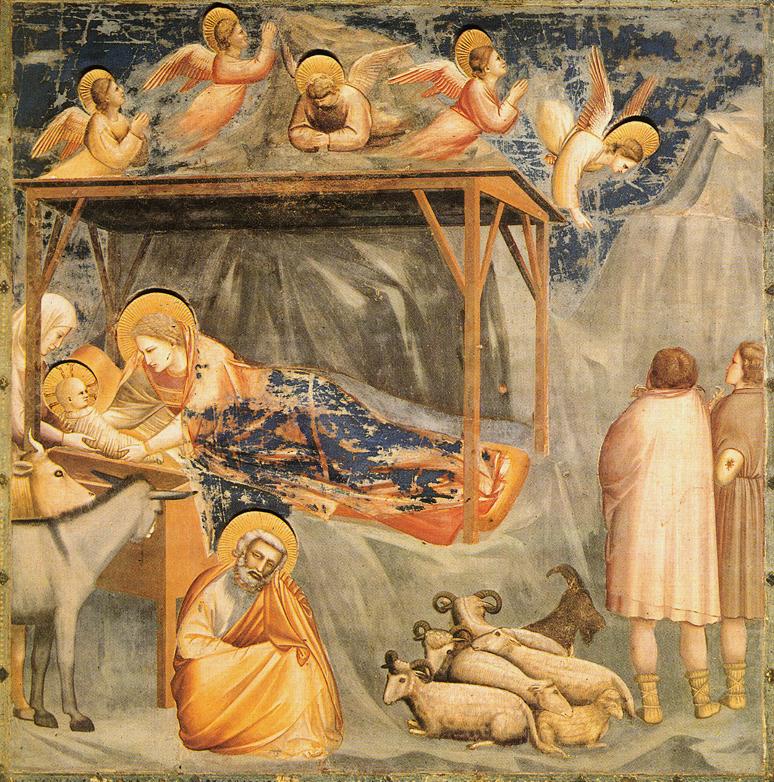
Thus the birth of Jesus at the end of December (or at the beginning of January, as it is celebrated in the East) is a date derived from a series of combined calculations whose memory has been lost, fifteen months after the announcement to Zechariah, nine months after the Annunciation to Mary, and six months after the birth of John the Baptist. The fact that there were shepherds with their flocks out in the open on the night Jesus was born is no reason to rule out that it was winter. Even today in Bethlehem one can see sheep grazing in December. The setting of Mary’s childbirth in a cave that later became sacred, that is, mythically luminous, finds its context in the Jewish, and later Jewish-Christian, belief in the possibility that the divine Light sanctifies a dark place, where it prefers to shine precisely in order to stand out.
One last historical-literary contextualization concerns the Finding of Jesus in the Temple. No one considers it a legend any longer, because in the first century the rabbis set the age at which one was obliged to begin observing the Law at exactly twelve years, and all the customs of Lk 2:41-50 are likewise widely attested in Jewish literature.
Delve deeper into your studies: explore Mariology, Marian Theology, Marian apparitions, and the Postgraduate Program in Mariology.
To reflect more deeply on Mary, Mother of God, consult the Encyclical Redemptoris Mater by Pope John Paul II.
Postgraduate Program in Mariology
Would you like to deepen your formation in Mariology? Discover the Postgraduate Program in Mariology of Locus Mariologicus, an academic formation that unites theological rigor, spiritual life, and the living tradition of the Church.
Would you like to study Mariology seriously?
This article grows out of the works in the Locus Mariologicus library. The Postgraduate Program in Mariology takes you to the same source, with academic guidance: Scripture, the Fathers of the Church, and the Magisterium, from the first dogma to contemporary questions.




Responses