“The kingdom of heaven is like a net cast into the sea, which gathers all kinds of fish; so it is with the gospel.” – Matthew 13:47“Mary is the star of the sea.”
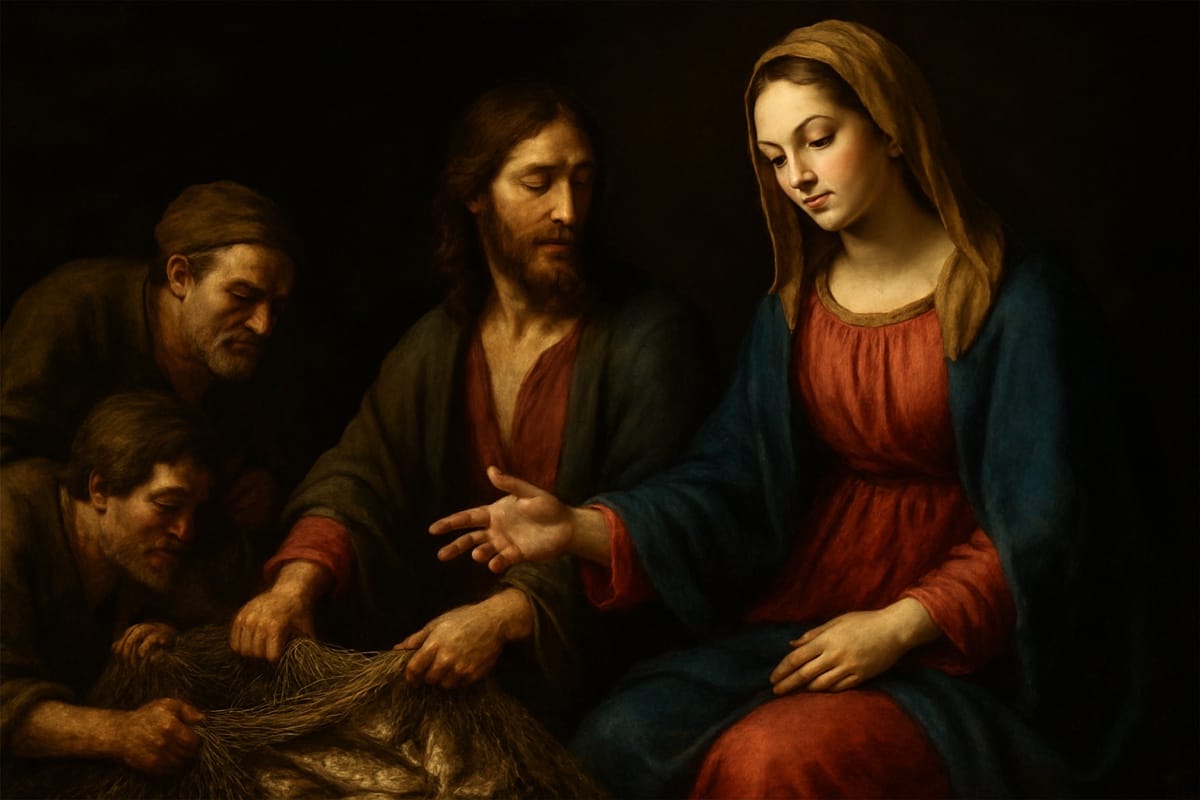
Scriptural Passage:> “It is like the kingdom of heaven, which is similar to a net thrown into the sea; it gathers all kinds of fish, and when it is full they draw it ashore, and sit down and gather the good into containers, but discard the bad.” (Matthew 13:47-48)Analysis:Matthew 13:47-53 concludes the great chapter of Matthew’s parables with two brief parables (the net and the new treasure) and a key question to a scribe. The parable of the net is structurally parallel to that of the wheat and tares: a mixture (of good and bad fish) only separated at the end, by reapers/fishers, not by the sower/fisher himself. The context difference is significant: while wheat and tares are in a field (an earth image), the fish are in the sea, and the sea in biblical imagery is often a symbol of chaos and forces opposing God (cf. Revelation 21:1: “In the new heaven and new earth, there will be no sea anymore”).I. “Sagenae missae in mare”: The Universal Net> “It is like the kingdom of heaven, which is similar to a net thrown into the sea… (Matthew 13:47)”The sagena (net) is a dragnet, different from the individual fishing net. A dragnet operated along the coast: it was thrown into the sea, dragged across the bottom, and pulled in by multiple fishers on shore. The image is of communal mission: not a solitary fisher but a community of fishers working together to draw the net along the entire sea.The “all kinds” (ἐκ παντὸς γένους) that the net catches represents the universality of the Kingdom: not just Israel but the Gentiles, not just the righteous but sinners, not just legal scholars but the ignorant. The Church as a “dragnet” encompassing all types is the image of catholicity; “catholic” means precisely “according to the whole,” the universality that does not exclude by category.Mary, as “Mother of the Church,” is by definition within this universal net: she who said “do whatever he tells you” (John 2:5) to all at the wedding in Cana, she who was at the Cenacle with disciples of all types (Acts 1:14), is the figure of the Church that welcomes all because her Son, whom she generated, came to save all. Devotion to Mary as “Mother of All Peoples” has in the parable of the net its evangelical image.II. “Separaverunt malos de bonis”: The Final Judgment> “Thus it will be at the end of the age: the angels will come and separate the wicked from the righteous.” (Matthew 13:49)As in the parable of the wheat and tares, the final separation is made by angels, not humans. Matthew’s judgment structure is consistent: humans do not make the final judgment, they only participate in it as subjects. Judgment belongs to God through his messengers; human attempts to anticipate the final judgment are the temptation of fanaticism that the parable implicitly rejects.“‘There will be wailing and gnashing of teeth’ (Mt 13:50), the expression of ‘sorrow and the grinding of teeth’ that concludes the parable of the net (as did the parable of the weeds, Mt 13:42) is one of Matthew’s most austere escatological warnings. It is not theological sadism, but the gravity of each human life’s decision. ‘Making good and bad fish’ is not an arbitrary attribution but the accumulated result of choices over a lifetime. Judgment reveals what a person chose to be, not imposing categorization from the outside.’The Virgin Mary and the theme of judgment: the tradition of the ‘Final Judgment’ in medieval art often depicted Mary as intercessor with Christ the Judge (Deesis iconography). This representation does not contest divine judgment, but expresses confidence in Mary’s intercession as our ‘Advocate’ (Salve Regina). Mary intercedes for those who still have time for conversion, not for those already definitively separated. Her intercession is, like in the parable of the net, an act of fishing, helping those still at sea reach the shore before final separation.”“‘Every scribe trained in the kingdom of heaven is like a household father who brings out from his treasure both new and old’ (Mt 13:52), the small parable of the Kingdom’s scribe concludes the chapter of parables with an image of integration. The scribe who ‘understood’ (Mt 13:51) does not abandon the old treasure (the Torah, the Prophets, tradition) but integrates it with the new (Jesus’ teaching). ‘New and old’ is the image of Christian hermeneutics: not replacement of the Old Testament by the New, but interpretation of the old in light of the new.”“Jesus’ question, ‘Have you understood all this?’ (Mt 13:51), and the disciples’ response, ‘Yes’ contrasts with the misunderstanding of the crowds. The disciples who ‘understood’ are the new scribes of the Kingdom, called to integrate the treasure of previous revelation with the radical newness of the Gospel. This task is permanent in the life of the Church: ‘theology’ as an effort to integrate ‘new and old’ is the scribe’s ministry in the Kingdom.”“Mary as ‘scribe of the Kingdom’: she who ‘kept all these things in her heart’ (Lk 2:19.51) was the first to integrate the ‘new’ (the Incarnated Son of God) with the ‘old’ (Israel’s tradition, known through the Magnificat filled with Old Testament echoes). The Magnificat is literally an integration of ‘new and old treasure’: the new grace received at the Annunciation sung in words from the Psalms, Hannah’s canticle (1 Sm 2:1-10), and the Prophets. Mary who sang the Magnificat is the model of the ‘scribe of the Kingdom’, who proclaimed from her heart ‘new and old’.”
IV. Mary and the Kingdom’s Net: Presence at Sea and on Shore
The image of a net cast into the sea has a Marian application that tradition subtly developed: Mary as the “net” that, through her intercession, draws men to the shore of final judgment. The title “Star of the Sea” (Stella Maris, attributed to Mary since at least the 4th century, based on an etymological play with “Maria” = “stilla maris,” drop of the sea) finds its symbolic context here: the star that guides fishermen in the dark sea, the one, in maritime symbolism, that steers navigators towards safe shore.Mary who was present at both moments of the net, at casting it out (Annunciation: the moment when the Son entered the sea of human history) and at pulling it in (Ascension: the moment when the Church began to draw the net), is the figure of maternal presence throughout the mission. From the “fiat” that launched the Son into the sea of history to the “orante” of the Ascension who waited for the Holy Spirit to begin drawing the net, Mary accompanies the entire story of the Kingdom’s fishing.July 30th, on the liturgical calendar, does not have a special feast day; it is a Common Time day filled with regular Liturgy of the Hours and Eucharist. But the parable of the net invites meditation on the universality of the Church that fishes: the Church that each day casts its net into the sea of humanity and patiently waits for the harvest of final judgment. Mary, Stella Maris, guides this daily fishing.Master’s in Mariology
Want to deepen your formation in Mariology? Learn about the Master’s in Mariology from Locus Mariologicus, an academic formation that combines theological rigor, spiritual life, and the living tradition of the Church.
Would you like to study Mariology seriously?
This article draws on the works of the Locus Mariologicus library. The Postgraduate Programme in Mariology takes you to the same sources with academic guidance: Scripture, the Church Fathers and the Magisterium, from the first dogma to contemporary questions.




Responses