Transfiguratus est ante eos: the Transfiguration of the Lord and Mary, contemplative of the glorious Son
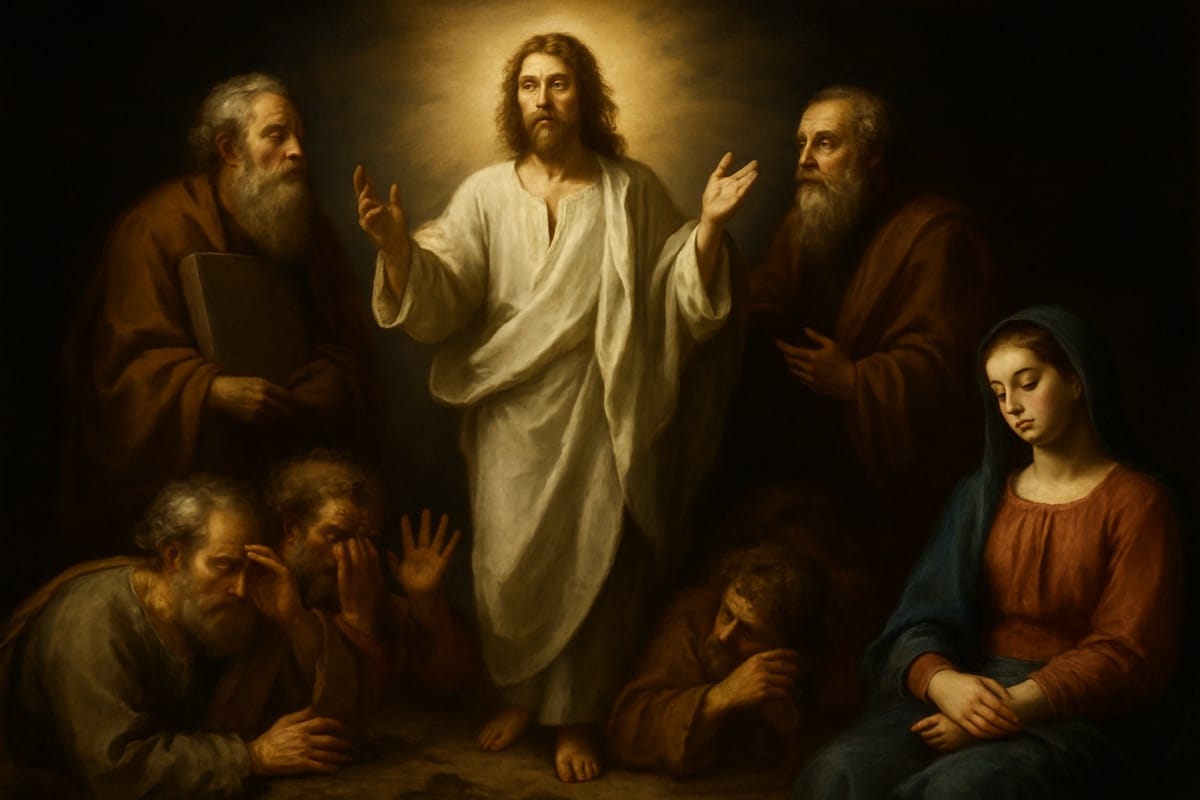
Et transfiguratus est ante eos: et resplenduit facies eius sicut sol, vestimenta autem eius facta sunt alba sicut nix. Et ecce apparuerunt illis Moses et Elias cum eo loquentes.
Mt 17:1-3
The Transfiguration (Mt 17:1-9) is the narrative summit of the Gospel of Matthew before the Passion: the revelation of Jesus’ divine identity within a restricted group of disciples, at the top of a mountain, between the figures of Moses and Elijah. The scene has a deliberate liturgical structure: the ascent of the mountain (v. 1), the luminous transformation (v. 2), the appearance of the patriarchs and prophets (v. 3), the voice of the Father repeating the formula of the Baptism (v. 5), the prostration of the disciples (v. 6), and the descent with the instruction to keep silence (vv. 7-9). Each element corresponds to an earlier biblical scene: the mountain of Moses, the light of the Exodus, the voice of Sinai.
The Transfiguration takes place “six days after” (Mt 17:1) Peter’s confession (Mt 16:13-20) and the first prediction of the Passion (Mt 16:21-23). The juxtaposition is not accidental: Jesus announced the Passion and showed the glory, the same event seen from two angles. The Cross and the Transfiguration are the two faces of the same mystery: the kenosis that leads to the doxa, the way of the Cross that ends in the resurrection whose anticipation is the light of Tabor. Peter, who resisted the Passion, is the same one who saw the glory, and the experience of Tabor should have given meaning to the experience of Calvary.
I. “Resplenduit facies eius sicut sol”: the glory revealed
“His face shone like the sun, and His garments became white as snow” (Mt 17:2), the luminosity of the Transfiguration is the language of the biblical doxa: the glory (כָּבוֹד / δόξα) of God that Ezekiel saw as “fire and brightness” (Ezek 1:26-28), that Moses could not see face to face (Ex 33:20-23) and that shone on the face of Moses after he had been with God (Ex 34:29-35). Jesus does not reflect the glory of God like Moses, He is the source of the glory: “His face shone” not by contact with the Holy One but because He is the Holy One.
The appearance of Moses and Elijah, the two great mediators of the Old Testament, one representing the Torah and the other the Prophets, places Jesus within the continuity of biblical revelation but also within its consummation. They “talk with Him” (Mt 17:3) about what Luke will make explicit as “His exodus, which He was about to accomplish at Jerusalem” (Lk 9:31): the Passion is the subject of the conversation on Tabor. The glory of the Transfiguration does not exist in spite of the Cross but because of it; the doxa that the disciples see is the doxa of the One who is going to die and rise again.
The voice of the Father, “This is My beloved Son, with whom I am well pleased. Listen to Him” (Mt 17:5), repeats and reinforces the voice of the Baptism (Mt 3:17), adding the imperative “listen to Him”. At the Baptism, the voice identified Jesus. On Tabor, the voice commands us to listen: the revelation of the identity culminates in the commandment to listen. The theology of Tabor is, in the last analysis, a theology of obedience: to recognize the glory of Jesus is to commit oneself to listening to Him, including when He speaks of the Cross and of death.
II. “Non est hic bonum esse”: the temptation to remain on Tabor
“Lord, it is good for us to be here!” (Mt 17:4), Peter’s proposal to build three tents is the temptation to fix the extraordinary spiritual experience in place: to turn the moment of grace into a permanent dwelling. Peter wants to “remain” on Tabor because the experience is too good to end; he does not understand that the Transfiguration is an anticipation, not a destination. Tabor is given to illuminate the way of the Cross, not to replace it.
The temptation to “remain on Tabor” runs through spiritual history: the search for mystical consolations that avoids the desert, the enthusiasm of experiences of prayer that dispenses with ordinary life, the initial fervor that does not pass through the dark night. Jesus’ instruction, “rise, and have no fear” (Mt 17:7), is the movement of descent that always follows the experience of glory: Tabor is not the end of the journey but the strength to continue it.
III. Mary and Tabor: the contemplative of the glorious Son
According to the Gospels, Mary was not on Tabor; the Transfiguration was revealed only to Peter, James, and John. But the contemplation of the Son’s glory is a central dimension of Marian spirituality: she who “contemplated” the Son from Bethlehem onward, who “kept and pondered” the mysteries (Lk 2:19, 51), came to contemplate the glory in a way that none of the three disciples of Tabor attained, the glory of the Risen One, who “shines like the sun” in the Resurrection and whose glory Mary shares in the Assumption.
The Assumption of Mary, defined dogmatically by Pius XII in 1950, is, from a theological perspective, Mary’s personal “Transfiguration”: the body that bore the glorious Son shares in the bodily glorification of the Risen One. What the disciples saw on Tabor for a few moments, the human body transfigured by divine glory, Mary lives eternally in the Assumption. The feast of the Transfiguration (August 6) and the feast of the Assumption (August 15), separated by only ten days in the liturgical calendar, form a contemplative diptych: the glory revealed in the Son (August 6) and the glory shared by the Mother (August 15).
Marian contemplation of the glorious Son also has an earthly dimension: Mary saw the risen Son before the apostles did (according to the tradition mentioned by John Paul II) and contemplated in Him the consummation of what she had intuited from the Annunciation onward. The “face that shines like the sun” of Tabor is the same face that Mary contemplated on the morning of the Resurrection, and it is the face that, according to the mystical tradition, keeps her in eternal contemplation in Heaven. The devotion to the “face of Jesus” that the Marian tradition cultivated has its two focal points in Tabor and in the Resurrection: the transfigured face that Peter, James, and John saw and the risen face that Mary contemplated.
IV. “Hic est filius meus dilectus”: from the voice of the Father to the faith of Mary
“This is My beloved Son, with whom I am well pleased. Listen to Him” (Mt 17:5), the Trinitarian formula of the Transfiguration (the Son revealed, the Father who speaks, the luminous cloud who is the Spirit) has in Mary its privileged recipient in the history of salvation. Mary was the first to hear “Son of the Most High” (Lk 1:32) said of Jesus, through the Angel who transmitted the Word of the Father. The voice of Tabor is the solemn confirmation of what Mary accepted in faith from the Annunciation onward: that the Son she bore is the Son of the Father.
The imperative “listen to Him” that the voice of the Father adds at the Transfiguration is the imperative that Mary lived before any disciple: she who “kept and pondered” (Lk 2:19, 51) is the one who most radically “listened to” the Son, not only the words of the public preaching but the silent words of thirty years at Nazareth, the gestures of the miracles, the silence of Gethsemane. Mary’s “listening” is the model of the listening to which Tabor invites: not the superficial listening that wants to “remain on Tabor” but the listening that goes down with Jesus along the way of the Cross and waits for the third day.
The feast of the Transfiguration, established universally by Callixtus III in 1457 in thanksgiving for the victory of Belgrade over the Turks (July 22, 1456, announced on August 6), is at once a feast of the glory of Christ and an invitation to contemplation: to see the glory in order to have strength for the Cross, to contemplate Tabor in order to pass through Calvary. Mary, who passed through Calvary without abandoning her faith, is the model of this contemplation that sustains the journey, she who did not “remain on the Tabor” of the Annunciation but went down into the valley of the Cross and to the Calvary of self-giving, in order to rise again in the glory of the Assumption.
Postgraduate Program in Mariology
Would you like to deepen your formation in Mariology? Discover the Postgraduate Program in Mariology of Locus Mariologicus — an academic formation that unites theological rigor, spiritual life, and the living tradition of the Church.
Would you like to study Mariology seriously?
This article grows out of the works in the Locus Mariologicus library. The Postgraduate Program in Mariology takes you to the same source, with academic guidance: Scripture, the Fathers of the Church, and the Magisterium, from the first dogma to contemporary questions.




Responses