Verba vitae aeternae: Mary and the faith that remains
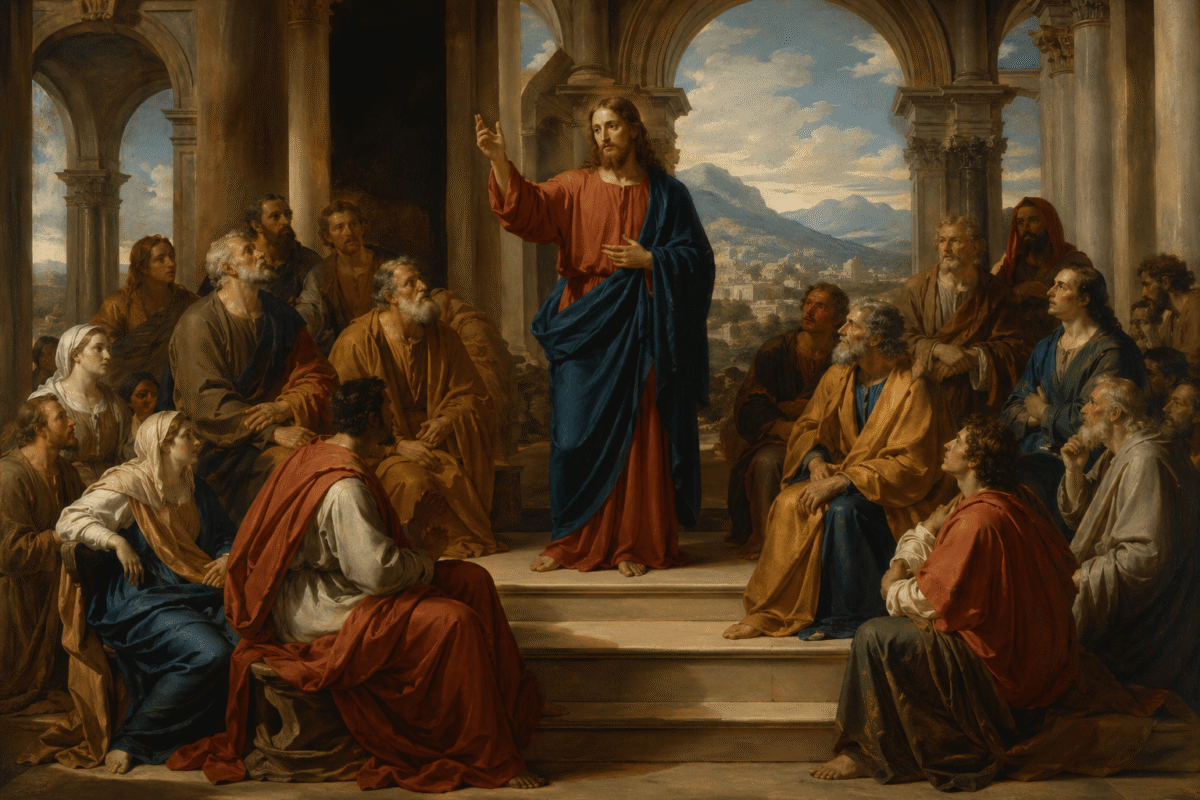
Domine, ad quem ibimus? Verba vitae aeternae habes.
Jn 6:68
When many disciples abandon Jesus after the Bread of Life discourse, the episode of greatest abandonment recorded in the Gospels, Jesus turns to the Twelve and asks: “Do you also want to go away”? (Jn 6:67). Peter answers with one of the most beautiful confessions of faith in the New Testament: “Lord, to whom shall we go? You have the words of eternal life”. Mariology finds in this scene a privileged point of reflection: Mary was, before Peter and the Apostles, the faithful one who remained when everything invites one to abandon Him.
I. The crisis of faith in Jn 6 and the perseverance of the disciples
Jn 6:60-71 narrates the greatest crisis of faith in the Johannine Gospels. The discourse on the flesh and blood of Jesus as true food and drink provokes a scandal: “Many of his disciples, when they heard these words, said: ‘This saying is hard. Who can listen to it?’” (Jn 6:60). The Greek verb for “to listen” is akouein, which in John frequently has the sense of “to accept”, “to receive”. The difficulty is not acoustic; it is theological: the message of Jesus challenges human categories and demands an adherence that surpasses comprehension.
The text says that “Many of his disciples turned back and no longer walked with him” (Jn 6:66). This apostasy, for it is apostasy in the technical sense of abandonment of the faith, is not that of the declared enemies of Jesus: it is that of His own disciples, of those who had heard the discourse, who had followed Jesus, who had seen His signs. The crisis of Jn 6 anticipates the crisis of Jn 18-19: in the courtyard of the High Priest and on Calvary the disciples likewise abandon Jesus.
Against this tide of abandonment, Peter formulates perseverance: “To whom shall we go? You have the words of eternal life”. This confession has a specific structure: it is not that of someone who “understands” the discourse of Jesus. Peter does not say “we understand everything you have said”. It is the confession of someone who, even without understanding fully, recognizes that there is no alternative: only Jesus has “words of eternal life”, only He holds the key to the ultimate meaning of human existence.
Johannine faith, as it manifests itself in this scene, is not a faith based on full comprehension, but on a relationship of trust. Peter does not “understand” the Eucharist, but he trusts Jesus. This is the model of mature faith: not the faith that demands prior comprehension, but the faith that welcomes the word of Jesus even when it surpasses the capacity for immediate assimilation. This model has its supreme icon in Mary.
II. Mary, the faithful one who remained
The Gospel narrative does not record Mary in the episode of Jn 6; she is neither among those who abandon Him nor among those who remain. But the mariological tradition has always recognized in Mary the supreme model of perseverance in faith, which the episode of Jn 6 dramatizes. She who said “let it be done to me according to your word” (Lk 1:38) before fully understanding what that “yes” implied is the faithful one who remained when others abandoned Him.
Elizabeth greets Mary as “she who believed” (hē pisteusasa, Lk 1:45): the aorist participle indicates an act of faith that inaugurates a permanent condition. Mary did not merely “believe” at one moment; she is the one who believes, who lives in faith, who remains in trust in her Son. This faith is not naive: it passes through incomprehension (“they did not understand what he said to them”, Lk 2:50), through apparent refusal (“who is my mother”?, Mk 3:33), through the silence of the Cross.
John Paul II, in Redemptoris Mater, developed at length the concept of Mary’s “pilgrimage of faith”: she who believed at the Annunciation was tested throughout her whole life, and each trial deepened and purified her faith. Mary’s “kenosis of faith”, her experience of obscurity, of the silence of God, of incomprehension, is not less than the kenosis of Christ: it is participation in it.
Calvary is the highest point of this pilgrimage. When the disciples flee, Mary remains. Not because the Cross does not tear her apart — the sword that Simeon foretold (Lk 2:35) is being fulfilled. But because her faith is stronger than the scandal of the Cross. She who heard the “words of eternal life” at the Annunciation does not abandon them now that those words seem to have been belied by the apparent failure of her Son. This is the summit of Marian faith: faith in the resurrection before the resurrection, faith in life before seeing it confirmed.
III. “When the hour had come”: the temple of the body and the intelligence of faith
Jn 2:22: “When he was raised from the dead, his disciples remembered that he had said this, and they believed the Scripture and the words that Jesus had said”. The faith of the disciples after the Resurrection has a new structure: it is not a blind faith, but a faith that “understands”, in the light of the Resurrection, what before was obscure. The words of Jesus, which had been “hard” to hear (Jn 6:60), now become luminous.
The patristic and medieval tradition distinguished between historical faith (adherence to the events of the life of Jesus) and theological faith (the understanding of the saving meaning of those events). The Resurrection does not create faith out of nothing; it deepens, clarifies, and confirms a faith that was present but obscure. “They remembered and they believed”: the “remembering” (anamnesis) is the condition of the intelligence of faith.
Mary is, in this perspective, the figure of intelligentia fidei, not because she “knew everything” from the beginning, but because she “kept and pondered” (Lk 2:19, 51) the words and the events until their meaning became luminous. Her meditation of the heart is the model of the process by which faith deepens: not by the acquisition of new information, but by the progressive contemplation of the mysteries already received.
The Magnificat (Lk 1:46-55) is the most beautiful expression of this intelligentia fidei of Mary. The canticle presupposes a profound knowledge of the Scriptures and a prolonged meditation on the promises of God to Israel. Mary does not improvise a canticle; she synthesizes the whole tradition of Israel in the light of what is happening within her. The “words of eternal life” of which Peter will later speak are the same words that Mary recognized as fulfilled in her own flesh.
IV. “We also believe and know”: Mary and the Church that confesses
Jn 6:69: “We believe and know that you are the Holy One of God”. Peter’s confession uses two verbs: pisteuein (to believe) and ginoskein (to know). In John, these two verbs are frequently parallel: faith and knowledge are complementary aspects of the relationship with Jesus. It is not a matter of a blind faith that refuses knowledge, nor of a purely intellectual knowledge that dispenses with faith: it is the unity of a personal relationship that engages the whole person.
This unity of faith and knowledge has in Mary its fullest realization. She “believes”: her fiat is an act of pure faith, without external guarantees. And she “knows”: her Magnificat demonstrates a profound theological understanding of what God is accomplishing. Mary is at once the simple faithful one and the contemplative theologian: not because she attended schools of theology, but because the grace that dwelt in her oriented her toward the heart of the mystery.
The Church, which confesses with Peter “you are the Holy One of God”, finds in Mary the model of her own confession. The Creed is not merely an intellectual formula; it is the expression of a lived faith, of an experienced knowledge, of a relationship with Jesus that runs through the whole of history. Mary, who was the first to confess Jesus as Lord with her fiat, is the figure of the Church at prayer, in confession, in contemplation.
The title “Mother of the Church” (Mater Ecclesiae) that Paul VI proclaimed is not merely an honorific title; it is the expression of a constitutive relationship. Mary begets the Church as she begot her Son: with faith, with obedience, with love. Each time the Church confesses “we believe and know”, she repeats the confession that Mary anticipated with her “yes” at the Annunciation. The faith of the Church is participation in the faith of Mary. The perseverance of the Church is participation in the perseverance of Mary, who remained when others abandoned Him.
Mary, who remained when the disciples abandoned Him, is the model of the faith that perseveres beyond comprehension, trusting only in the “words of eternal life” of her Son.
References
- John Paul II, Redemptoris Mater, nn. 17-19 (1987).
- Second Vatican Council, Lumen Gentium, n. 58 (1964).
- R. Laurentin, Structure et Théologie de Luc I-II (1957).
- H. U. von Balthasar, The Glory of the Lord, vol. I.
- A. Serra, Maria e la Parola di Dio (1984).
Postgraduate Program in Mariology
Would you like to deepen your formation in Mariology? Discover the Postgraduate Program in Mariology from Locus Mariologicus – an academic formation that unites theological rigor, spiritual life, and the living tradition of the Church.
Would you like to study Mariology seriously?
This article is born from the works in the library of Locus Mariologicus. The Postgraduate Program in Mariology takes you to the same source, with academic guidance: Scripture, the Fathers of the Church, and the Magisterium, from the first dogma to contemporary questions.


Responses