Mary by the cross

From Cana to the cross
The pericope of Jn 19:25-27 is a remarkable scene, set within the very heart of the paschal mystery of Christ. Its importance emerges from the density of the text, from the context of the hour, and from its relationship with the episode of Cana. We shall begin with the latter.
The scene of the wedding (Jn 2:1-12) not only announces and in a certain way anticipates that of Calvary, but in the latter it attains its full meaning and reveals its exceptional density. Placed at the beginning and at the end of the Gospel, these two scenes are crucial, fundamental not only for understanding the figure and the role of Mary, but also the Johannine message as a whole. The two scenes, carefully orchestrated, show an evident parallelism. The characters are the same: Jesus, at the beginning and at the fulfillment of His work, the mother of Jesus, the disciples, represented at the cross by the “beloved disciple”.
In both cases, the Virgin is not mentioned by her personal name, but as “mother of Jesus” and, later, as “woman”, an unusual title used by a son in relation to his mother. In both passages there is talk of the hour of Jesus, which at Cana had not yet come (cf. Jn 2:4) and at the cross was complete (cf. Jn 19:27). Both episodes are followed by the same expression: “After this…” (Jn 2:12; 19:28), a formula that reveals great importance:
- Jn 2:12: “After this”, there is a community of faith gathered around Jesus.
- Jn 19:27: “After this”, all things are accomplished.
In general, we can say that if Cana stands under the sign of the hour that has not yet come, the Cross represents the fulfillment of the hour. If at Cana there was the “beginning”, the archetype of the signs, at the Cross there is the sign par excellence, the exaltation of the Son of Man, which reveals the glory of God and confirms the faith of the disciples.
The context of the hour of Jesus
The scene of Jn 19:25-27 receives light from the comparison with Cana, but reveals its exceptional density in the immediate context of the “acts” of Jesus on the cross (Jn 19:17-37). There are five episodes that make up the last phase of the passion:
- The inscription of the title on the cross (vv. 19-22)
- The division of the garments (vv. 23-24)
- The words to the mother and the disciple (vv. 25-27)
- The accomplishment of the work entrusted by the Father (vv. 28-30)
- The piercing of the side (vv. 31-37).
Our pericope, as can be seen, stands at the center of the supreme events of the hour of Jesus, all of them highly symbolic and of exceptional theological importance. The profound unity of these scenes and their importance must be emphasized, since the evangelist presents them as the mysterious fulfillment of the Scriptures.
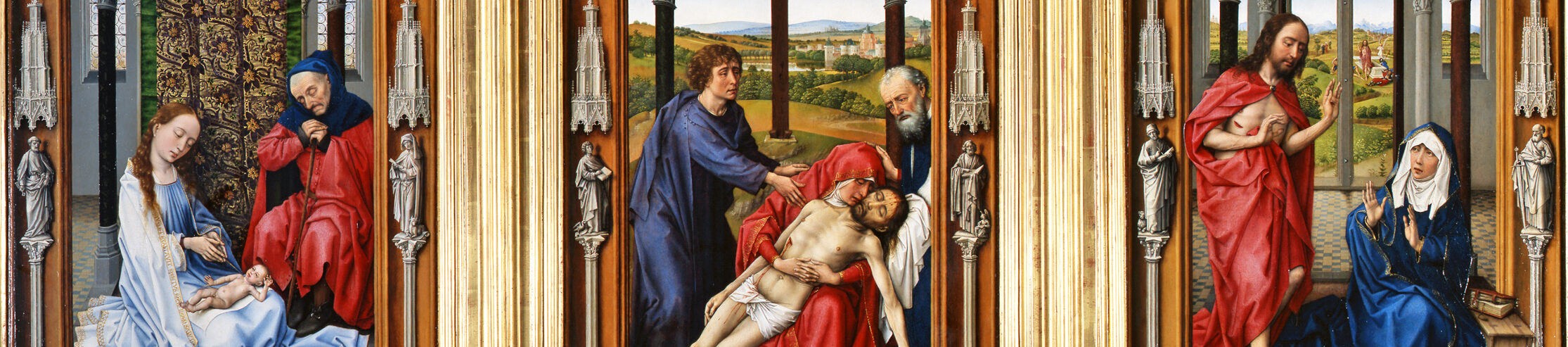
They cannot be read on a superficial and phenomenological level, but must be understood as the definitive paschal revelation. It even seems that a scene of revelation is present in our episode, in which the true identity of the mother of Jesus and of the beloved disciple is manifested. Despite the presence of other people, at the center of the scene of Calvary there are, as noted, three protagonists:
- Jesus, who in His royal majesty as the Son of Man lifted up on the cross communicates the supreme revelations and gives the last testamentary dispositions.
- The mother, who, unlike at Cana, does not speak, but is at the center of attention as the principal custodian of the will of the Son. She is mentioned four times as the mother of Jesus, once as the mother of the disciple, and once as “woman”.
- The disciple, who, although not initially mentioned among those standing by the cross, is subsequently identified, like Mary, as the recipient of the gift of the Master.
From the point of view of frequency, the figure most emphasized is the mother. She appears initially as the mother of Jesus, but also as woman, mother of the disciple. The disciple, in turn, is not only the one who follows the Master and is loved by him but, precisely because he is such, he is also the son of the “woman”. While motherhood in relation to Jesus is traditionally accepted, the title of “woman” and the motherhood in relation to the disciple require explanation.
The beloved disciple
As always in the Gospel of John, and especially in these scenes of the Passion, we cannot limit our understanding to the material and therefore superficial level of the message. The scene of Jn 19:25-27 does not simply represent an act of family piety toward a mother who would have been left alone, as is frequently asserted, especially in non-Catholic contexts.
This contradicts the text, which highlights in the first place the presence and the role of the mother (“Woman, behold your son”), and only in the second place, as a consequence, entrusts the mother to the disciple. Moreover, the relationships between them are not of a natural order, but of generation according to the Spirit.
Who, then, is the disciple?
He is a person and at the same time a symbol. The words of Jesus solemnly lifted up on the cross have essentially the same meaning as those addressed to the Father in the priestly prayer of Jn 17:20ff: “I do not pray for these only, but also for those who will believe in me through their word…”. The beloved disciple expresses “the type of the disciples”: the man of faith, the witness of the cross, “the son of the mother of Jesus”, that is, the representative of the disciples who, by their position in relation to God, have also become brothers of Jesus (20:17).
Note that the disciple, in our text, is mentioned three times (vv. 26-27) and always with the definite article, emphatically: the beloved disciple represents all those who believed and received Jesus. They constitute the new people of God: they are the community of those redeemed by the sacrifice of the Lamb, whose bone must not be broken (cf. vv. 33-36). The Church born from the blood and the water that flowed from the side of the Redeemer (v. 34), the New Eve taken from the side of the new Adam asleep on the cross.
The “woman”, mother of the children of God
The woman, as a consequence, is the mother of the disciple and of the disciples, of the community of all those who were scattered and for whom Jesus died. “For it was necessary that he should die… in order to gather into unity the scattered children of God” (Jn 11:51f). In the thought of the Old Testament, the scattered children of God are the children of Israel exiled among the nations because of their sins (cf. especially Deut 4:25-27; 28:62-66; 30:1-4).
The Lord, who had scattered them among the peoples, far from their land, will bring them back to their land and to their house. He will make of them a single people out of the divided kingdoms of Israel and Judah, and a descendant of David will be their shepherd (cf. Ezek 34:23-24; Ezek 37:24). He will make a new covenant with them, whose mediator will be a mysterious “servant” of God (cf. Is 42:6; 49:8), who will offer his life as a ransom for the multitudes (cf. Is 53:10f). All the nations will then come and gather in Jerusalem, which will become the mother of countless children (cf. Is 49:19-20; 60:1-9; Tob 32:12f).
Once the bride of God, abandoned because of her infidelity and deprived of her children, she will see the return of the Lord and will welcome within her walls a posterity that cannot be counted. It will be a prodigious and universal motherhood. The city and the people are frequently indicated by the symbol of a woman, bride and mother, and with the title of “daughter of Zion”, invited to rejoice, after great suffering, in the redemption and the return of her children. In the eyes of the first Christian generation, the mother of Jesus took shape as the ideal embodiment of the ‘daughter of Zion’. In her, as an individual person, the vocation of Zion-Jerusalem and of all Israel, the people of the Covenant, matured in an exemplary way.
In this context, the beloved disciple represents all the redeemed, and Mary, the woman-daughter of Zion, symbolizes the community of the covenant, mother of the children of God once scattered and now gathered into unity. Mary is not merely a figure of the ancient daughter of Zion, in whom the splendid promises were fulfilled only partially and temporarily. The Mother of Jesus inaugurates, as first fruits, the vocation of the new Zion, the community of the New Testament, mother of all the disciples of the Lord. Precisely because she is the Mother of Christ, the “firstborn among many brethren” (Rom 8:29).
Mary is the mother of all those who have been reborn through faith in the Son. Her motherhood, which began with the birth of Jesus, reaches its fullness at Calvary. As can be seen, the episode of Jn 19:25-27 goes far beyond a simple domestic scene, beyond an act of filial care on the part of Jesus.
The welcoming of the mother
Faced with this motherhood, a revealing gift of the Master, the disciple is called to adopt an attitude of faith, a vital adherence and a decision that springs from the depths of his freedom: a free decision, but not an optional one. The beloved disciple cannot refuse the gift of his Lord. The acceptance of the mother is one of the traits that characterize the true disciple of Christ. And “from that hour” (v. 27), the disciple received her into his own life.
The hour of the acceptance of the mother, which is not so much a chronological indication as a theological moment, coincides, and this is of substantial significance, with the fulfillment of the hour of Jesus. The expression “after this”, with which the next verse begins (v. 28), does not seem a simple formula of transition, but intends to emphasize a close connection between what occurred before and what follows. “After this”, in consequence of this, “Jesus, knowing that all was now accomplished, in order that the Scripture might be fulfilled, said…” (v. 28).
As can be perceived, it is a particularly solemn language, characteristic of the Johannine style, which places our episode at the summit of the hour established by the Father and as the seal of the saving work. With the gift-revelation of Mary as mother of the faithful and with her welcome by the disciple, the work of Jesus is completed. These are magnificent and grand visions that emerge from the depths of the Gospel of John.
The genius of Origen (d. 254) had already intuited this: for him, no one can understand the meaning of the Fourth Gospel without leaning on the breast of Jesus and without receiving Mary from Jesus as mother. In the light of the episode of Mary by the cross, the mysterious sign of Cana is also clarified. We can better understand the meaning of the wedding and of the hour, as well as the role of that woman in the life of the disciples of the Lord.
Deepen your studies: explore Mariology, Marian Theology, Marian apparitions, and the Postgraduate Program in Mariology.
Redemptoris Mater of Pope John Paul II, on Mary by the Cross and her participation in the redemptive mystery of the Son.
Postgraduate Program in Mariology
Would you like to deepen your formation in Mariology? Discover the Postgraduate Program in Mariology of Locus Mariologicus – an academic formation that unites theological rigor, spiritual life, and the living tradition of the Church.
Would you like to study Mariology seriously?
This article is born of the works in the library of Locus Mariologicus. The Postgraduate Program in Mariology brings you to that same source, with academic guidance: Scripture, the Fathers of the Church, and the Magisterium, from the first dogma to contemporary questions.




Responses