Called to Holiness in Mary’s Footsteps
1. CALLED TO HOLINESS
The expression called to holiness punctuates like an antiphon the preambles of the Pauline letters: “saints by vocation” (Rom 1:7), “called to be saints” (1 Cor 1:2), “all the saints throughout Achaia” (2 Cor 1:2), “chosen before the creation of the world to be holy and immaculate before him in charity” (Eph 1:4). From the beginning the Churches are thought of in God as a being in holiness, as the public manifestation, “in that place” and “in that time”, of the truth of man, evident in an adjective that becomes a name defining the brothers and sisters of Jesus, “saints” (Col 1:2), and their Church: “I believe in the holy Church”. A vocation whose background, ever current, lies in the experience consigned to the writings of Israel, bound to the vocabulary of the “holy”, qadosh.

God is called Far
There is no term comparable to “holy” for defining the identity and the profound truth of the Judeo-Christian God. So the heavenly court sings it: “Holy, holy, holy is the Lord God” (Rev 4:8; Is 6:3). So the voice of the Law proclaims it: “I, the Lord your God, am holy” (Lev 19:2). So the earthly Church confesses it in the celebration of the Eucharist.
The thrice-holy of Isaiah and of the triságion is, therefore, as the Hebrew root of the term underlines, the “separated”, the “distinct” from the world and from man, the “distant”. A diversity in himself: “I am God and not man” (Hos 11:9), “the only one who possesses immortality, who dwells in unapproachable light, whom no one among men has ever seen or can see” (1Tim 6:16), and which reaches also the sphere of thinking and of acting: “My thoughts are not your thoughts, your ways are not my ways. As high as the heavens rise above the earth, so high do my ways rise above yours, and my thoughts above yours” (Is 55:8-9). Indeed, “God is not a man, that he should lie, nor a son of man, that he should repent. Does he speak and not act? Does he promise something and not fulfill it?” (Num 23:19).
To proclaim the holiness of God means, therefore, to recognize first of all the radical and constitutive otherness in relation to the cosmos and to man. It means to make one’s own the prayer of the psalmist: “Know that the Lord is God, it is he who made us” (Ps 100:3). It means to proclaim with the evangelist: “No one is good but God alone” (Lk 18:19). A God not created by man’s questions about the origin, the end, and the meaning of living, and therefore not the projective work of his mind and of his heart, even though he is neither foreign nor indifferent to human questioning and searching. A useful clarification in view of not descending into the realm of idolatry, which appears when the Holy One is identified with one of our systems of thoughts, of images, of desires, and of discourses about God. He is other and beyond. Far is his name.
God makes himself Near
The dimension of otherness, though fundamental, does not exhaust the unfathomable richness of the mystery of God.
The never-concluded parable of faithful Israel proclaimed and continues repeatedly to proclaim that the far one, the distant one, the Other, the sinless one, in short the Holy One, loves to come out of his inaccessibility in order to make himself near, close, present. It is written, indeed: “I am the Holy One in your midst” (Hos 11:9), coming to you to constitute you a “holy nation” (Ex 19:6): “Be (therefore) holy, because I, the Lord your God, am holy” (Lev 19:2).
The Holy-far becomes Holy-near in order to make of Israel a portion of holy humanity, that is, far and near, separated and close: distant from idols and from idolatrous ways, allied with God and initiated into his way. And still different from the nations, because to it was given to be a “priestly people” (Ex 19:6), among them and for them a witness of the Name and of its code of holiness, of good and just life.
This is the perennial vocation of Israel, its call to holiness, which consists in a going out from the before, idolatry, from thoughts and ways that are not good, and in an entering into the after, the company of the God of the fathers, of the thoughts and of the ways of life and of light. A passage made possible by the decision to “be in the midst” of Israel so as not to deprive humanity of the memory of his presence and of his directions. A vocation to holiness marvelously summed up in this verse of the prophet Micah: “Man, you have been taught what is good and what the Lord requires of you: to do justice, to love mercy, to walk humbly with your God” (Mic 6:8).
Called to be saints
The being-near of the Far One, in Christian experience, reaches its apex in Jesus. In him, the Unspeakable becomes word (Jn 1:14), the Invisible becomes face (Jn 14:9), the code of holiness is summed up and translated into: “This is my commandment: that you love one another as I have loved you” (Jn 15:12). An as that speaks newness and fullness. I have loved you as the “Only-begotten Son of God”, even to the giving of my life. In him, Emmanuel, truly “God is with us”. In him, Jesus, truly “God saves”. In him, finally, lies the distinction between Israel and the Churches. The latter are called to holiness through him.
A clarification, as has already been written, recurrent in the Pauline letters, for example in the first letter to the Christians of Corinth, where the expression called to be saints alludes in all likelihood to the “holy convocation” of Exodus and Leviticus (Ex 12:16. Lev 23:2-44). Indeed, according to Ex 10:1-8, the going out is in view of the emergence of a priestly people, a holy nation. And because it is “holy”, a term that includes at once the meanings of separation and of belonging, Israel is the priest of the Most High among the nations and for the nations. Hence, called to holiness as a provocation to an alternative history, fruit of the word received from an Ally great in mercy and committed to renewing the face of the earth, to making it an Eden where milk, honey, wine, justice, right, and peace flow. In the “fragment of Israel” is included and signified God’s plan for the whole.
This background, implied in the expression “called to be saints” applied to the elect in Corinth, is nevertheless specified, as has already been hinted, by a peculiarity of its own. The God who, within that great Hellenic city, decides to create for himself a portion dedicated to him and to his ways, tearing it away from the idolatrous before (1 Cor 12:2), does so by means of Jesus Christ. The theological passive “sanctified in Christ Jesus” (1 Cor 1:2) is clear and illuminating. Those called by the Father in Corinth are so through Christ Jesus and in view of communion with Christ Jesus, his Son and our Lord (1 Cor 1:9). Son-Lord who sanctifies, it is understood, through the superabundant outpouring of the great gift, source of all gifts (1 Cor 1:5): the Holy Spirit, who makes of the elect the assembly of one God, the Abba of Jesus, of one Lord invoked and awaited (1 Cor 1:2. 16:22), of one commandment, agape (1 Cor 13), which makes the days blameless (1 Cor 1:8).
The reason for such an invitation is evident. God calls out of idolatry, holiness as “separation”, so that some among the Corinthians may become his allies, holiness as “belonging”. And he does so in Jesus Christ, summoning those called to become conformed to the Son (Rom 8:29), a letter of Christ written with the ink of the Spirit of the living God and legible by all human beings (2 Cor 3:2-3), in short a “holy nation” (1Pet 2:9).
Once again, the call to holiness has an evident political dimension. To be, in the polis, the city, witnesses of the Father of Jesus Christ and of his Holy One: free from every pseudo-idol-ideology and filled with a Spirit who makes the impossible happen, the koinonia with the Abba-Father in the Lord Jesus, the reconciliation of the different in love, the prayerful expectation of the irruption of “God all in all” (1 Cor 15:28). Definitively free from all evil and from death.
Holiness as Christoformity
New creature
In Christian experience, the call to holiness is therefore the work of the Father, through the Son, in the Spirit and, more specifically, it can be defined as a summons to become conformed to Christ, to his image and likeness, and in him conformed to the Father. He is, indeed, the Holy One of God in our midst, that is, the “hidden mystery” made manifest “in the last time”, as the full manifestation and the consummate interpretation of the Ineffable One and of his ineffable way. Thus, “called… and predestined to be conformed to the image of his Son” (Rom 8:28-29), in such a way that “we are transformed into that same image, from glory to glory, according to the action of the Spirit of the Lord” (2Cor 3:18). To say “holy Church” and “holy disciples, men and women” means simply to become what we are called to be, like Christ and in him like the Father, in the Spirit: “Be perfect as your heavenly Father is perfect”, a perfection made flesh and visible in the Lord Jesus. There are no other criteria for defining Christian holiness.
It is an event that entails a transfer and takes up again the etymological meaning of the term holy as separation from and closeness to. Let us read: “It is God, indeed, who delivered us from the power of darkness and transferred us into the Kingdom of his beloved Son”, (Col 1:13). A closeness that the synoptics translate as being with him in discipleship, Paul as being in him, and John as abiding in him, in his love and in his word. An event that implies a transformation and takes up again the etymological meaning of the term holy as separation from the old, from the before, and assumption of the new, of the now.
“If anyone is in Christ, he is a new creature”, (2Cor 5:17), a new man (Eph 2:15. 4:24. Col 3:10) conformed to him (Rom 8:29. 2Cor 3:18) in thinking (1Cor 2:16), in feeling (Phil 2:5), in acting (1Jn 2:5), and in dying and rising (Phil 3:10-11). Christoformity is, therefore, the new form of existence given to the Churches, a truly precious pearl: “What counts is being a new creature” (Gal 6:15). And it is given as an answer to the question of the contemporary world about the quality of life, a question that cannot be frustrated in its expectation of a great vision, Christophany as the prolongation, in human vicissitude, of the cosmic and active compassion of the Lord Jesus. This must become the mother tongue of all the Churches, truly universal and visible, audible and comprehensible by all.
Compassion translated, first of all, into custody of the right of the poor and of nature, attentive to the cry of the oppressed and to the groaning of creation, constitutive chapters of the Christiform spirituality of this as of every age. Therefore, holiness as the prolongation of the Christological act even to dying for it, martyrdom as being, without any exclusion, with and for the other even to the unconditional gift of self, epiphany of the face of the Father and of man made flesh and history in Jesus, will characterize the Churches in history more and more. United in the visibility of existential newness in terms of messianic praxis.
An event that amounts, on the part of the Churches, to declaring concluded the time of the category of the enemy and of the use of the sword in the name of God and in defense of God’s reasons: “Enough of this”. The truth of God in Christ is a morsel of bread for the one who betrays, is forgiveness for the one who kills you. Whoever that may be.
Bread hard to digest, which qualifies, in the third place, holiness as an event of struggle, the agón and the agony of asceticism as an exercise of death and of life. Holy is the one who, in the Spirit, takes distance from death, the open negation of God and of man determined by the worldliness that generates the old man. It is the one who, in the same Spirit, enters into the life that generates the new man as the place through which the love of the Father, who grants grace in the Son and who opens to communion in the Spirit, continues to become human compassion. Of such figures and of such a Church the earth has need. Holiness as the ecstasy of history, as the otherwise of history.
The otherwise of history
The earth, therefore, calls for a holiness of not conforming to this world and of not fleeing from this world, of being-there in another way. The Gospel metaphors of light, of salt, and of leaven leave no doubt in this regard, as do the exhortations to be in the world but not of the world, not to conform to its logic, as does a highly evocative vocabulary in suggesting to the Churches the way of inhabiting the earth.
Sent by grace
Knowing and feeling oneself, as Churches, to be a gift of the free and gratuitous initiative of God to the world.
Strangers and pilgrims
The expression strangers and pilgrims (1Pet 2:11. Heb 11:13) suggests the whence, the whither, and the how of the Churches and of the disciples of the Lord in history. “Our homeland is in heaven” (Phil 3:20), from there we came and there we are going: “here below we have no lasting city, but we seek the one to come” (Heb 13:14), living, meanwhile, “as citizens worthy of the Gospel” (Phil 1:27).
In the here and now of the diaspora (1Pet 1:1), to be according to the homeland from which one comes and toward which one tends in expectation. “Homeland properly indicates a city with its governor, regulated by determined norms or laws to which all who dwell in it with the right of citizenship must adhere. Norms and laws that give meaning and order to individual and social living”. This means: to live the earthly here and now determined and oriented by heaven. Therefore, a “spirituality of the stranger” as non-identification, at the root, with natural and cultural homelands, out of place and in diaspora everywhere, and a “spirituality of pilgrimage” in the footsteps of the itinerary of the Son: from up there, the ineffable beginning, to down here, toward up there, the ineffable goal awaited and toward which one walks. Prophets of origins, of consummations, and of the one who opens to meaning the day and the hour given us to live.
Meaning given by walking with men, in a loving company even to the cross. The being-there of the Churches and of the Christian in history therefore conjugates at the same time the categories of the beyond, of the otherwise, and of company. ‘Worldliness’ (being in the world), ‘contemporaneity’ (being in this world), and ‘ethicity’ (being-there as God in Christ) is what has fallen by lot to the disciples of the Lord. It is their holiness, which consists in a being-there as participation in the love even to the pain of God for the world. Churches as the place through which Emmanuel, God with us, continues to make himself Jesus, God saves, for this poor world.
Apparition and metamorphosis
Churches, therefore, as the company of faith whose work, by pure grace, is the witness, in the daily round of life, to the agape of the Ineffable One, of which every believer is called to be a visible fragment, an apparition, a sign of a not impossible transformation of man to the stature of the true man and true Man who is Christ Jesus, the Ecce Homo, a window open upon the mystery of God and upon the mystery of man.
In the footsteps of Holy Mary: code of holiness
The Church and Christians are, therefore, those called to holiness in the footsteps, that is, according to the example and the traces of Christ Jesus: “Christ left you an example, so that you might follow in his footsteps” (1Pet 2:21), he, the mark of God to be followed, the chapter of holiness as sequela Christi in Spiritu. Only after underlining this discourse as the “decisive” one can we take up again the theme of the imitation of the imitators: “be my imitators”, Paul writes to the Corinthians (1Cor 4:16), specifying shortly afterward: “be my imitators as I am of Christ” (1Cor 11:1). Therefore: “you know how you ought to imitate us” (2Thess 3:7), “you became imitators of us and of the Lord” (1Thess 1:6). For this reason: “imitate the faith of your leaders” (Heb 3:7), and again: “let us walk in the footsteps of the faith of Abraham” (Rom 4:12) and, as Christian tradition enlightened by the Spirit understood from the beginning, “in the footsteps of the faith of Mary”. To a father in faith is joined a mother in faith.
This is the delicate chapter of the relationship between Christian existence and the saints, whose presence and whose kind of exemplarity require constant critical attention. A being-there not in the sense of “intermediaries” to facilitate access to God and to his favors, as if Christ were not enough as the sole interlocutor between God and man and man and God, but in the sense of “company” expressive of a friendship and of a brotherhood never interrupted. The communion of saints is not interrupted by death. Thus, communion with the Mother of God is not with a goddess or a demigoddess, but with a Woman entirely on our side, for us and for the Churches presence, memory, and prophecy. A company that, for example, recalls and prophesies, in her own body and in her own way, the code of holiness.
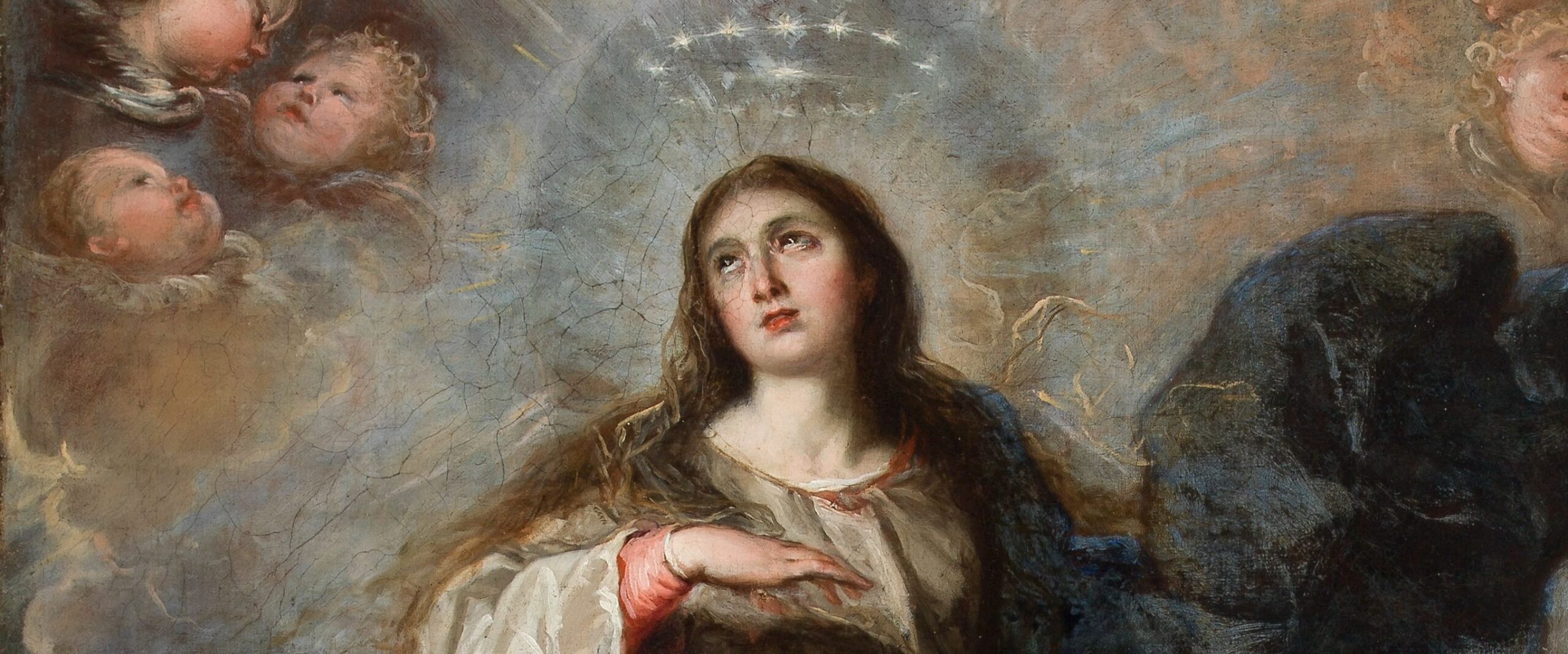
Christ, Holiness of God, is said to be such by many codes: the Scriptures celebrated in the Liturgy, explained by the Fathers and legible in the lives of those most like him. Among these, Mary, defined by tradition forma disciplinae Christi and by Dante in the Paradiso, 32,85: “The face that most resembles Christ”. Mary, therefore, as a code of holiness, of that holiness which in Jesus found its highest expression, because in him, the Holy of Holies, holiness itself became one of us. A code, Mary, therefore, to be leafed through chapter after chapter. We limit ourselves to listing a few titles, enough for a reading of holiness in terms of an event of grace, an event of faith.
Mary, code of grace
“Holy is his name” (Lk 1:49) is the title of the chapter with which the code of holiness “Holy Mary” opens. This means, in harmony with the Jewish and Christian tradition and summing it up, that the phenomenon of holiness does not belong to the genus of things available to man. It lies outside the horizon of his desires, of his thoughts, of his projects, of his decisions, and of his possibilities. In short, outside his name. It dwells in what is other than man and beyond man, in the one whom the Eucharistic Prayer proclaims “Holy, fount of all holiness”. Self-referentiality as owners of our own holiness, as Church and as Christians, is cut off at the root. Man is not the alpha, the beginning, the origin, and the cause. Like the Giver, the Holy One, holiness too is distant and hidden, a “never seen” and a “never heard”. A most important chapter for recognizing and for making others recognize the radical unavailability and otherness of God and of his way, an indispensable premise for a right placing and a right attitude: to stand before the Mystery in availability. The Holy One and holiness belong to the horizon of the gift to be received: “Holy is his name”, and holy is his way, neither the one nor the other the conquest of an asceticism, but the grace of a descent. Judaism and Christianity are not, in the first place, the religion of man’s going to God, but of God’s coming to man, without which there is no knowledge either of him or of his orienting word. By this we do not wish to deny the wholly human longing for the other and for the beyond, the history of man’s self-transcending. We wish only to affirm that, if the groan is not received by that Other who dwells beyond, the tension remains without attention and the waiting without encounter.
“He looked upon the lowliness of his handmaid” (Lk 1:48), “you have found grace before God” (Lk 1:30), “the angel was sent by God… to Mary… he entered where she was” (Lk 1:26-28), “The Lord is with you” (Lk 1:28). These are the paragraphs of the second chapter of the code of holiness called Mary. The In principio of holiness, its fontal connotation, lies in the experience of a most pure gift that comes not from man, but from God (Eph 2:8): to be looked upon with benevolence and to be visited with benevolence by a Distant One who, freely, gratuitously, sovereignly, and unilaterally, decided to make himself near, “with you”, to enter into your space of life, “he entered where she was”. A disconcerting experience that gives one food for thought: Mary “was troubled… and pondered the meaning” (Lk 1:29). This is what the code of Holy Mary recalls and prophesies: holy is the Church and holy is the creature initiated, without any merit and without any claim, into knowing herself looked upon with benevolence and found with benevolence by a God who asks for company, wonder, and reflection. The gaze and the encounter of the Holy One, of the God who is other and innocent, who makes innocent in his eyes all who make room for his friendly presence. The sustenance of holiness lies in being looked upon with love and visited with love. Whoever you may be: amor non invenit, sed creat diligibile, Luther notes with wisdom. Holiness comes to us from beyond us.
“You have been made beautiful” (Lk 1:28). Thus is entitled the third chapter. God’s coming to Mary is in view of the truth of Mary, that is, of her coinciding with the way God sees man: a good creature, capable of doing good and, for this reason, beautiful, lovable, and full of grace, like the woodland gilded by the autumn sun. This is what the code of holiness “Holy Mary” prophesies. By grace, he made her the icon of the uncontaminated creation of the origins and of the consummations. The coming of the Wholly Other is so that those visited may become wholly other than they are: “holy and immaculate before him in charity” (Eph 1:4-5), “blameless” (Col 1:22). Beautiful and good in the likeness of the “most beautiful among the sons of men”, Christ, beauty of God because a translation of the goodness of God for friend and for enemy even to dying for it. In him, the via crucis was converted into via pulchritudinis. In the “You have been made beautiful” is therefore revealed the reason for a coming forth of God from his silence: to make every creature under the sun beautiful, remodeling it in the Spirit according to Christ. Holy, a theme already developed, is the image of Christ, and holy is the Church, image of Christ, gift of newness and of possibility from God in history.
“Entering where she was, he said… Behold, you will conceive… the Holy Spirit will come upon you… the child to be born of you will be holy… Jesus… Son of the Most High… Son of God” (Lk 1:28.31-35). Fourth chapter of a code closely bound to the preceding ones. The coming, in grace, of the Other, the only good one, is in view of another creation, a good one, destined, like a new dawn, to give light to the sun of justice, destined, like a new earth, to contain and to become the gate of heaven. She who was begotten for beauty is called to beget the most beautiful among the sons of men, the perfect gift of God, bearer of the perfect gifts of God: forgiveness, the word, love, eternal life, the Holy Spirit, and Mary herself given as mother to the beloved Church (Jn 19:25-27). Given as the cipher of a specific and permanent vocation. In the footsteps of “Holy Mary”, mother of the Son of the Most High, Son of God, to become “holy Church”, that is, a humanity set apart in view of a radically other thought and way (Is 55:10-11), both by provenance and by goodness. In the Spirit of a perennial Pentecost, God’s way is to beget for the world the “God with us”, the “God for us”, the thought of God. The peculiar vocation of the Church and of the disciple, in the light of the code “Holy Mary”, is that of generation: to be the place through which, in the Spirit, the Son continues to make himself history and company, and this by means of the witness (Acts 1:8) of the word, of life, and of blood.
Vocation, a most important aspect, in the word. In the angel’s “he said” to Mary is summed up the experience of Israel, “people of listening” to the word in the law, in the prophets, and in the sages. And there is prophesied the experience of the Church, people of listening to the very Word made flesh: “God, who in times past spoke many times and in many ways… , in these last days has spoken to us through the Son” (Heb 1:1-2). The distant one makes himself near through the word.
“Rejoice” (Lk 1:28), “Blessed” (Lk 1:42). The invitation, imperative, to joy is the first word that God, in his messenger, addresses to Mary. It is the first word that God addresses to all who encounter him. A recapitulation of the announcements of salvation in the light of Zion, this greeting is a command to come out of fear before God. To the Adam of every age who says: “I heard your step… I was afraid… I hid myself” (Gen 3:10), God answers: “Do not be afraid” (Lk 1:30). His is the step of one who is concerned solely with your joy, with covering with light your shame, your nakedness (Gen 3:10). And reasons for exultation are not lacking. They are those already indicated thus far by the code of holiness “Holy Mary”. Rejoice, because the Holy One, the one other than you both in place and in thinking, gratuitously and freely comes to you, Church and disciple, as word to make you holy, that is, other. A difference of placing, in his divine setting. A difference as to the way of being and of existing: looked upon with love, called by name, opened to dialogue with him, clothed with light, and made capable of loving in the footsteps of Christ. And, finally, other by the singularity of the task: to beget the Word for the world, for the joy and the salvation of the world, witnesses with a presence that instills not fear of the existence of the God of “Holy Mary”, but joy for man.
Mary, code of faith
Holiness bestowed, the new existence in Christ, according to Christ, through Christ, as an excess of truth and of meaning, existentially reaches its aim when it becomes holiness received in entire trust, fidelity, and firmness, open to the forgiveness of its opposite. And Holy Mary, code of grace, becomes code of faith.
“Handmaid of the Lord… let it be done to me according to what you have said” (Lk 1:38). The initiative bears the name of the Other: “Holy is his name”, and the project of the other over oneself. The one initiated has her own name and her own acting: I am your handmaid, at the service of your word. It is the Other who defines the identity and the task of Mary. In this lies an evident index of the “in what it consists” of holiness: to let oneself be defined and projected by the Lord and by his word. Holiness as a going out of oneself, out of giving oneself one’s own name, and out of one’s own projects, one’s own will, in order to become the other’s, servant is my name, and for the other. The title of his decision is my project, in radical availability: “Here I am” (Lk 1:38). What distinguishes the saint in the footsteps of Holy Mary is the cutting, at the root, of self-referentiality, the primacy of the I, constituted, at the root, by the ownership of the Other and of his Gospel. Land of God in the Lord Jesus. The biblical citations and experiences and those of the history of holiness stand out in underlining that holiness as donum is being made a friend of God and set apart in his decisions, and is at the same time holiness as munus, a task whose charge is to be publicly assumed, adhering to the order received and loving the Giver more than the I and more than the dearest things.
An adhesion-adherence with precise traits. Here we enter into the merit of the quality and of the articulation of the response of faith. The being for God of Mary is qualified and articulated as the welcoming of a presence, the Son, which happens and unfolds in time, in fear (Lk 1:29), in astonishment (Lk 2:18.48), in joy (Lk 2:46-55), in sorrow (Lk 2:34-35), in the obscurity of understanding (Lk 2:50; Mk 3:31-34; Jn 2:2-4), in the question (Lk 1:29.34. 2:48), and in reflection (Lk 2:19). The relationship of Mary with the Father, in reference to the Messiah, lies along the line of a total yes that introduces Mary into the horizon of the vision of faith as a hospitality never frustrated and never interrupted toward a Word at once understood and not understood, in the specification of his messianity (Mk 3:31-34), jubilation and sword, given, lost (Lk 2:43-46), taken away (Jn 19:26), and given back together with the friends (Acts 1:14; Jn 19:27). A journey with God, in relation to Christ, that makes of Holy Mary the woman not exempted from the typically human office of “questioning herself”: “What does this mean?” (Lk 1:29), of “asking”: “How will this happen?” and “Why have you done this to us?” (Lk 1:34. 2:48), “They have no more wine” (Jn 2:3), and of “reflecting”: “Mary, for her part, kept all these things, words and events, pondering them in her heart” (Lk 2:19). A “for her part” that becomes an admirable summary of the ars cogitandi on our part. A miniature code of the art of thinking one’s own lived experience in relation to Christ.
First, to gather in depth the words and events of him and about him. It is the moment of placing and preserving in the right place, in the heart, the things to be remembered. Interiority as the place of guardian memory, tabernacle of the preservation of the presence and of the fragments. Second, it is a matter of composing such things together. It is the moment of connection, as liberation from the dispersive fragmentariness of memories. Third, it is a matter of reading such events and words in the light of an entire history, present and past. It is the moment of situating and of understanding one’s own experience in the bed of the immediate context and of the great tradition. Each one, in the school of Mary, is a fragment illumined by the whole and illumining the whole, a fragment initiated into a supereminent event. What you are and what is happening in you is an event of the mercy of God (Lk 1:54) for Israel, for the Churches, and for the world. A “subversive” mercy (Lk 1:51-53).
The altar of God in the altar of Myriam, the beautiful one, becomes even now a sung celebration of that which will have no future: the pride of life, the self-sufficiency of money, the arrogance of power and of culture, and the presumption of a justice claimed as the fruit of an ostentatious and finger-pointing religiosity. This is the liturgy of the humble, humble because they did not proclaim themselves great, but because by God they were made great (Lk 1:49) and made capable, as the etymology of magnify suggests (to make God great) (Lk 1:46), in their existing. In the fourth place, Mary is the cipher of conjugations that cannot be separated: the new heart, the “you have been made beautiful”, which is spoken in a new song, the “Magnificat”, and in a new existence, the “Fiat”, as generation and communication of the Son to Israel (Lk 1:43; 2:16) and to the nations (Mt 2:11). A Son to be listened to (Jn 2:5) and to be followed even to the cross (Jn 19:25-27).
The discourse makes itself explicit. Memorial of the gratuitous and willed closeness of a God impassioned for the truth of man and a friend who reveals to his allies his designs, Mary is also the way of standing before God. In negative terms, a “typology of response” not entrusted to feeling, to concern for self, and to the claim that everything be clear and obvious. In positive terms, a “typology of response” in the furrow of the great tradition of Israel and of the Churches. A response that qualifies holiness as unconditional adhesion to the bare word, which strips one of self and of the reasons of self. So as to become, in the Spirit, the place of the Word outside you, who comes to you, Church and Christian, in order to go out with you toward life as the good news of the forgiveness, the wisdom, the love, and the resurrection of God.
The saint, according to the code of holiness “Holy Mary”, is the one cut off from self, the alienated one par excellence, constitutively for God and for man: to beget for the earth the Son with one’s own face, with one’s own word, with one’s own life, and with one’s own death. A donum-munus that constitutes the marvel of his life, at once pondered, joyful, suffered, and in expectation. Like the mysteries of the rosary reflected upon with Mary before God: joyful, sorrowful, and glorious.
Mary, code of representativeness
One last observation. Mary, daughter of grace, daughter of the commandment, daughter of the obedience of faith, daughter of the resurrection, is for the Churches and for the disciples an index of a representative holiness. In her election, it is Israel, it is the Churches, and it is the world that are called. In her Fiat and in her Magnificat, it is Israel, it is the Churches, it is humanity, and it is the universe that pronounce the yes in song. This is what “daughter of Zion” and “new Eve” say. A code of how holiness cannot be understood except in terms of catholicity and of ecumenicity.
Fragments, indices of the presence of God to the whole and to the particular. Fragments, indices of the presence of the whole and of the particular to God. Microcosm of the macrocosm. Creatures who read themselves as “the Lord with all” and “all with the Lord”. Cosmic intercessors in a mercy that reaches the whole and that embraces the particular: a child born in poverty, an elderly woman in need, a married couple without wine, and a crucified man.
To deepen the call to holiness following the example of Mary, the encyclical Redemptoris Mater by John Paul II presents Mary as the most perfect model of Christian discipleship and holiness.
Deepen your studies: explore MariologyMarian TheologyMarian apparitions and the Postgraduate Program in Mariology.
Continue your Marian formation: Explore our resources on MariologyMarian Theology and Marian apparitions. Complete the Postgraduate Program in Mariology of the Locus Mariologicus Institute.
Postgraduate Program in Mariology
Would you like to deepen your formation in Mariology? Discover the Postgraduate Program in Mariology of Locus Mariologicus, an academic formation that unites theological rigor, spiritual life, and the living tradition of the Church.
Would you like to study Mariology seriously?
This article is born of the works in the library of Locus Mariologicus. The Postgraduate Program in Mariology takes you to the same source, with academic guidance: Scripture, Fathers of the Church, and Magisterium, from the first dogma to contemporary questions.





Responses