The Mariology of Gerhard Müller
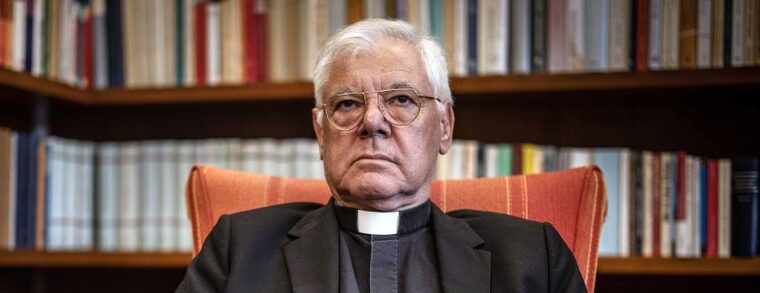
Gerhard Müller’s work on the Virgin Mary
In his work, which bears the German title Geboren von der Jungfrau Maria? Eine theologische Deutung (Born of the Virgin Mary? A theological interpretation), the author, professor of dogmatic theology at the University of Munich, confronts with theological intelligence the grave question of the birth of Jesus from Mary. Müller knows, and makes a point of reiterating it from the outset, that the subject examined touches intimately upon the dogma of Christ, true God and true man. True God: “Paul and John know, as the idea of preexistence shows, a mode of divine existence of Jesus as Son or Logos of God already before His being sent into the world and, therefore, ‘before’ His earthly mode of existing.” True man: as the man who came to us by the power of the Spirit and through the extraordinary generative act by which He assumes humanity from Mary, “not in the mode of sexual generation, but in the mode of redemptive creative assumption and, therefore, of the absolute metaphysical constitution of Jesus’ being-man without the mediation, as second cause, of a human generative act. The man Jesus therefore exists exclusively thanks to the revelatory presence of God in His Spirit, who is God Himself.”
The study, articulate and profound, seeks to offer an intellectually honest and current contribution to bringing out the dignity and the salvific relevance of the Natus ex Maria Virgine (Born of the Virgin Mary), softening the tones of a debate that has become heated and polemical.
Controversies over the virgin birth
It is well known that the contestation of the Christological truth has its roots in the beginnings of the faith. Already in Matthew’s Gospel narrative one can perceive apologetic traces that suggest a harsh polemic between the early Christian community and Jewish circles. A polemic later joined by the pagans (Celsus, Julian the Apostate…), and then by the heretics of Marcionite, Gnostic, Ebionite, and Adoptionist stamp. The controversy, thanks to the doctrine of the Fathers and of the first great Councils, subsided for quite some time, only to erupt again in the sixteenth century through the work of the Socinians, who decidedly rejected the virgin birth of Christ because they considered it contrary to reason: “With the nascent mechanistic conception of the world, Müller observes, the virgin birth of Jesus appeared more and more as an isolated miracle of nature, by which the omnipotence of God would have intervened arbitrarily in the workings of the world-machine.”
With the Enlightenment, then, the dogma of the virginal incarnation of Christ becomes an object of derision: it would be, so it is claimed, the expression of the Church’s deep-rooted scientific and historical ignorance. In this context, deeply adverse to the faith and to Christian thought, “scientific explanations” arise, that is, new interpretations of a psychological, mythological, hermeneutical, and historical-religious order, aimed at masking and rectifying the obsolete, supernaturalistic-dogmatic culture of Roman Catholicism. Thus Feuerbach denounces the inconsistency of scientific knowledge in Antiquity, which would have led the evangelists themselves to a mythological interpretation of the events concerning the origin, the person, and the ministry of the Nazarene. Years earlier, D. F. Strauss, under the influence of the rationalist critique of the “miracle” and of I. Kant’s moralistic interpretation of Christianity, had dismissed the virginal incarnation as “the most conspicuous deviation from all natural laws.”
Interpreting the biblical texts with the categories of depth psychology, the German theologian Drewermann sees in the Gospels the illustration of an archetypal model present in the collective unconscious of humanity, so that the birth narratives in Matthew and Luke would be quasi-mythical legends. Jesus, as man, it is claimed, was generated and born like any other man: what would be extraordinary is not His origin, but His life. It would be precisely in order to explain this that the evangelists would have made use of the “virgin birth,” taking it from ancient Near Eastern narratives about royal births. As a consequence, Mary’s perpetual virginity would be left without any real foundation: these would be mythical symbols of a “new birth” and of a “new generation,” linked to the Egyptian myth of the pharaoh, son of the sun.
The Mariological deepening
After presenting these and other modern and contemporary objections and alluding to the vast historical-critical, hermeneutical, and semantic problematic to which the current interpretation of the dogma must submit so that it loses nothing of its congruence and consistency of faith, Müller dwells on the more properly Mariological aspect: Mary’s spiritual and bodily virginity is the tangible and real sign that the God-man Jesus of Nazareth cannot be the mere result of the “potentialities of the creature.” The virginity of the Mother of the Lord, moreover, has a broad theological (Trinitarian and ecclesial), theologal (Marian typology of faith), and anthropological spectrum to be deepened and indicated.
The virginitas ante partum
The virginitas ante partum is treated by the German theologian taking into account the profession of faith, the recent theological problematization (the value of human sexuality, the nexus between the image of the world and the hermeneutics of faith), comparative religions, evangelical systematic theology, and the controversial and significant contribution of historical-critical exegesis. The resurrection of Christ as the originating event of faith and as the principle of development of the synoptic Christology of the Pneuma. The birth of Jesus from the Virgin as an element profoundly necessary for the profession of faith in Him. As to the question of the real and theological consistency of the virginal conception of the Son of God, Müller concludes synthetically: “The miracle of the conception of the man Jesus from the Virgin Mary is an implicit moment of the broader event and of the miracle of God’s presence in the man Jesus, whom the community recognizes as its messiah. It is, in any case, the miracle in which a human being, Mary, was in fact enabled to give God to the world.”
A biological verification of this absolutely new and unforeseeable event is not possible, nor should it be demanded. The incomparability of Mary’s conception cannot be called “unnatural.” On the contrary, it would be precisely against the nature of the natural act of generation, by which the creaturely subsistence that constitutes the person is essentially determined, if God were to bring forth from it a material substratum to which His own subsistence would “slide underneath.”
The virginitas in partu
The virginitas in partu proclaims the absence of suffering in childbirth and the prodigious reconstitution of Mary’s womb after the birth of the Son of God. This doctrine is commonly upheld by the patristic tradition and by the ordinary and extraordinary Magisterium of the Church, even though the various testimonies of ecclesial teaching must be evaluated, case by case, in a differentiated way as to their importance, their enunciative intention, and their ultimate binding character.
It is very difficult, Müller observes, to describe with completeness the bodily integrity of the Mother of God within the phenomenon of childbirth, because “singular physiological definitions cannot be the substance of the statement of faith, but only elements through which the reality of virginity in childbirth must be designated as a reality that can be grasped only in faith.” This doctrine, far from being the exclusive product of the ascetic ideal of virginity, is the mature fruit of the Christological development of the ancient Church concerning the integrity of the divine and human nature of the Logos in the question of the hypostatic union. In this doctrinal context, the statement of the virginal motherhood of the Panaghia arises, develops, is deepened, and is sanctioned. Mary “is not in this process a biological way station, but is herself characterized as a person by her personal relationship with the incarnate Logos. For this reason, the doctrine of the hypostatic union is bound to the affirmation of Mary as genitrix of God (Theotokos) and must also be expressed linguistically in the light of this reality. From this is delineated the central Mariological statement of Mary as Virgin Mother of God. Mary is not a physical instrument, but a personal one.”
The virginal childbirth of the Theotokos must not be denied or minimized in its formal contents, but must be read, interpreted, and received as a sign of the salvation-historical time inaugurated by the Son of God. “A reality of the new world of redemption that presents itself by virtue of Christ. ” The birth of the Messiah and Mary’s childbearing are a divine newness that affirms the admirable closeness of the event and of the divine Person in the spirit and in the flesh of the Virgin. They are not an arbitrary withdrawal of the Child and of the Mother from nature and from human solidarity. Mary’s freedom from pain and her remaining intact, despite the truth and the reality of the childbirth, possess a meaning that points back to the typological-patristic exegesis of Is 66:7-10, where there is narrated, in strongly figurative language, a sudden, sovereign, and prodigious irruption of eschatological salvation in Jerusalem: “Before she was in labor, she gave birth. Before her pains came upon her, she delivered a son. Who has ever heard of such a thing, who has seen things like these?…”.
If the event of eschatological salvation is read in reference to the antithetical Eve-Mary parallel, used by the Fathers to illustrate the virginitas in partu, one understands how it favored the Virgin’s “fiat” and made the effects of the divine punishment imposed on Eve in Gen 3:16 “fall away” in her. Indeed, “through her ‘yes’ to the message of the birth of the Redeemer’s humanity, Mary’s relationship with Jesus is new and determined in a different way also in childbirth. She already stands within the horizon of the new promise of salvation. If one speaks here of the miracle of the birth of Jesus, then this certainly can have nothing to do with miraculous phenomena. Moreover, Mary, even taking into account the later doctrine of her preservation from original sin in consideration of the merits of Christ, finds herself only within the context of an infralapsarian world. As for the biblically attested doctrine of Mary’s following of the cross, the discourse on Mary’s preservation from the pains of childbirth must likewise be interpreted in an eschatological perspective.” The patristic interpretation of Ezek 44:1-2 applied to Mary is likewise the expression of a realistic conception of the salvation of virginity in childbirth.
The faithful, in receiving the dogma of Mary’s true and virginal motherhood, sanctioned by the ecclesial Magisterium, must be well aware that “it is not the gynecological details, which in individual cases have been evaluated in differing ways, that determine the content of this dogma of faith. Rather, as to the content of the faith, Mary’s true motherhood must be expressed in such a way that her fundamental relationship with the Son of God who reveals Himself is not annulled, that is, wounded. Consequently, her childbirth, in the complexity of its personal, spiritual, and bodily aspects, is in itself entirely natural.” The German theologian, referring to Karl Rahner’s Mariological teaching, likes to underline and to deepen the theological interpretation of the virginitas in partu rather than to dwell on the glossary and on the physicalist problematic of the statement, so laden with salvation-historical, eschatological, anthropological, and symbolic meaning.
The virginitas post partum
In order to understand fully the content and the theological value of the virginitas post partum, the German theologian warns, it is necessary to take up again the earlier reflections on the “fundamental Mariological principle” (Mary is the virginal genitrix of the incarnate Logos) and to know and assess the various and opposing considerations of an exegetical, historical, and theological order regarding the “brothers and sisters of Jesus.” Of the spousal relationship between Mary and Joseph. Of the expression father and mother of Jesus (Lk 2:33, 48). Of the controversial formulation of Mt 1:25. Of the probative value of Jn 19:26… The Magisterium, in its process of deepening in the light of the Spirit and of the Word, after evaluating objections and adherences, held, with the rigorous logic of faith, that “Mary was not the Mother of the incarnate Logos in a dramatic condition of exception only then to lead a normal family life.” “Mary, as the virginal Theotokos, entered into a corresponding relationship with God, unique of its kind, so that it must be expressed in her marriage with Joseph in such a way that the personal designation of virgin and genitrix of God would not be limited or even annulled.”
This precision captures exactly the Christological humus of the Mariological statement, inviting the faithful to consider that, beyond the justifiable claims of a guarantee of historical certainty, Mary’s earthly existence was a total and permanent response of her person, spiritual and bodily, to the immeasurable gift of an uncommon, transcendent, virginal, and spousal motherhood. An undoubtedly unrepeatable charism that belongs to her alone, without in any way removing her from the Christian “common.”
Conclusion
The itinerary traced by Gerhard Ludwig Müller proves, in multiple respects, to be of unequivocal theological density and timeliness. In the first place, one is struck by the methodological sobriety with which the author faces a delicate and frequently polarized question, refusing both the rationalist reduction of the mystery and a merely reactive defense of the dogmatic datum. In rigorously reconstructing the ancient and modern controversies concerning the virgin birth, Müller does not limit himself to enumerating objections: he situates them, qualifies them, and measures them, without prejudice, in the light of historical-critical instruments, of contemporary hermeneutical questions, and of the broader horizon of systematic theology.
Within this framework, the decisive merit of the study consists in placing Mary’s virginity back within its original Christological humus. Virginity ante partum, in partu, and post partum is treated neither as a devotional appendix nor as a physiological problem to be resolved by empirical descriptions. It is interpreted as a real theological sign, intrinsically bound to the dogma of Christ, true God and true man, and consequently as ecclesial language that intends to safeguard the absolute gratuitousness of the divine initiative in the incarnation. Müller’s insistence on distinguishing the content of faith from details of a biological or imagistic order prevents the statement from being hijacked by physicalist readings, without, however, emptying it into a purely mythical symbol. Marian virginity thus remains a reality confessed in faith, whose theological intelligibility can be grasped within the salvific economy inaugurated by Christ.
From the Mariological point of view, the work shows with acuity that Mary cannot be understood as a “way station” in the history of salvation. The affirmation of Mary as Theotokos and Virgin Mother of God, inseparable from the development of the doctrine of the hypostatic union, confers on Mariology its properly Christological and ecclesial status. In such a perspective, Mary’s virginity, spiritual and bodily, manifests the singularity of her personal relationship with the incarnate Logos and at the same time illuminates the typology of faith and the vocation of the Church, called to receive the Word in obedience and in the fruitfulness of the Spirit.
Finally, in proposing guiding theses for a future Mariology, Müller suggests a path of deepening that does not depart from the dogmatic core, but makes it hermeneutically communicable without amputating its theological realism. The proximity to Karl Rahner’s intuitions, far from making the approach uniform, reinforces the intention of offering to believing thought an intellectually honest and pastorally relevant way, capable of answering, with serenity and consistency, the ever-recurring question about the meaning and the scope of the conception of Jesus by the work of the Holy Spirit and of His birth from the ever-Virgin Mary.
For the doctrinal framing of contemporary Mariology, chapter VIII of Lumen Gentium of the Second Vatican Council constitutes the fundamental conciliar reference on Mary in the life of the Church.
Deepen your studies: explore Mariology, Marian Theology, Marian apparitions, and the Postgraduate Program in Mariology.
Continue your Marian formation: explore our resources on Mariology, Marian Theology, and Marian apparitions. Discover the Postgraduate Program in Mariology of the Locus Mariologicus Institute.
To deepen systematic Marian Theology and Mary’s place in the faith of the Church, consult the Encyclical Redemptoris Mater of Pope John Paul II.
Postgraduate Program in Mariology
Would you like to deepen your formation in Mariology? Discover the Postgraduate Program in Mariology of Locus Mariologicus – an academic formation that unites theological rigor, spiritual life, and the living tradition of the Church.
Would you like to study Mariology seriously?
This article is born of the works in the Locus Mariologicus library. The Postgraduate Program in Mariology takes you to the same source, with academic guidance: Scripture, the Fathers of the Church, and the Magisterium, from the first dogma to contemporary questions.





Responses