Sanctifica eos in veritate: Mary and Being Consecrated in the Truth
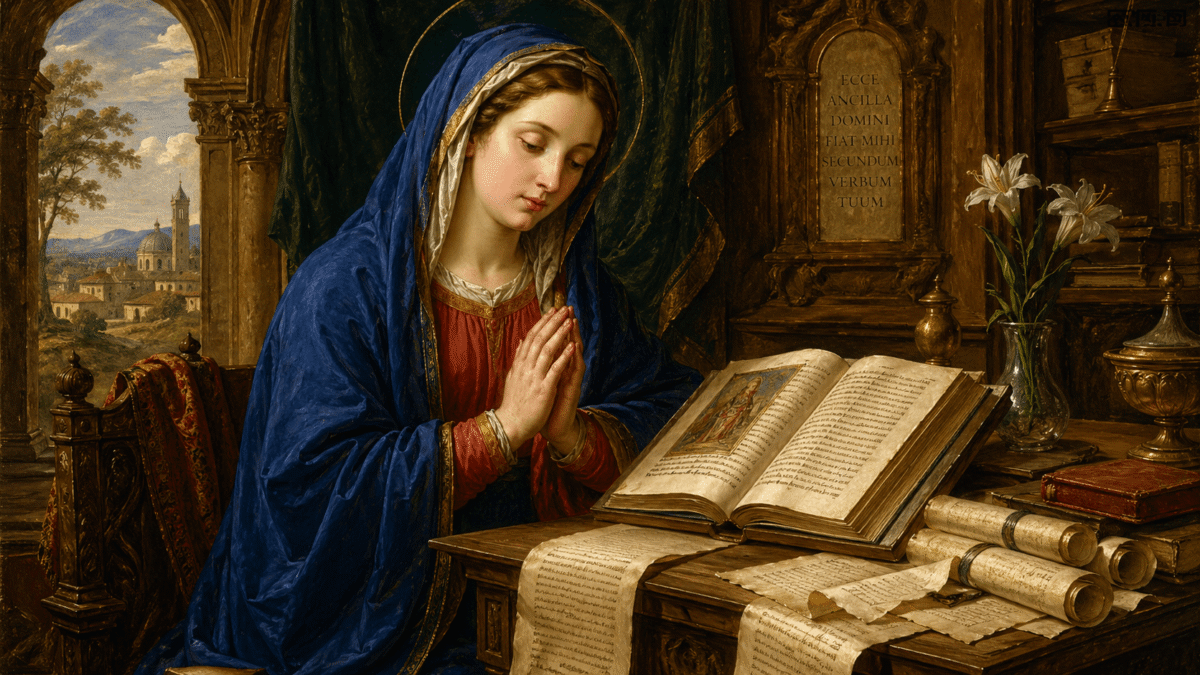
Sanctifica eos in veritate: sermo tuus veritas est.
Jn 17:17
“Sanctify them in the truth: your word is truth.” Jesus’ priestly prayer for those whom the Father gave him (Jn 17:6-19) includes this petition for sanctification: that the disciples be “consecrated” (hagiazein) in the truth that is the Word of the Father. This sanctification is not merely moral; it is ontological: a progressive configuration to the truth of God that transforms the nature of the believer. Mariology finds in this sanctification its deepest dogmatic foundation: Mary, sanctified in a unique and singular way by the grace of Christ, is the model of and the intercessor for the sanctification of all the disciples.
I. “Sanctify” in John: Consecration and Configuration
The verb hagiazein, “to sanctify,” “to consecrate,” has in John a primarily cultic dimension: “to consecrate” is to set apart for God, to reserve for sacred use, to order entirely to the divine service. In Jn 17:17, 19, Jesus asks that the disciples be “consecrated,” set apart from the world for the mission, and affirms that he himself “consecrates” himself so that they too may be “consecrated in the truth” (Jn 17:19). The priesthood of Christ is the foundation of the disciples’ sanctification: their “consecration” derives from the consecration of the Son.
Sanctification “in the truth” specifies the means: not a sanctification by merit or by ascetical effort, but a sanctification through participation in the Word of God, which is “truth.” The Word that sanctifies is not only Scripture as a text; it is Christ himself, who is “the Truth” (Jn 14:6) and whose Word, “kept” (Jn 17:6) by the disciples, progressively transforms them into his image. This sanctification is what theology has called “divinization” (theôsis): the progressive participation in the divine nature (2 Pet 1:4) that Christ communicates to his own.
The structure of sanctification has an ecclesial dimension that John emphasizes: Jesus does not sanctify the disciples individually but as a community; “sanctify them” is in the plural. Christian sanctification is always communal: it takes place in the sacraments (communal acts), in the liturgy (communal prayer), and in charity (mutual service). This ecclesial dimension of sanctification finds its most eloquent figure in Mary: she who was sanctified in a singular way is at the same time “Mother of the Church,” the heart of the community of the sanctified.
The connection between sanctification and mission in Jn 17:18 is deliberate: “as you sent me into the world, so I have sent them into the world.” Sanctification is not meant for “staying” with God, apart from the world; it is meant for “going” into the world with the mission that the Son received from the Father. Christian holiness is missionary: not separation from the world in the sense of an enclosure, but separation “for God” that equips one for the mission “to the world.” Mary, sanctified in a supreme way, is also the missionary par excellence, the one who presented the Son to the world and who continues to present him through her spiritual motherhood.
II. Mary, the Most Completely Sanctified
Dogmatic Mariology affirms that Mary was sanctified in a unique and singular way: the Immaculate Conception is the preservative sanctification by the one Mediator (LG 56). The fullness of grace at the Annunciation is the inaugural sanctification of the New Covenant. Her whole life is the progressive sanctification that culminates in the glory of the Assumption. No other human being has been sanctified so completely, so early, and so definitively.
This singular sanctification of Mary is not a gratuitous privilege; it is a theological necessity. The Son who becomes incarnate “in” Mary’s flesh cannot assume flesh stained by sin without this affecting the dignity of his humanity. The “flesh he assumed” (Jn 1:14) is Mary’s flesh. And the holiness of this flesh is a condition of the fitting dignity of the Incarnation. The Immaculate Conception is not a decoration of the mystery of the Incarnation; it is one of its conditions of fittingness.
The sanctification of Mary is, at the same time, the most perfect fulfillment of the promise of Jn 17:17. She was “sanctified in the Truth” to the highest degree: the Truth who is the Son dwelt in her, the Word of the Father who “is truth” took flesh in her, and the Spirit who “guides into all the truth” (Jn 16:13) dwelt in her in a singular way. The whole work of the Trinity in the sanctification of the disciples reached its paradigm and its summit in Mary.
The spiritual tradition, particularly the Carmelite school (Teresa of Ávila, John of the Cross, Thérèse of the Child Jesus), developed the contemplation of Mary as the model of the “interior mansions” of holiness: she who reached the “seventh mansion,” transforming union with God, more fully than any other human being, is the guide for the spiritual journey of every Christian. Her holiness is not a reality closed in on itself; it is an invitation and a model for the holiness of all.
III. “Your Word Is Truth”: Mary and Scripture
Jn 17:17: “your word is truth” (ho logos ho sos alêtheia estin). This identification of the Word of the Father with “truth” has a direct Mariological dimension: the “Logos” who is “the truth” of which John speaks is the same Logos who “came to dwell among us” (Jn 1:14) and whom Mary bore. The “Word that is truth,” in its written form (Scripture) and in its living form (Christ), has in Mary its model of “welcoming”: she who welcomed the living Word in her womb is the model of the soul that welcomes the written Word in its heart.
Mary’s relationship with Scripture is one of the most fruitful themes of contemporary Mariology. The Magnificat (Lk 1:46-55) is woven from allusions to the Scriptures of Israel: the Psalms, the song of Hannah (1 Sam 2:1-10), the prophecies of Isaiah, the promises to Abraham. Mary does not improvise; she quotes, alludes, evokes, and rereads in the light of what is happening within her. This “rereading” of Scripture in the light of living experience is the model of lectio divina: not reading the text as literature, but as an encounter with the living Truth that the text mediates.
The patristic tradition called Mary the “Ark of the New Covenant,” not only because she carried the Son as the Ark carried the tablets of the Law, but because she is the model of the human heart that “keeps” the Word with the reverence with which Israel kept the Ark. To keep the Word is not to lock it away in a chest; it is to let it “dwell” within, to let it work, to let it sanctify. This “indwelling of the Word” in the heart is the process of sanctification that Jn 17:17 describes, and Mary is its most perfect model.
The Second Vatican Council (DV 8) affirms that the understanding of the Scriptures “grows through the contemplation and study of believers.” This “contemplation” that makes understanding grow is exactly what Mary practiced: she “kept and pondered” (Lk 2:19, 51). The Church, which meditates on the Scriptures in the Divine Office, in lectio divina, and in preaching, repeats Mary’s gesture. And Mary, who “practiced” this gesture more perfectly than anyone, is the most qualified intercessor so that the Church may continue to be sanctified “in the Truth” that is the Word of the Father.
IV. “I Also Send Them into the World”: Missionary Holiness and Mary
Jn 17:18: “As you sent me into the world, so I have sent them into the world.” Sanctification demands mission: whoever is “sanctified” in the truth is “sent” into the world with the same mission as the Son. There is no authentic holiness that is not missionary, nor any authentic mission that does not spring from holiness. This unity of holiness and mission finds its most perfect expression in Mary: she who was sanctified in a singular way was also “sent” in a singular way, as the one who presented the Son to the world and who continues to “present him” through her spiritual motherhood.
In the Mariological tradition, the “mission of Mary” is described with diverse images: she is the “star of the sea” that guides sailors to port, the “aqueduct” that conveys the grace of the Son to his members, the “Mater Ecclesiae” who continually brings forth new members for the Body of Christ, the “Auxilium Christianorum” who intercedes in the tribulations of the mission. All these images express the conviction that Mary’s sanctification was not for Mary; it was for the world.
Missionary Mariology has a particularly eloquent historical expression: the great missions that brought the Gospel to new peoples were frequently accompanied by an intensification of Marian devotion. The evangelization of Latin America (16th century), with Guadalupe as its most powerful symbol, and the evangelization of Africa and Asia, with the apparitions of Our Lady of Kibeho in Rwanda and of Our Lady of Akita in Japan as contemporary signs, show how Mary’s missionary holiness continues to make the mission of the Church fruitful.
The conclusion of the priestly prayer in John is the inclusion of “all who will believe” in the sanctification Jesus asks for: “I do not pray for these only, but also for those who will believe in me through their word” (Jn 17:20). This universal inclusion points to the mission of each generation: sanctification “in the truth” is not for those who already believe; it is for those who do not yet believe and to whom the faithful are sent. Mary, as the figure of the universal mission, intercedes for this extension of sanctification to all who have not yet been reached by the Truth who is the Son.
Mary, sanctified in the Truth more fully than any other human being, is the model of the missionary holiness that Jn 17 describes: consecrated in order to be sent, sanctified in order to sanctify the world.
References
- Second Vatican Council, Lumen Gentium, number 56 (1964).
- John Paul II, Redemptoris Missio, number 92 (1990).
- St. Teresa of Ávila, The Interior Castle, Seventh Mansions.
- Second Vatican Council, Dei Verbum, number 8 (1965).
- R. Laurentin, Court Traité de Théologie Mariale (1953).
Postgraduate Program in Mariology
Would you like to deepen your formation in Mariology? Discover the Postgraduate Program in Mariology of Locus Mariologicus, an academic program that unites theological rigor, spiritual life, and the living tradition of the Church.
Would you like to study Mariology seriously?
This article grows out of the works in the Locus Mariologicus library. The Postgraduate Program in Mariology takes you to the same source, with academic guidance: Scripture, the Fathers of the Church, and the Magisterium, from the first dogma to contemporary questions.




Responses