“Stabat autem iuxta crucem”: Mary’s compassio, Hebrews 5 and the gift of the Son
By Prof. Dr. Daniel C. Afonso · Updated
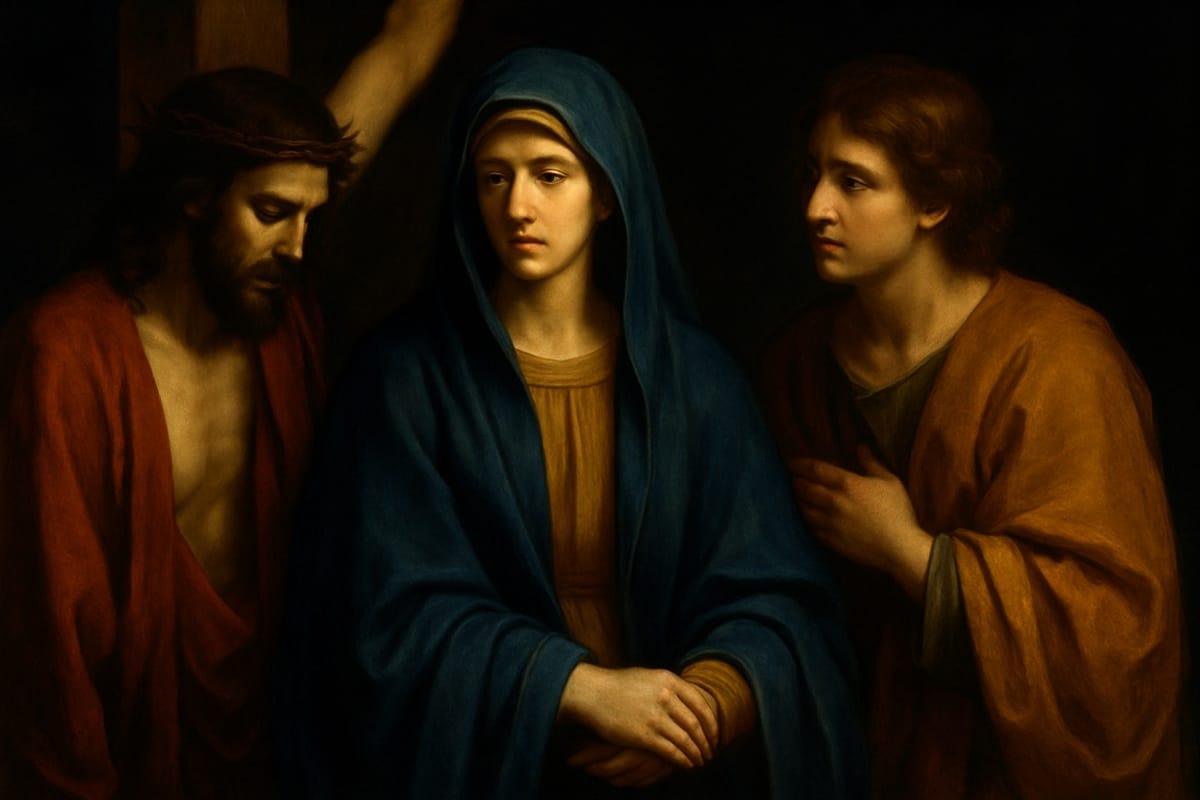
Stabat autem iuxta crucem Iesu mater eius.
Jn 19:25
The liturgical memorial of Our Lady of Sorrows is joined to Heb 5 and Jn 19 in a reflection on suffering as a path of perfection. In Heb 5, the Son learns obedience through what He suffered and becomes the cause of eternal salvation for all who obey Him. In Jn 19, Mary stands beside the Cross, receiving the beloved disciple as a son. Mary’s compassio is not separable from the obedience of the Son: both obey the Father in the hour of the greatest suffering, and that common obedience is the origin of Mary’s spiritual motherhood over all the disciples.
I. The first reading: Heb 5:7-9
Hebrews 5:7-9 presents one of the most surprising affirmations of the New Testament about the Son of God: “although He was a Son, He learned obedience through what He suffered” (v.8). This is not a matter of previous ignorance but of an existential learning: the obedience that the Son practiced in the Incarnation reached its full form in the hour of Gethsemane and of the Cross. “Crying out with a loud cry and with tears to the One who could save Him from death” (v.7): the Son who prays is the same one the disciples saw healing and teaching, now at the limit of human suffering.
“Having been made perfect, He became the cause of eternal salvation for all who obey Him” (v.9): the perfection of the Son is the consummation of obedience through suffering. Heb 5 does not glorify suffering in itself but suffering embraced in obedience, which leads to “consummation”. Mary, who heard Simeon say that “a sword will pierce your own soul” (Lk 2:35), walked the same path: obedience to the Father that leads to the greatest suffering as the way to the greatest participation in the work of salvation.
II. The Gospel: Jn 19:25-27
John 19:25-27 is the founding text of Mary’s spiritual motherhood: beside the Cross stand the mother of Jesus, His aunt, and Mary Magdalene. Jesus, on seeing His mother and the beloved disciple, says: “Woman, behold your son”, and to the disciple: “Behold your mother” (vv. 26-27). Jesus’ testament on the Cross institutes a new motherhood: Mary does not cease to be the mother of the Son, but her motherhood is extended to the beloved disciple and through him to all the disciples.
The title “Woman” that Jesus uses for Mary in Jn 19 takes up the same title of Jn 2:4: at Cana, where the mission begins, and on Calvary, where the mission is consummated, Jesus calls Mary “Woman”. The patristic tradition links this title to the “woman” of Gen 3:15: Mary as the new Eve who stands where the old one fell. The “stabat” of Jn 19:25 is the posture of the new humanity that receives the Cross as a gift and does not flee before the suffering of the Son.
III. The compassio: suffering as participation and perfection
The theology of Mary’s compassio affirms that Mary participated in the suffering of the Son in a way that exceeds the suffering of any other saint: not only out of maternal love but out of co-obedience to the Father. What Heb 5 says of the Son, the tradition applies to Mary: she too learned obedience through what she suffered. Simeon’s sword that “pierced her soul” is not only a metaphor for pain: it is the description of a real participation in the work of redemption that Heb 5:9 describes as “the cause of eternal salvation”.
Our Lady of Sorrows is not celebrated as a victim of fate but as a cooperator in the redemption who embraced suffering in obedience. The seven Sorrows of Mary describe an itinerary of learning obedience that Heb 5 identifies as the way of “consummation”. Mary’s sorrow is the sorrow of one who said “Fiat” and kept the “Fiat” to the end, even when the “Fiat” meant the Cross of the Son.
IV. Mary Mater dolorosa: the sword that reveals hearts
Simeon said to Mary: “this child is destined to be a sign of contradiction, and as for you, a sword will pierce your own soul, so that the thoughts of many hearts may be revealed” (Lk 2:34-35). Mary’s sword is not only suffering: it is revelation. The Cross of the Son, which the Mother received standing, reveals what is in the hearts of those who contemplate it: faith or unbelief, love or indifference, acceptance or rejection.
Our Lady of Sorrows is celebrated on the day after the Exaltation of the Holy Cross because the mother who stood beside the Cross is inseparable from the Cross that the Church exalts. To contemplate the Cross without contemplating Mary, who received it standing, is to lose the human dimension of the mystery. To contemplate Mary without the Cross is to lose the redemptive dimension of her presence. The memorial of Our Lady of Sorrows invites us to unite the two gazes: the exalted Cross and the Mother who, standing, contemplated it with the eyes of faith.
Postgraduate Program in Mariology
Would you like to deepen your formation in Mariology? Discover the Postgraduate Program in Mariology of Locus Mariologicus – an academic formation that unites theological rigor, spiritual life, and the living tradition of the Church.
Responses