Kecharitôménē, “Full of grace”: the Greek title of Mary in Lk 1:28
Kecharitôménē, the unique title of Mary at the Annunciation
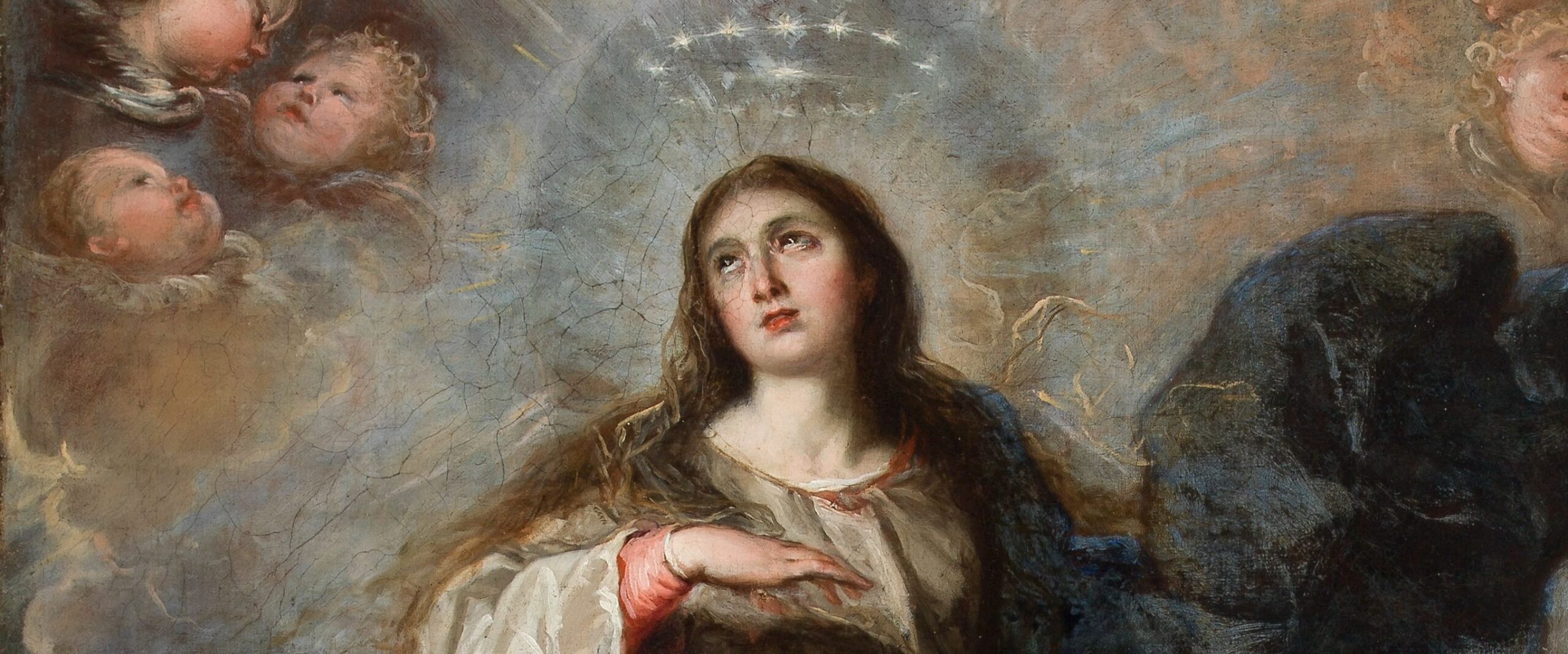
When the archangel Gabriel enters Mary’s house in Nazareth, he does not greet her by her name but by a unique title: Kecharitôménē (κεχαριτωμένη), usually translated as “full of grace” (Lk 1:28). This term, which appears only once in the whole of Scripture in this full sense, is the indispensable starting point of any serious Mariological study. Its Greek morphology is precise and revealing: it is a perfect passive participle of the verb charitóô (χαριτόω), “to bestow grace,” in the passive voice. Mary did not earn this grace, but received it from God.
The Greek perfect expresses a past action whose effects remain in the present. Kecharitôménē therefore means “she who has been fully and permanently transfigured by grace.” The state of grace in Mary is not contingent or episodic: it is a stable condition, prior to the moment of the Annunciation. This grammatical datum is of enormous theological importance: it suggests that the grace that fills Mary was granted to her before the instant in which Gabriel speaks, that is, from her conception.
Kecharitôménē and the Immaculate Conception
The link between Kecharitôménē and the dogma of the Immaculate Conception (Pius IX, Ineffabilis Deus, 1854) is the most debated point in biblical Mariology. The Magisterium does not affirm that the Greek perfect by itself proves the dogma, but that the biblical text is consistent with it and points toward it. The dogma is defined on the basis of the whole of Scripture, of Tradition, and of the sensus fidei of the Church. Modern exegesis, notably the work of Ignace de la Potterie (Marie dans le mystère de l’Alliance, 1988), has shown that the passive perfect Kecharitôménē implies a prior ontological transformation, not merely a favorable moral disposition.
There is a second New Testament text in which the verb charitóô appears: Eph 1:6, “in the Beloved, in whom He bestowed grace upon us” (echaritôsen hēmas en tô ēgapēmenô). In this context, grace is bestowed on all the baptized in Christ. The difference between Eph 1:6 (aorist) and Lk 1:28 (perfect) is significant: the aorist of Eph 1:6 expresses a punctual act (baptism). The perfect of Lk 1:28 expresses a permanent and prior state. Mary is therefore the recipient of a grace qualitatively distinct from ordinary baptismal grace.
Kecharitôménē in the patristic and liturgical tradition
The Greek Fathers of the Church commented on Kecharitôménē with an awareness of its singularity. John Damascene (Homilia I in Dormitionem) saw in this title the expression of a total and original holiness. The Eastern liturgical tradition, which never ceased to celebrate the Conception of Mary as a feast of purity and grace, finds in Kecharitôménē the scriptural foundation of universal Marian devotion. The current Roman liturgy, on December 8, uses Lk 1:28 as the Alleluia verse, inscribing Kecharitôménē at the heart of the dogmatic celebration.
Deepen your studies: explore the Immaculate Conception, the Archangel Gabriel, Mary in the Bible, Mariology, the Postgraduate Program in Mariology and grace in Greek.
Postgraduate Program in Mariology
Would you like to deepen your formation in Mariology? Discover the Postgraduate Program in Mariology of Locus Mariologicus, an academic formation that unites theological rigor, spiritual life, and the living tradition of the Church.
Learn what the Church teaches about Mary, Mediatrix of All Graces.
Would you like to study Mariology seriously?
This article is born of the works in the library of Locus Mariologicus. The Postgraduate Program in Mariology takes you to the same source, with academic guidance: Scripture, the Fathers of the Church, and the Magisterium, from the first dogma to contemporary questions.




Responses