Voca levi: Matthew, Mary, and the Mercy That Calls
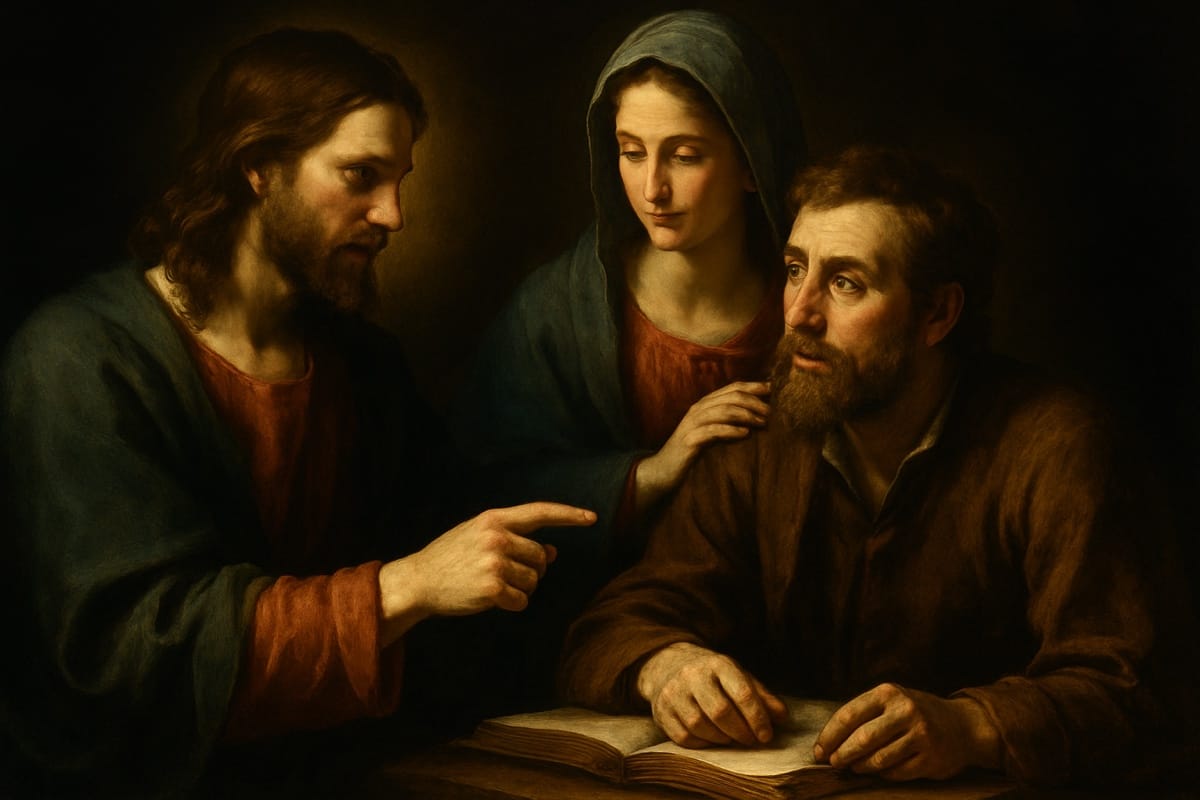
Et dicebat eis: Non est opus valentibus medicus sed male habentibus. Euntes autem discite quid est: Misericordiam volo et non sacrificium. Non enim veni vocare iustos sed peccatores.
Mt 9:12-13
The calling of Matthew (Mt 9:9-13) is one of the most theologically dense scenes in the Synoptic Gospels. A tax collector—a socially dishonored figure, ritually impure through contact with Gentiles and with tainted money, a collaborator with the Roman occupation—is called to Jesus’ table and then welcomed into the house together with his fellow tax collectors and other “sinners.” The reaction of the Pharisees, “why does your Teacher eat with tax collectors and sinners?”, is the reaction of the logic of purity when faced with the logic of mercy. Jesus’ answer, “I came not to call the righteous, but sinners,” is one of the most radical self-declarations in the Gospel about the nature of His mission.
The text of Hosea quoted by Jesus, “I desire mercy, and not sacrifice” (Hos 6:6), appears twice in Matthew (9:13 and 12:7) and is central to Matthean theology: the concrete mercy shown in relationship with those who suffer is superior to a ritual of purity that is closed in on itself. This principle, hesed (“loyal love,” “mercy”) over zebah (“ritual sacrifice”), is a constant of Israel’s prophetic tradition, which repeatedly placed the ethics of relationship above worship without conversion (cf. Am 5:21-24; Is 1:11-17; Jer 7:22-23; Mic 6:6-8). Jesus places Himself within this tradition and radicalizes it: mercy is not merely preferable to sacrifice when sacrifice is hypocritical; it is the form of sacrifice that God desires.
I. The Calling of Matthew: The Call to the Sinner
The brevity of the account of Matthew’s calling—“Jesus saw a man called Matthew sitting at the tax booth, and said to him: Follow me. And he rose and followed Him” (Mt 9:9)—conceals a radical break. Matthew left behind not only a job but an entire social identity: that of the tax collector who was at once wealthy (relative to the average level of the population of Galilee), dishonored (excluded from the synagogue and from many social relationships), and integrated into a system of power (the administration of Rome and of Herod Antipas). The “he rose and followed Him” is a metanoia, a conversion, which only the personal authority of Jesus can explain.
What follows immediately, the banquet in Matthew’s house with “many tax collectors and sinners,” reveals the logic of conversion in the Gospel of Matthew: grace received overflows at once into sharing. Matthew did not convert and then withdraw from his former world in an ascetic way: he invited Jesus into his world; he made Jesus the center of his old social circle. This logic—“the grace I have received I must share with those who were my own”—is the logic of mission that Matthew himself narrated in Mt 10 (the missionary discourse) and that Barnabas lived out (cf. Art64). Conversion is not flight from the world but the transformation of the world from within.
The fact that it is Matthew the evangelist who narrates his own calling with such brevity—without psychological drama, without describing his interior state, without justification—is in itself theologically significant. In writing his Gospel, Matthew did not put himself in the spotlight: he put Jesus there. His conversion is described in two verbs, “he rose and followed,” which is exactly what matters. Not the psychology of conversion, not an elaboration of the interior change, but the fact of the decision and of the following. This narrative sobriety is itself a fruit of conversion: the humility of one who knows that he is not the center of the story.
Comparing Matthew’s calling with the calling of the first disciples (Mt 4:18-22) reveals a constant: in every case, the call is direct, the response is immediate, and the text describes no deliberation. Not that following Jesus had no cost. The fishermen left their nets and their father. Matthew left economic security and social identity, but the encounter with Jesus created an attraction that made the decision immediate. This immediacy is not irrationality: it is the recognition of an authority that speaks to the depths of the person and makes hesitation secondary.
II. “I desire mercy, not sacrifice” (Hos 6:6)
The quotation of Hos 6:6 that Jesus uses in reply to the Pharisees is a rereading of the prophetic tradition with far-reaching implications for the Christian theology of liturgy and worship. The eighth-century prophets, Amos, Hosea, Isaiah, and Micah, systematically criticized a worship that had become a substitute for moral conversion: the multiplication of sacrifices, feasts, and oblations was, in their view, a way of “buying” divine favor without transforming the structures of injustice that God hated. The prophetic critique did not abolish worship but subordinated it to hesed, to the loyal love that shows itself in justice, in mercy, in care for the poor.
Jesus radicalizes this tradition by applying it to the concrete case of His table fellowship with sinners. The “sacrifice” that the Pharisees prefer is ritual separation from the impure, the observance of the purity laws that guarantee the holiness of the community. The “mercy” that Jesus prefers is the open table with those whom purity had excluded, the contact that ritually defiles but is the sign of a love that knows no boundaries. This preference is not religious lawlessness: it is the consistent application of the prophetic principle that the Pharisees themselves knew but had not applied to this case.
Christian Eucharistic theology inherits this tension and tries to resolve it: the Eucharist is at once “sacrifice” (an offering that re-presents the one sacrifice of Christ on the Cross) and “mercy” (an open table that includes sinners in the communion of the Body of Christ). The question of who may approach the Eucharistic table, which runs through the history of the Church from Corinth (1 Cor 11:27-29) to today’s discussions about Communion and irregular situations, is precisely the tension between “sacrifice” (the holiness of the table, which must not be profaned) and “mercy” (the table that Christ opened to sinners). The principle of Hos 6:6, quoted by Jesus, is an abiding criterion for this discernment.
Hosea’s mercy, hesed, is rooted in the conjugal love that the prophet himself lived out tragically: God loved Israel as Hosea loved Gomer, his unfaithful wife, whom he went on loving even in her infidelity. This love that does not give up, that keeps on loving despite infidelity, is the model of divine mercy. Mary, “Mother of Mercy,” is the feminine embodiment of this love that does not give up: the mother who remains at the foot of the Cross of her condemned Son, who does not abandon Him when human logic would have justified flight, is the icon of the hesed that Hosea and Jesus described.
III. Mary and the Logic of Preferential Mercy
The “preferential option for the poor,” a formulation that Latin American theology of the 1970s and 1980s placed at the center of ecclesial reflection and that John Paul II and Benedict XVI integrated into the social Magisterium of the Church, has its most explicit biblical root in the Magnificat. “He has filled the hungry with good things, and the rich he has sent away empty-handed” (Lk 1:53): according to Mary, God’s preference for the poor is not a contingent political option but a constant of His action in history. The Magnificat is Mary’s interpretation of the Incarnation. The Son of God was born not in Herod’s palace but in a manger, was visited by the shepherds before the Magi, and fled to Egypt as a refugee.
In the devotional tradition, Mary’s mercy is specifically preferential toward those whom religious “logic” would exclude. The Salve Regina is the prayer of the “poor children of Eve” who are “mourning and weeping,” not of the satisfied rich. The Litany of Loreto invokes Mary as “Refuge of Sinners” and “Help of Christians,” not as the reward of the virtuous. Popular devotion to Mary, stronger on the social and geographical peripheries than among the elites, intuitively reflects this preference: Mary is with those whom society pushes to the margins, just as Jesus sat at table with the tax collectors.
The connection between Marian mercy and the calling of Matthew is a connection of logic: the same mercy that Jesus showed in calling Matthew is the mercy that Mary represents in popular devotion. Jesus “calls” tax collectors because He “came not to call the righteous, but sinners.” Mary intercedes for sinners because she is “our advocate”: not an arbiter who judges, but a defender who presents to the Son the cases of those who do not deserve a defense on their own. In both cases, the logic of mercy is the logic of a love that goes beyond merit.
The shrine of Fatima, where Mary’s message was given to three children from an outlying village in Portugal in a time of war and crisis, is an example of this preference: Mary does not appear in the centers of political or ecclesiastical power, but on the periphery. This constant of Marian phenomena (Guadalupe to the indigenous people of Mexico, Lourdes to a poor adolescent girl from an illiterate family, Fatima to shepherd children) is not accidental: it reflects the logic of the Magnificat and of the call to Matthew. God manifests His mercy by preferring those whom the world despises.
IV. The Open Table: The Eucharist and the Communion of Sinners
Matthew’s banquet, at which Jesus eats with “many tax collectors and sinners,” is a Eucharistic prototype: a banquet presided over by Jesus, open to the excluded, which scandalizes the “pure.” The patristic interpretation of this scene, especially in John Chrysostom and Ambrose of Milan, saw in Matthew’s banquet a prefiguration of the Eucharist: the table of the Lord which, at its institution, was presided over by one who knew there were traitors among His guests and did not exclude them.
The question of Eucharistic communion for sinners, for those in “irregular situations,” for those who have sinned gravely, for those who have drifted away, is one of the most sensitive in the Church’s pastoral ministry today. The principle of Hos 6:6 (“I desire mercy, not sacrifice”) and the scene of Mt 9 (“I came not to call the righteous, but sinners”) offer a theological orientation that does not automatically resolve every concrete pastoral case but does set a clear direction: the Eucharistic table of Jesus is primarily a remedy for sinners, not a reward for the righteous.
Mariology contributes to this reflection with the image of Mary in the Upper Room (Acts 1:14): Mary was with the disciples in the prayer that preceded Pentecost, and those disciples included Peter (who had denied Jesus), those who had fled from Gethsemane, and those who had doubted the Resurrection. Mary’s presence in the Upper Room with those who had failed is a sign that mercy does not wait for perfection before admitting people to communion: it sustains the community of the imperfect who await the gift of the Spirit. This image of the Upper Room (Mary, Mother of Mercy, in the midst of the flawed disciples) is the model of the Church that Jesus founded at Matthew’s table.
“I came not to call the righteous, but sinners.” This saying of Jesus is at once the most consoling and the most demanding in the Gospel. Consoling, because no tax collector, no sinner, no person with a difficult past is beyond the call of Jesus. Demanding, because whoever identifies with the “righteous,” whoever believes he has no need of mercy, whoever is sure of his own uprightness, places himself beyond the reach of the call. The only position in which the call of Jesus can be heard is Matthew’s position before the encounter: seated at his post, aware of what he was, not yet transformed but ready to “rise and follow.”
Postgraduate Program in Mariology
Would you like to deepen your formation in Mariology? Discover the Postgraduate Program in Mariology of Locus Mariologicus, an academic formation that unites theological rigor, spiritual life, and the living tradition of the Church.
Would you like to study Mariology seriously?
This article grows out of the works in the Locus Mariologicus library. The Postgraduate Program in Mariology takes you to the same source, with academic guidance: Scripture, the Fathers of the Church, and the Magisterium, from the first dogma to contemporary questions.




Responses