The blessed one in Christ, fierce enemy of the ancient adversary

Introduction
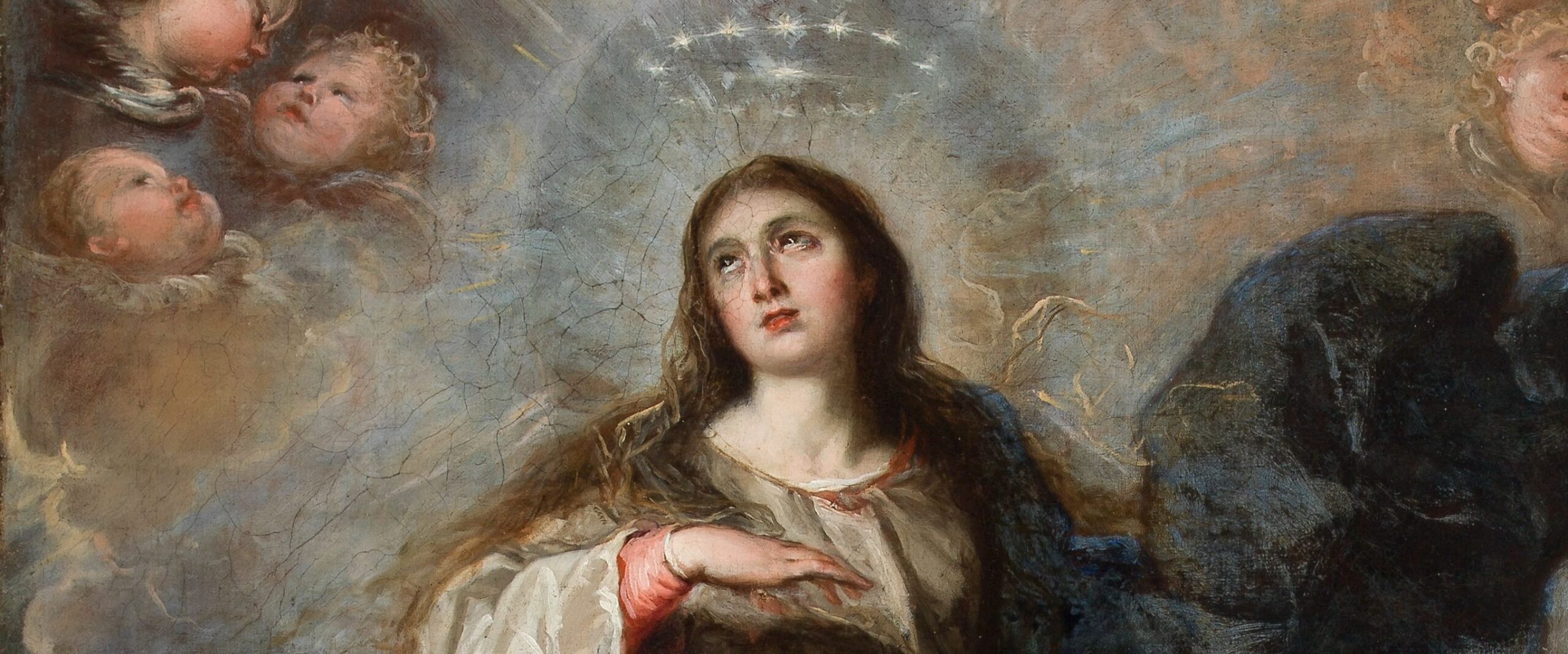
Just as the provident design of the Trinity chose and predestined Mary of Nazareth in Christ, it also chose and predestined men and women to be, if they so desire, sons and daughters of Forgiveness, that is, children of the Light and children of the Day that will know no setting: the blessed day of the resurrection of the dead. This election/gift of the Father will be, if we welcome it in faith and make it bear fruit in our witness, stronger than any seduction/experience of evil and of sin, as the story of Mary of Nazareth, the first ally of God against Satan and evil, splendidly shows.
Invoking the All Holy One, sharing in her acceptance of the gift of the Spirit of the Father and of the Son through daily adherence to the demands and values of the Kingdom, the disciple, man and woman alike, knows that such a following of the Holy and Blessed One of God involves a hard battle that “is not against creatures made of flesh and blood, but against the Principalities and the Powers, against the rulers of this world of darkness, against the spirits of evil” (Eph 6:12). Like Mary, blessed because she believed (cf. Lk 1:45), the disciples of Christ, men and women, must resist the seductive Adversary, remaining firm in the faith (cf. 1 Pet 5:8-9).
After Vatican II…
The presence and the action of the Mother of the Redeemer in Christ’s struggle against Satan, especially after the Second Vatican Council, have not usually been addressed by theologians and are not present in contemporary texts of theology and Mariology, except in a few rare and quite recent cases. In this regard, Stefano De Fiores wrote in his book Mary and the Mystery of Evil, published posthumously in 2013: “Whoever considers the Bible sees that ‘for Israel, for a long time, there were only two causes of evil: man and God.’ Then it is understood that, while man cannot escape his responsibility, having a ‘heart always inclined to evil’ (Gen 6:5), God cannot in any way be an accomplice of evil. Thus, ‘since it became unthinkable that God could cause evil, responsibility for it was assigned to Satan, who was conceived as one of the powers hostile to man.’ And Satan, which means ‘to be hostile, enemy, adversary,’ was seen as the author of every illness and of every evil. Despite his wide maleficent action, the total space, though granted, of the New Testament does not reserve for Satan a place of great prominence: he does not appear at all in the central and constitutive proclamation of the faith, which turns upon Christ dead, risen, ascended to the Father and giver of the Spirit of holiness and truth. Nevertheless, the struggle against Satan is inevitable and always current, for the inauguration of the Kingdom of God implies the destruction of the kingdom of Evil, that is, of the ‘dystopian, that is, perverse, structures’ inspired and organized by the Evil One”.
In the struggle waged against evil and the Evil One by Christ and by his Church, the particular contribution of the Mother of the Redeemer is present, as the patristic, liturgical and magisterial tradition bears witness, including the recent one. Indeed, the Church, in her doctrine, in her liturgical life and in her pastoral ministry, has always regarded and invoked the Mother of Jesus as a sure protection against Evil! The Second Vatican Council itself, in the dogmatic constitution Lumen Gentium, drew attention to the relationship between the Holy Virgin and Satan in Lumen Gentium 55 and 63, both times in relation to the serpent of the Scriptures and to the divine promise (cf. Gen 3:15).
The contribution of Saint John Paul II
From the very beginning of the encyclical Redemptoris Mater (=RM), of March 25, 1987, in addressing the question of the agonic character of the Mother of the Redeemer, that is, of a tenacious adversary and strong combatant against Evil, against every curse, Saint John Paul II (1978-2005) places the Virgin within the context of the history of salvation, highlighting her close bond with the Son-Lord (for “only in the mystery of Christ is her mystery fully clarified”: RM 4) and with the Church on her journey, indissolubly united to her Lord, underlining her blessed presence and action within history itself. “Space” where the struggle between the Woman and the serpent still continues, “a struggle that accompanies the history of humanity on earth and the very history of salvation” (RM 11), for the central core of the history of salvation is constituted by the freedom of man, who can choose or reject Christ, welcoming or rejecting the influx of the Spirit and the generous mercy of the Father, thus remaining a prisoner and a servant of the curse.
From the incarnation of the Son of God until his definitive coming at the Parousia, John Paul II teaches in the Marian encyclical, “the victory of the woman’s Son will not take place without a hard struggle, which must run through the whole of human history. The ‘enmity,’ announced at the beginning, is confirmed in the Book of Revelation, the book of the last realities of the Church and of the world, where the sign of the ‘woman’ reappears, this time ‘clothed with the sun’ (Rev 12:1) […]. Mary thus remains before God, and also before the whole of humanity, as the unchangeable and inviolable sign of God’s election, of which the Pauline letter speaks: ‘In Christ he chose us before the creation of the world […], predestining us to be his adopted sons’ (Eph 1:4). This election is more powerful than any experience of evil and of sin, than all that ‘enmity’ which marks the history of humanity. In this history, Mary remains a sign of sure hope (RM 11)”.
The Mariological reading of the Servants of Mary
This is how the third Marian document of the Servants describes that dramatic but necessary struggle, connecting the texts of Genesis 3 and Revelation 12: “In the apocalyptic account, fragility, birth and the earth are opposed to the dragon. These are intentionally linked to the woman clothed with the sun, to her experience and to her history. Fragility is graphically and dramatically represented by the woman who, though clothed with the sun, is in the midst of the pains of childbirth. Human life is threatened and enveloped by the enigma of suffering and of pain from its very beginning (cf. Rev 12:2, 4). Nevertheless, this fragility is, according to the sacred writer, in heaven (cf. Rev 12:1). We, on the other hand, would have placed it on the earth, because, by definition, heaven is the opposite of fragility. Heaven is the place of omnipotence and of transcendence, it is the place of security, it is the place immune to suffering and to pain. We seek that heaven. And, perhaps, we seek it because it is the heaven imagined by the serpent (cf. Gen 3:4-5). We seek it because we are attracted by its words (cf. Gen 3:6). In that heaven, there is no room for the one who is fragile. In that heaven, there is no place for the human couple and their fruits. In that heaven, there is no room for fatherhood, motherhood and filiation. The serpent wants, in fact, to devour, to eliminate all of this. Nevertheless, it is not the dragon who dwells in heaven. He is not the lord. He cannot lead anyone there. Heaven belongs to God. He is the Lord. In God’s heaven, in the kingdom of heaven proclaimed and accomplished by the Son, the Word made flesh, fragility is familiar: it is even the origin and the destiny. The Church proclaims this evangelical witness by pointing to the person of the Assumed One in glory as a word of consolation and of sure hope. Mary enters heaven because she lived without the poisonous word of the serpent ever ensnaring her creaturely fragility. The event of birth is also opposed to the dragon. It is true, birth announces a mystery of death: we are born precisely because those who begot us are not and were not immortal. If someone is born, it is because he will die. By trying to devour the child at the moment of his birth (cf. Rev 12:4), the serpent therefore wants to prove that we are essentially ‘beings for death.’ For him, death is the key and the truth of every human existence. This being so, human speech cannot but admit that fatherhood, motherhood and filiation are merely structures of curse through which it is not life that is propagated, but death. The wise man must say: ‘Perish the day on which I was born and the night in which it was said: “a boy has been conceived”’ (Job 3:2. Cf. Jer 20:15-18). But in God’s heaven, it happens otherwise. The one who is born, fragile and defenseless, is immediately taken up to God and to his throne (cf. Rev 12:5). God guarantees that birth, fatherhood, motherhood and filiation are stronger than death. Thanks to this revelation (cf. Rev 11:19; 12:1), the wise man can then say: ‘I know that you can do all things and that no plan of yours can be thwarted […]. Before, I knew you only by hearsay, but now my eyes see you’ (Job 42:2-5. Cf. Lk 1:37-38). Only if this is life is the other a brother and a sister, not hell. Only if this is life can conflict and diversity find paths of reconciliation, respect and welcome. Only if this is life does birth become promise, and the mystery of pain, of suffering and of death itself does not prevent us from becoming men and women of hope who struggle against every form of social, cultural and religious fear. Finally, it is necessary to perceive that the earth itself is opposed to the dragon (cf. Rev 12:15-16). The earth is a refuge for the woman clothed with the sun (cf. Rev 12:13-14). The earth swallows the river that the dragon spews out against her. The serpent is not lord of the earth either. The earth belongs to God (cf. Rev 4:11; 5:13; 11:17-18; 14:7. Gen 1:1; 2:4-14). We are not apostles of a dualistic vision that opposes body and soul, the material and the spiritual, the immanent and the transcendent, the finite and the infinite, earth and heaven, evil and good. We are not bearers of a syncretistic wisdom, shaped by the dictates of the New Age. We are not prophets of a universal religion, capable of going beyond the faithful identities of each spiritual tradition. We are not guardians of a civil, horizontal religion, in which love of neighbor becomes ideology. Nor are we heralds of experiences that fall within that vast field which scholars call ‘religions of the mother.’ We are, on the contrary, those who place themselves at the service of the vital potentialities given by God to the earth (cf. Lk 12:54-57 and parallels). Nevertheless, we must not fall into the ‘farmer complex’ and think that the earth bears fruit only if it is cultivated. It is not by chance that Jesus tells the parable of the earth that produces fruit spontaneously (cf. Mk 4:26-29. Jn 4:31-38). Parables are not simplistic stories for ignorant listeners. On the contrary, they are sharpened stones: they are the Word that becomes a sword to ‘pluck up and break down, to destroy and to overthrow, to build and to plant’ (Jer 1:10) the evangelical good news that the earth does not take on and need not necessarily take on the face of the farmer who is cultivating it. The face that the earth must have is the one that God gives it, because He desires to grant it in His loving freedom. Simply because it is His”.
Benedict XVI and the ritual of exorcism
In this respect, it is not by chance that, in his teaching, Benedict XVI takes up biblical apocalyptic in a subtle and critical way in order to frame the current conflict between Christian humanism and atheistic humanism (in the sense of Henri de Lubac’s theological thought). In discerning the terms of the conflict, he recovers the apocalyptic theme of the People of God, showing how it is involved in a struggle against antagonistic forces. Within this apocalyptic scenario, atheistic humanism appears as an example of what the eschatological false prophet is: the lie of one who presents himself under the mantle of truth and, for precisely this reason, ends up leading the People of God astray, destroying it. Following the line of the book of Revelation, Pope Ratzinger sees in prophetic witness, which has the Christic form of charity in truth, the appropriate response to this conflict.
In the renewed liturgical rite of exorcism, which contributes to manifesting the Church as a community of blessing, in the invocative formula pronounced by the priest, the almighty and merciful God is asked to hear “the prayer of the Blessed Virgin Mary: the Son Jesus, dying on the cross, crushed the head of the ancient serpent and entrusted to the Mother all men as her children”. Thus the rite also makes its own the witness of Scripture concerning this struggle between the Blessed One and the Cursed One, to which she who is “full of grace” and “blessed among women” is associated as mater viventium. This universal motherhood the Mother of heaven does not renounce exercising, out of love for the Son’s disciples, men and women, who are under the terrible dominion of the Devil, who, as the exorcists themselves admit, considers her his fierce and implacable enemy for the simple fact of existing as a creature, as a woman, as a person, as one perfectly redeemed by grace and by faith, in a structural, stable and dynamic relationship, blessed and blessing, with all those who are called to be part of the communio sanctorum!
Conclusion
To the enmity of Satan, Mary also responds with enmity against him and his works. Nevertheless, the meaning and the terms of this “enmity” must be well explained, for the word, in its everyday and non-everyday use, contains elements that can suggest hatred and violence: never, however, were these cursed dimensions of life adopted by the Blessed One among women. We can be helped by the already mentioned Marian document of the Servants, when it writes: “Only Christ, in fact, saves us from becoming like the wicked man and the idolater portrayed in the psalmic prayer: ferocious animals that feed on human flesh, devouring to the right and to the left those who cannot, do not know how and do not want to become like them (cf. Ps 10[9]:8-10; 17[16]:12; 22[21]:14; 35[34]:17; 57[56]:5). They spread terror around them (cf. Jer 20:10) and destroy creation (cf. Jer 12:10-14; 14:2-6). Mary is the mother of those who fight such a cruel animal ferocity. She is the mother of her Servants, men and women, who have chosen to live this struggle as the rule of their Christiform and Christifying life (cf. 2 Macc 7:1-41). She is the mother of all those who, even while suffering in their flesh the violence of the prince of this world, do not submit to his rules and logics. She is the mother of those whom the world considers ‘dead’ and as such treats, hides and erases, but who, in reality, in Christ, with Him and through Him, are the truly living, because they have ‘returned from the dead’ (Rom 6:13. Cf. Rev 6:9-11)”.
Understood in this way, the enmity of the Mother of the Lord against Satan must be integrated into her peregrinatio fidei as a woman and a believer, justified, in a sublime and perfect manner, precisely by her faith. And it must be inserted into the gift of spiritual motherhood conferred on her by Providence. In this regard, a well-known theologian and exorcist writes: “In the struggle against Satan, we reserve a wholly special place for Marian prayer. The mystery of the Annunciation reveals to us how the Mother of the Redeemer was able to repair the sin of Eve, becoming an instrument of salvation for all humanity. Obeying the will of God, Mary restores paradise to us. In the struggle against the ancient dragon, the Mother of God is more powerful than an army in battle. ‘Who is this that arises like the dawn, beautiful as the moon, bright as the sun, awe-inspiring as an army with banners unfurled?’ (Song 6:10). Many saints teach us that the prayer of the Rosary is a powerful weapon against the devil”.
How are we to understand the affirmation about the power that Marian prayer possesses? In this regard, the document of the Servants states: “The account of Genesis, beyond any reductionist reading indebted to an undue patriarchal tradition, introduces the woman as the one who ‘preserves’ Adam in his human specificity, preventing it from being confused with animality (cf. Gen 2:18-25). Mary, a woman who came from the ranks of the poor of the Lord and of the holy women of Israel, is the Mater viventium (cf. Gen 3:20), because she is the intact Hodegetria who leads to the One in whom shines forth the fullness of the humanity created in the image and likeness of God, the true bridegroom of the Church (cf. Eph 5:29-32) […]. Indeed, in her intercession before her Son Jesus, Holy Mary asks for the grace and the gift of unity, of peace and of joy for humanity, with a view to building the Civilization of Love, overcoming the tendencies to division, the temptations of vengeance and of hatred, and the perverse fascination of destructive violence. Pointing Christ out to us, the Mater viventium bears witness in Him that God is the source of life, because He is not to be identified with the one that Adam and Eve thought He was when they listened to the serpent. According to the serpent, God is the one who pretends to beget for life, but in truth abandons to death, because He prevents the knowledge of good and evil. Without this, there is no development of vital and therefore just relationships, and the human couple does not know how to situate itself in the world in the light of truth. The God revealed by the serpent closely resembles the destiny narrated and handed down by Greek tragedy, where the characters are forced to confess that abandonment is their origin and the final destiny that awaits all and everything. The Risen One inverts this paradigm of thought and of life. In the hour of the Cross, His hour, He keeps unaltered the consciousness of His origin, as Son, from the Father: God so loved the world that He gave His only Son (cf. Jn 3:16). He is fully conscious of His birth: He is the one born of the Father (cf. Jn 3:6), the one who came down from heaven (cf. Jn 3:13-15). He knows well what His destiny is: the Father (cf. Jn 13:1-3). The hour of Jesus is not abandonment, but filiation (cf. Jn 19:28-30). In that hour, the Son enfolds the Mother. The Woman of Sorrows becomes Mater viventium, witness to the origin and to the destiny that awaits all humanity: the God who loves and gives”.
The mystery of the incarnation of the Son of God, true mysterium pietatis et benedictionis, accomplished by the Spirit of the Father in order to defeat the mysterium iniquitatis et maledictionis (cf. 2 Thess 2:7. Eph 6:12), places the “Woman” of Genesis and of Revelation, mother of the Messiah Jesus Christ, in a state of permanent struggle and service, in continual agonic tension with the Church and her members. In this context of struggle and of victory, in which Christ is, despite the baleful virulence of the Evil One, the “stronger one” who conquered “the strong man” (cf. Lk 11:22), the Mother of the Redeemer, “who belongs to the ‘humble and poor of the Lord,’ the ‘Daughter of Zion,’ bears in herself, like no other human being, that ‘glory of grace’ which the Father ‘has given us in His beloved Son,’ and this grace determines the extraordinary greatness and beauty of her whole being” (RM 11).
Mary’s faith, her holiness, her acceptance, with splendid and true humility and docility, of the divine will in all the circumstances of life and of the following of Jesus, her exemplary and theological fear of God, her cooperation with Christ and with the Spirit for the salvation of men (as the Gospels bear witness), the enmity and the struggle undertaken in her earthly life and continued now in the communion of saints in heaven, against evil and the Evil One, are evidently shared, through the sacraments and the manifold gifts of the Spirit, by the Church herself, as Pope Wojtyla teaches in RM 25-28. All this is “transmitted at the same time by way of knowledge and of the heart, acquired or continually reacquired through prayer” (RM 28). Cardinal and theologian Angelo Amato writes: “The weapons of the Christian against Satan, says Saint Paul, are the shield of faith, the breastplate of righteousness and the sword of the Spirit (cf. Eph 6:13-17). As Jesus says more simply, the weapons for overcoming the adversary of God are two: prayer and fasting. But even more effective are the weapons that the Church makes available to us, especially in the sacraments of reconciliation and of the Eucharist. It is the sacraments that strengthen us in grace, assimilate us to Jesus and make us strong against every temptation, raising us up immediately when we fall”.
Nevertheless, the exhortation to sincere and unceasing prayer as the way to the “salvation of souls” remains indispensable, and in this same direction goes the call to penance and to conversion to the good and merciful God, presented and manifested in a hypostatic way in the person of Jesus, Son of God and of the Virgin of Nazareth, woman and mother of an Immaculate and merciful Heart.
Deepen your studies: explore Mariology, Marian Theology, Marian apparitions and the Postgraduate Program in Mariology.
To deepen the theology of Mary in Christ, consult the Encyclical Redemptoris Mater by Pope John Paul II.
Postgraduate Program in Mariology
Would you like to deepen your formation in Mariology? Discover the Postgraduate Program in Mariology of Locus Mariologicus, an academic formation that unites theological rigor, spiritual life and the living tradition of the Church.



Responses