Marian iconography, the representation of Mary in Christian art
What is Marian iconography?
Marian iconography is the body of types, themes, and visual conventions that Christian art developed over twenty centuries to represent the Virgin Mary. The term “iconography” (from the Greek εἰκών, “image”, + γραφή, “writing/description”) designates the systematic study of the themes and symbols of a pictorial tradition. In the Marian case, iconography articulates dogma and devotion: each iconographic type expresses a theological truth: the divine motherhood, virginity, mediation, the eschatological glory of Mary.
The first Marian images: the catacombs of Priscilla
The oldest known representation of Mary is found in the Catacombs of Priscilla, in Rome, dating from the 2nd-3rd century. The fresco of the Cappella Greca shows a woman with a child on her lap and a figure pointing to a star, interpreted either as the Annunciation or as Mary with the Child Jesus. The representation of Mary in bust form, seated with the Son, corresponds to the type that the Greek tradition would call Theotókos or Hodegetria. These early images are catechetical: they represent dogmas before they were formally defined.
The great iconographic types
Hodegetria (“She Who Guides the Way”): Mary holds the Child Jesus with her left arm and points to Him with her right hand. The Son is depicted as a Pantokrator in miniature, already with adult gestures, holding a scroll. This type, attributed to Luke the Evangelist, is the iconographic model of Our Lady of Perpetual Help and of numerous medieval and Byzantine images.
Eleousa (“The Merciful One” or “The Tenderness”): The faces of Mary and the Child touch each other. This type, of Byzantine origin, expresses the intimacy between Mother and Son. The most famous is the Madonna of Vladimir (12th century), currently in the Tretyakov Gallery, in Moscow.
Glykophilousa (“The Sweet One Who Kisses”): A variant of the Eleousa in which the kiss between Mary and the Child is more explicit. It expresses maternal love in its most human and tender aspect.
Orans (“She Who Prays”): Mary with her arms extended and raised in the posture of prayer. Without the Child, it represents Mary as intercessor. With the Child on her breast (within a medallion, the Platytera type), it represents the divine motherhood.
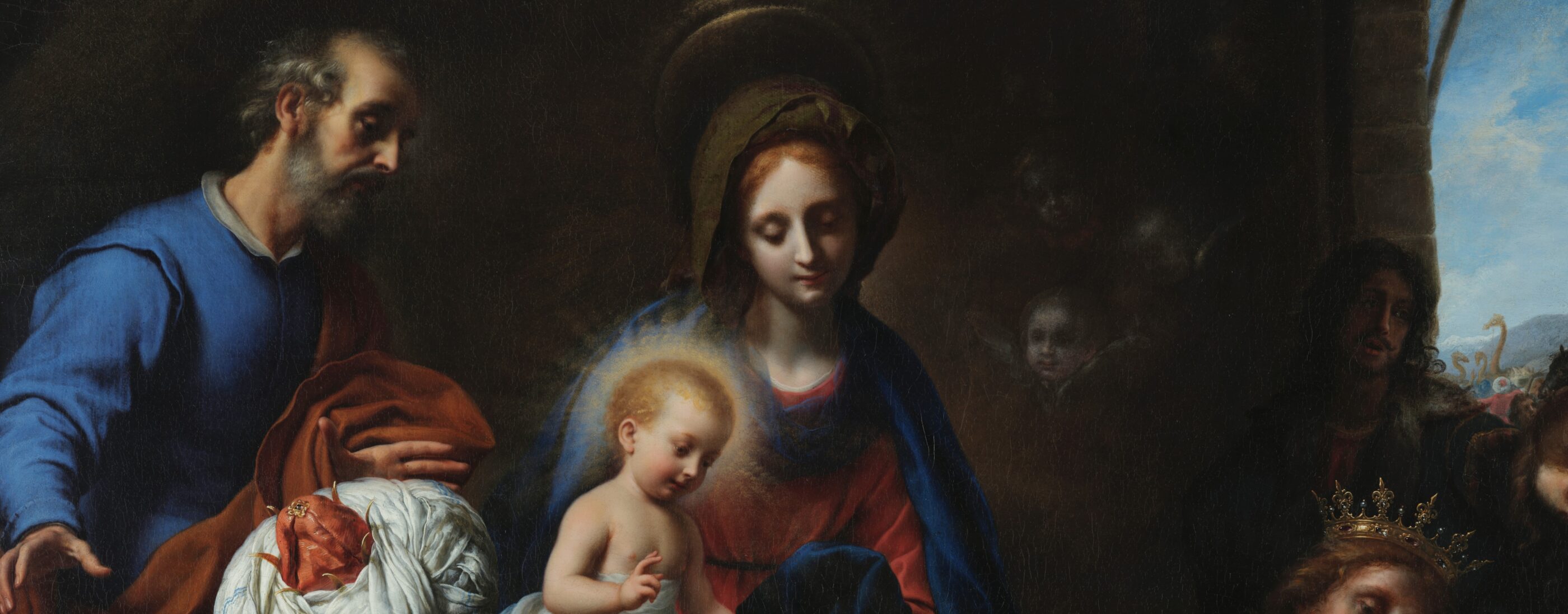
Regina Caeli (Queen of Heaven): Mary crowned, enthroned, with the Child on her lap or surrounded by angels. It expresses the doctrine of her eschatological glory and of her royal mediation.
The Black Madonna
The Black Madonnas (Vierges Noires) are dark-colored images of Mary and the Child Jesus, found above all in medieval Mediterranean Europe. The darkness is attributed to: (1) oxidation of the varnish over the centuries, (2) the deliberate use of dark woods, and (3) the influence of Song of Songs 1:5 (“I am dark, but beautiful”). Among the most venerated: Our Lady of Montserrat (Catalonia), Our Lady of Częstochowa (Jasna Góra, Poland), and Our Lady of Loreto (Italy).
The Council of Nicaea II (787) and images
The Council of Nicaea II (787) dogmatically defined the licitness of the veneration of sacred images (icons), putting an end to the iconoclast controversy. It distinguished between latreia (adoration, due to God alone) and proskynesis or timē (relative veneration, due to sacred images). Marian images receive the veneration of hyperdulia, the highest degree of veneration among creatures, inferior only to divine latria. Nicaea II is the dogmatic foundation of all Christian iconography.
Deepen your studies: explore Mariology, the Catacombs of Priscilla, Theotókos, Marian Theology and the Postgraduate Program in Mariology.
Postgraduate Program in Mariology
Would you like to deepen your formation in Mariology? Discover the Postgraduate Program in Mariology of Locus Mariologicus – an academic formation that unites theological rigor, spiritual life, and the living tradition of the Church.
Discover the oldest Marian image in the Catacomb of Priscilla.
Would you like to study Mariology seriously?
This article grows out of the works in the Locus Mariologicus library. The Postgraduate Program in Mariology takes you to the same source, with academic guidance: Scripture, the Fathers of the Church, and the Magisterium, from the first dogma to contemporary questions.




Responses