Incarnation and Resurrection in Relation to Mary

The Holy Spirit, poured out by the risen Christ at Pentecost, introduced the early Christian community to a deeper understanding of the teaching of Jesus. Thanks to this decisive illumination by the divine Pneuma, the Church came to understand (among other things) that the Mother of Jesus was a constitutive and indispensable element of the faith. Therefore, she also became the subject and the object of catechesis, of evangelization. The proclamation of the Gospel also involved bearing witness to the “great things” that the Lord accomplished in the person and in the work of Mary. And such witness was borne by Mary and the Church together, in a way that we shall explain. We shall now see how the incarnation and the resurrection of Christ are considered the two essential extremes that define His work as Savior.
The Pauline synthesis Incarnation, Resurrection: Rom 1:3-4, Gal 4:4-6, 1 Tim 3:16 and 2 Tim 2:8In the context of the messages of the New Testament, the incarnation of the Word and His resurrection from the dead are considered the two essential poles that summarize the person and the mission of Christ the Savior. Five of the corresponding texts are drawn from the epistles of Paul (Gal 4:4-6, Rom 1:3-4, 10:6-7, 1 Tim 3:16 and 2 Tim 2:8), and two from the Gospels (Lk 1:31-33 and Jn 1:13, read in the singular). In the following section, we will focus on Gal 4:4-6 and Lk 1:31-33. Here, on the other hand, we will summarize the three Pauline texts of Rom 1:3-4, 1 Tim 3:16 and 2 Tim 2:8.
At the beginning of his magnificent letter to the Romans, Paul presents himself as an “apostle”, that is, as one sent and chosen to proclaim the Gospel of God (v. 1). This gospel, which the Lord had announced in the Old Testament through His prophets, has as its object His Son (v. 2). And, in seeking to summarize the characteristics of this Son, Paul mentions His incarnation and resurrection.
The Incarnation, since He is descended from the line of David “according to the flesh” (v. 3), that is, in relation to His human origin, His dimension as Son of man. The Resurrection, because the Father, in raising the Son from the dead by the Holy Spirit, enables Him to manifest His “power”. The life-giving energy of the Holy Spirit has invested the person of the risen Jesus and transformed Him into an active subject of sanctification. Now seated at the right hand of the Father, His equality with God as His Son having been revealed, He can pour out the power of the Spirit upon every creature (cf. Rom 4:25b), and therefore He becomes our “Lord” (v. 4). Upon the “weakness” or kenosis of His pre-paschal condition there is now superimposed His “power” as the Risen One.
In the first letter to Timothy, the apostle Paul declares: “We must confess that great is the mystery of piety: He was manifested in the flesh, was justified in the Spirit, appeared to the angels, was preached to the Gentiles, was believed in the world, was taken up in glory” (3:16). The “mystery of piety” of which the Apostle speaks is the divine plan of our salvation. A plan that is the object of our piety, that is, of our faith, of what we believe.
By its nature, this mystery or plan is centered on the person of Christ; it is summed up in the Incarnation and in the Resurrection. In the incarnation, the Son of God manifested Himself in human form, clothing Himself in our flesh (cf. Rom 1:3; Jn 1:14). In the resurrection, He was “justified in the Spirit”. This means that the Holy Spirit demonstrated that the resurrection of Jesus (His “going to the Father”) is a “triumphant victory” over the forces of the Evil One (Jn 16:8, 10).
Through the Holy Spirit, the Christ who was put to death was exalted in the glory of the resurrection. From the lowliness of the “flesh”, He passes to the “glory” as the Risen One, through the transforming energy of the Spirit (cf. Rom 1:4). And the Resurrection is an event that embraces heaven and earth, the heavenly world and the earthly one:
- Christ appeared to the angels (Phil 2:11; Eph 1:20 ff., 3:10; 1 Pet 3:22…).
- He was preached to the Gentiles (Rom 10:18; Col 1:6, 23…).
- in the world, He is believed in by those who receive the message of His gospel (Mk 16:15-16; Rom 10:11-15…).
- in heaven He is enthroned at the right hand of God (Acts 1:2; 2:32-33; Rom 1:4).
In the second letter to Timothy (2:8), Paul recalls: “Remember that Jesus Christ was raised from the dead, descended from David, according to my gospel”. In the traditional view, this letter is the Apostle’s last. As such, it may be considered his spiritual testament. While the sword is already hanging over his head, Paul, aware that he has come to the end of his “race” (4:7), reaffirms what constitutes the core of the gospel that he preached and that Timothy must “remember”. It is composed of the person of Jesus Christ, risen from the dead and descended from the line of David. This twofold connotation seems to refer to Rom 1:4. Yet with a difference: the “resurrection” is mentioned before the “Davidic descent”. Almost as if Easter were the prism through which Christmas must be reinterpreted. The second birth of Christ (the resurrection) points back to the first birth (the incarnation).
Mary in the key texts of the kerygma: Gal 4:4-6 (c. AD 50) and Lk 1:31-33We have seen that the kerygma of the New Testament frequently associates the mystery of the Incarnation immediately with that of the Resurrection, considering them as a synthesis of Christ, the incarnate Word and the divine Messiah. We must now observe that this same kerygma connects the person of Mary both to the moment of the Incarnation and to that of the Resurrection of this one great mystery.
Mary in Gal 4:4-6 and Lk 1:31-33: the woman of the Fiat and the birth of the Son of GodThe two texts of Gal 4:4-6 and Lk 1:31-33, on the one hand, bear witness to the Son of God incarnate and risen and, on the other hand, involve Mary in the event of the Incarnation.
Gal 4:4-6 is one of the oldest texts of the New Testament, dating from around AD 50. In it, Paul refers to the two constitutive elements of the person of Christ. First, there is the remembrance of the Incarnation. The Son of God, as one “sent-apostle” (v. 4), came to us: He was born of a woman, within a well-defined social context, the people of Israel, under the precepts of the Mosaic Law.
Like any human being, the incarnate Son of God has an individual and a social dimension; He is a singular person and a member of a community. The woman of whom He was born is not named, but she is evidently Mary of Nazareth. We do not know with certainty whether the apostle Paul met her personally, but within the apostolic community he must certainly have learned that Miriam of Nazareth was the mother of Jesus.
Second, the resurrection of Christ. Paul alludes to it indirectly when he states that we have received adoption as sons, since God has sent the Spirit of His Son into our hearts, crying: “Abba, Father!” (v. 6). In Paul’s theology it is an established point that the Holy Spirit is the overall fruit of the mission of Jesus. Only as a result of the resurrection from the dead does Christ become the giver of the Spirit (cf. Rom 1:4), becoming the “life-giving spirit” (1 Cor 15:45). He, as Son of God from eternity, possesses the Spirit in a unique way, but communicates Him to us, so that all of us, becoming “sons in the Son”, may cry: “Abba, Father!” (Gal 4:6; Rom 8:15-17).
Lk 1:31-33, on the other hand, makes an explicit reference to the mother of Jesus. The virgin of Nazareth, called Mary, is the woman whom God chose to conceive, to give birth to and to give the name of Jesus to the Son of the Most High who is about to be born (v. 31). He, rising from the dead, will inherit the throne of His father David and will reign forever over the House of Jacob (vv. 32-33). These words of the angel Gabriel echo the promise made centuries earlier by the prophet Nathan to King David (2 Sam 7:11-15). The early Christian community understood that this oracle was fully fulfilled in the paschal mystery of Christ. The Father, in raising Jesus of Nazareth, son of David, from the dead, reveals Him as His divine Son (cf. Ps 2:7 and Acts 13:16-33), enthrones Him at His right hand, giving Him an eternal kingdom over the whole new House of Israel, which is the Church (cf. Ps 110:1 and Acts 2:25-36; 20:28).
Mary and the paschal mystery in Luke and John: seven passages linked to the hour of Jesus (Jn 13:1)The Gospel traditions, especially the Gospels of Luke and John, establish frequent connections between the Mother of Jesus and the paschal mystery, understood as the passion, death and resurrection of the Lord. Many of the episodes relating to the Virgin undoubtedly reveal a paschal tonality. Without intending to be exhaustive, I will now mention seven passages in which, in various ways, Mary stands at the center of the hour of Jesus, when He passes from this world to the Father (cf. Jn 13:1).
The “virgin womb” of Mary and the new tomb of Jesus: Mt 1:18-25, Lk 1:34-35 and Mt 27:60- between the “virgin womb” of Mary and the “new” (virgin) tomb of Jesus (cf. Mt 1:18-25; Lk 1:34-35; Jn 1:13 read in the singular, with Mt 27:60; Lk 23:53; Jn 19:41).
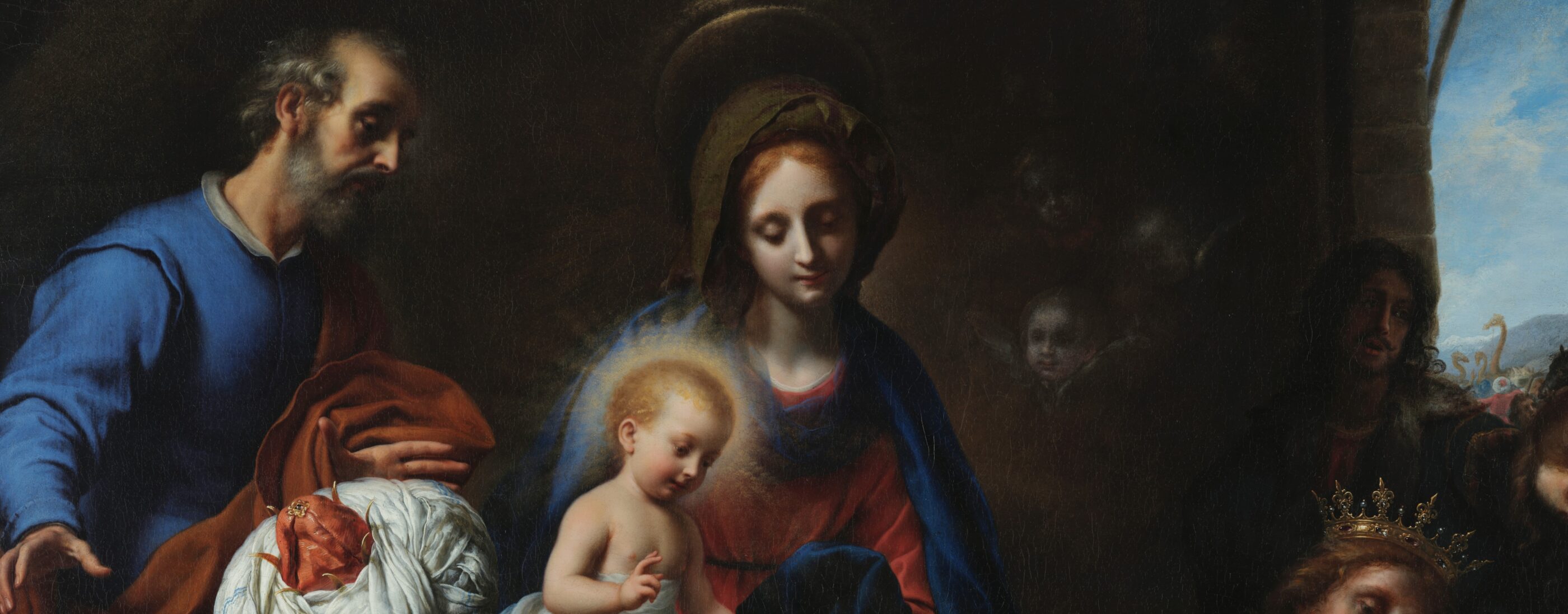
- between the swaddling clothes in which Mary wrapped her newborn (Lk 2:7b) and the burial cloths in which Joseph of Arimathea wrapped the body of Jesus taken down from the cross (Lk 23:53a).
- between the manger in which Mary laid the Child (Lk 2:7c) and the tomb in which Joseph of Arimathea laid Jesus (Lk 23:53b).
It is important to point out that these three correspondences have been constantly perceived by the Christian tradition.
The passage of the shepherds of Bethlehem to the crib (Lk 2:8-20)This passage certainly involves the memory of a visit that these shepherds made to the newborn, possibly born of Mary in a cave belonging to them. Nevertheless, in terms of the Lucan redaction, these shepherds also become a figure of the pastors of the Church. They are the apostles and all those who collaborated with them in the proclamation of the Word after the risen Lord had sent them out as witnesses. Their activity of proclamation is documented chiefly in the book of Acts, also a work of Luke.
The ecclesial dimension of the shepherds of Bethlehem was perceived unanimously by the ancient patristic tradition, both Eastern and Western, from Origen onward. Within this typological and ecclesial context, Mary is one of those who, within the community of Jerusalem, hear the message proclaimed by the shepherd-evangelizers, who are chiefly the Twelve (cf. Lk 2:17-18). She is not content with the “marveling astonishment” that the words and the wonders worked by the apostles gradually arouse in everyone (cf. Lk 2:18 and Acts 2:6-7; 3:10-12).
Mary, for her part, “kept all these things, pondering them in her heart” (Lk 2:19). This suggests that she, in the light of the paschal message proclaimed by the apostles, reflects anew on the circumstances of the birth of Jesus, of which she was an exceptional witness and protagonist. She makes an exegesis of them, understanding their full meaning, now that the splendors of the resurrection shine upon the Church. Even the Magnificat, for example, would be the result of the paschal meditation of the Mother of Jesus.
The Presentation of Jesus in the temple (Lk 2:22-40)This pericope mentions the purification of Mary only in passing (Lk 2:22, 24). The main focus of the narrative falls on the Child, who is “presented”, like every firstborn male, according to the Law of Moses (Lk 2:22-23, 27). Nevertheless, many exegetes observe that the scene reported by Luke emphasizes not so much the redemption of the Child as His consecration to the Lord. More than a firstborn to be redeemed, the Child appears to be an offering presented to the Lord, as though He were a sacrificial victim. So much so that the evangelist does not mention the price paid for the redemption.
In other words, Jesus is indeed “the Consecrated One of the Lord” (Lk 2:23). From the beginning, in His mother’s womb, He belonged to God in a unique and special way, having been conceived by the Holy Spirit. For this reason He was “Holy”, that is, dedicated to the Lord, wholly given over to Him. The angel said this to Mary (Lk 1:35). And Mary, who kept all these things in her heart (Lk 2:19, 51), knew that Jesus, her firstborn (Lk 2:7), belonged to the Lord in a way in which no other belonged. His whole life would be entirely dedicated to the Father.
Therefore, in fulfilling her personal purification, Mary finds occasion to present, to offer to the Lord the fruit of her womb. Her gesture recalls that of Hannah, who, centuries earlier, offered the little Samuel to the Lord, saying: “I offer him to the Lord for all the days of his life. He is offered to the Lord” (1 Sam 1:28). The action of Mary, joined by Joseph, her spouse and father of the Child, has the value of a consecration of the Son. A consecration with which she associates herself, as though she were one single reality with Him. Therefore the evangelist can speak of “their purification” (Lk 2:22). It was an offering that involved both the Son and the Mother. This foreshadowed the drama of the Passion.
For now it is only a gesture of giving, the first sacrificial offering made by the Redeemer through the Mother; for the Mother, it is the first direct association with the work of the redemption, a distant foreshadowing of her future collaboration in the sacrificial offering of the Son.
And a sword will pierce your own soul too, Simeon prophesied to Mary (Lk 2:35)In this “sword”, various contemporary exegetes, referring back to the Fathers of the East and of the West from the fourth and fifth centuries onward, see the symbol of the Word of God, which Jesus would proclaim. He, according to the oracle of Simeon, is the Servant of the Lord, the light of the nations and the glory of Israel (Lk 2:32. Cf. Is 42:6; 49:6). The Lord made His mouth like a sharpened sword (Is 49:2).
The word of Jesus, therefore, would be compared to a Sword that “…penetrates to the point of division of soul and spirit, of joints and marrow, and discerns the thoughts and intentions of the heart” (Heb 4:12). Mary allowed her thoughts to be illumined and judged by the brightness of that mystical sword which was the word of the Son. She kept His words and the events (Lk 2:19, 51b. Cf. Lk 8:19-21; 11:27-28). With wisdom, she was concerned to understand their depth, even when they caused her suffering and she did not immediately understand their meaning (Lk 2:48-50). The summit of this piercing of the soul would come at the hour of the Passion. Especially in the moments of dense darkness, Mary allowed the sword of the Word of God to penetrate the fibers of her spirit. She persevered in faith, with a suffering and trusting abandonment to the words of the Son, when He spoke of death and resurrection.
Other, more numerous authors, likewise referring to a line of Greek and Latin patristic exegesis that began in the fifth century, recognize in the “sword” prophesied by Simeon the intense sorrow that Mary experienced whenever the Son was rejected by His people. This happened during the public ministry (cf. Lk 4:16-30), in the passion and death (Lk 22:47-23:56) and subsequently in the life of the nascent Church, which was the target of continual persecution by the Jews (cf. Acts 4:1-31; 12:1-17; 13:45; 14:1-7; 28:22). It must not be forgotten that Mary was a member of that Church (Acts 1:14). As can be seen, both of the interpretations above point toward the paschal mystery as the conclusive summit of the prophecy of Simeon.
The pilgrimage of the twelve-year-old Jesus to the temple with His parents (Lk 2:41-51a)This episode is punctuated by many paschal motifs. What Mary and Joseph experienced in the course of this story of the boy Jesus, first lost, then sought among relatives and acquaintances and finally found in the Temple, the house of the Father, was an event open to the future revelation of the paschal mystery. It was, therefore, a distant prelude and a prophetic anticipation of what would happen to the disciples in the days of the death and resurrection of Christ. Another Pasch would come, during which, also in Jerusalem, the disciples, sorrowful and weeping, would lose the Master and would seek Him here among the dead. But “after three days” (that is, “on the third day”), they would discover that Christ is in the House of His Father: there He ascended, for He entered into His glory, was raised to the heavens, was exalted at the right hand of the Father. There it is necessary to “seek Him”, if we wish to live our Pasch.
The wedding at Cana (Jn 2:1-12): the mother of Jesus on the “third day” and the paschal prefigurationJohn’s account opens with a precise chronological indication: “On the third day there was a wedding at Cana in Galilee, and the mother of Jesus was there” (Jn 2:1).
With this observation, the evangelist also confers a “paschal” dynamic on the first of the signs worked by Jesus. That is, what is recounted in this episode is a figure and an anticipated foreshadowing of what the Church will live in a stable and continuous way in the age inaugurated by the “third day” of the resurrection of Jesus. And this is the age that embraces the whole duration of the Church, in which the wedding of the new Covenant with the risen Lord is celebrated (cf. Jn 3:29 and Rev 19:7). Thus the presence and the role that the Mother of Jesus plays on the “third day” of Cana continue in the today of the “third day” of the Church. As “Mother of Jesus” (Jn 2:1, 3, 5, 12; 19:25, 26, 27) and “Woman-Mother of the Church” (Jn 2:4; 19:26), the Virgin is always alert to awaken in us, servants of the Son, obedience to the Gospel: “Do whatever He tells you” (Jn 2:5). The welcoming of the Word promotes the union of the Church-bride around Christ the Bridegroom (cf. Jn 2:12; 10:16; 15:14).
The testament of Jesus on the cross: Mary and the beloved disciple (Jn 19:25-27)This episode is set among the events of “His hour”, when He passes from this world to the Father (cf. Jn 13:1). Even the last words addressed to the Mother (“Woman, behold your son”: v. 26) and to the disciple (“Behold your Mother”: v. 27a) bring His whole work as Messiah Savior to completion (cf. Jn 19:28: “After this…”). If, hypothetically, this gesture had been lacking, something essential would have been left out of the redemptive plan attested by the Scriptures. Not everything would have been fulfilled (cf. Jn 19:30). In response to the will of the Master, the disciple “from that hour took her into his home” (Jn 19:27b), as his own Mother. From that “hour”, by the will of Christ, the spiritual motherhood of Mary begins for all the disciples of the Son, and indeed for all humanity. It should be noted, however, that it is a “paschal” motherhood, since it springs also from the passion and resurrection of the Lord Jesus.
The Virgin of Nazareth on the horizon of salvation history: Incarnation, Resurrection and the Magnificat (Lk 1:49)Summarizing the contents presented in this article, we can affirm that the person of Mary of Nazareth is intimately bound both to the incarnation of the Word and to His resurrection from the dead. The Church of the first Christians, before these supreme events in the history of salvation, perceived that God had accomplished “great things” in the Mother of His Son: “The Mighty One has done marvels in me”, as the Virgin herself will sing in her hymn (Lk 1:49a).
Deepen your studies: explore Mariology, Marian Theology, Marian apparitions and the Postgraduate Program in Mariology.
On the relationship between the Incarnation, the Resurrection and Mary in Catholic theology, see the Encyclical Redemptoris Mater of Pope John Paul II.
Postgraduate Program in Mariology
Would you like to deepen your formation in Mariology? Discover the Postgraduate Program in Mariology of Locus Mariologicus – an academic formation that unites theological rigor, spiritual life and the living tradition of the Church.
Would you like to study Mariology seriously?
This article grows out of the works in the library of Locus Mariologicus. The Postgraduate Program in Mariology takes you to the same source, with academic guidance: Scripture, the Fathers of the Church and the Magisterium, from the first dogma to contemporary questions.




Responses