Our Lady of Luján, Patroness of Argentina
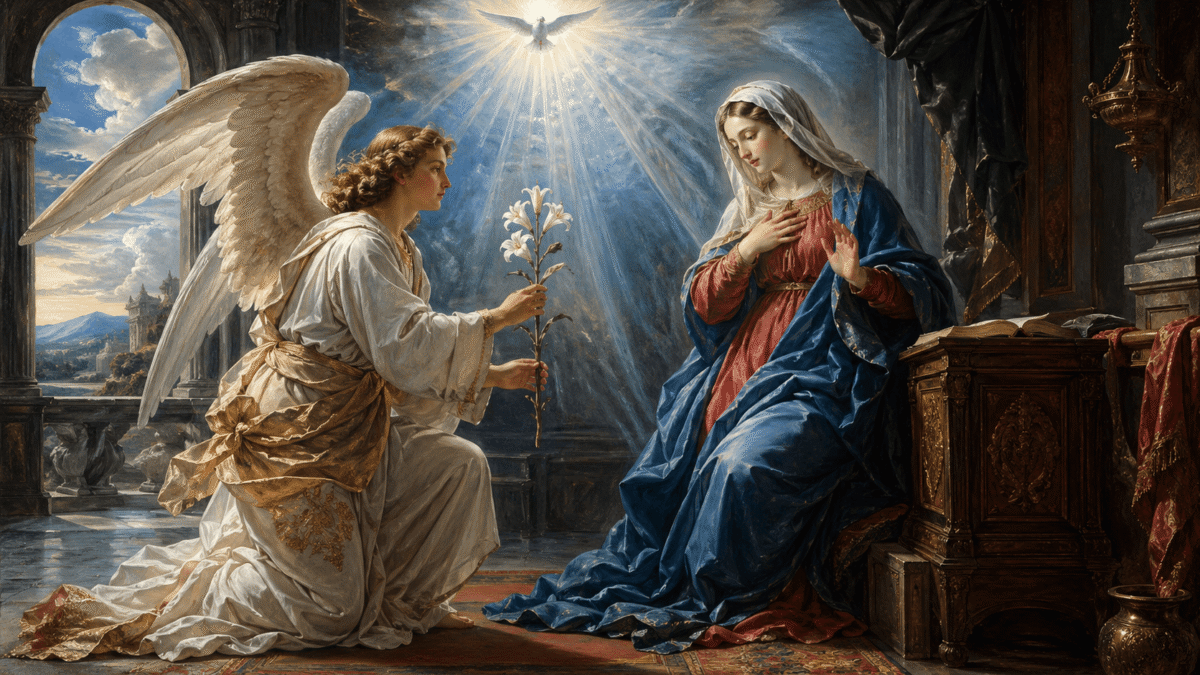
“In omnibus requiem quaesivi, et in hereditate Domini morabor” (Sir 24:11), “In all these I sought rest, and in the inheritance of the Lord I shall dwell”
I. Wisdom who chooses her dwelling: the oracle of Sirach
Chapter twenty-four of Sirach presents Wisdom personified, describing her divine origin and her journey until she finds her definitive dwelling in the midst of the chosen people. “I came forth from the mouth of the Most High, and like a cloud I covered the earth. I dwelt in the heights, and my throne is on a pillar of cloud. Alone I compassed the circuit of heaven and penetrated into the abyss of the depths. Over the waves of the sea, over all the earth, and over every people I held dominion. In all these I sought rest, and in the inheritance of the Lord I shall dwell” (Sir 24:3-7, 11). This oracle describes the movement of divine Wisdom as an itinerary of seeking, choosing, and settling. Wisdom does not dwell by imposition: she chooses the place where she wishes to remain. And this theological category of the choosing of Mary as the dwelling of Wisdom found a particularly eloquent illustration in Spanish American Marian history at Luján, in the far south of the continent, where the Virgin of the Immaculate Conception, in the seventeenth century, stopped midway along the road and showed her children, in the irrefutable language of signs, that this was the place she had chosen in which to dwell.
II. Luján, 1630: the image that halted the journey and chose its place
In the year 1630, on the vast Argentine plain known as the Pampa, a Portuguese landowner named António Farias de Sá had ordered from Brazil two images of the Virgin Mary: one of the Immaculate Conception and another of Mary with the Child, as a gift for his new chapel in Sumampa, in what is now northern Argentina. The images arrived at the port of Buenos Aires and began the long journey in a cart drawn by oxen toward their destination. When the party reached the property of the settler Don Rosendo Trigueros de Oria, near the Luján River, the oxen stopped abruptly and refused to go on. The Angolan slave Manuel Costa, who was in charge of the cargo, and the rest of the party tried every means to make the animals move forward, without success. By inspiration they unloaded the first crate, the one containing the image of the Immaculate Conception, and the oxen immediately set off without difficulty. When, later, they tried to take the image up again to continue the journey, the oxen stopped once more. Thus it was established, by the very language of the events, that this image wished to remain in Luján. It was kept in a small rural chapel, and around it there grew, over nearly four centuries, one of the greatest Marian shrines on the American continent. The Church proclaimed Our Lady of Luján Patroness of Argentina, Uruguay, and Paraguay. Pope Leo XIII authorized her canonical coronation in 1887. Cardinal Jorge Mario Bergoglio, later Pope Francis, made a pilgrimage to Luján every year throughout his episcopate in Buenos Aires and returned to the shrine, in spiritual pilgrimage, throughout his pontificate.
III. The Visitation: Mary who sets out to serve
The Gospel of Luke, which accompanies this celebration, presents the episode of the Visitation, in which Mary, with Christ newly incarnate in her womb, sets out in haste to serve Elizabeth, pregnant in her old age. “In those days Mary set out and went with haste into the hill country, to a town of Judah. She entered the house of Zechariah and greeted Elizabeth” (Lk 1:39-40). The Visitation is the most luminous manifestation of the style of Mary’s spiritual motherhood: she does not wait for her children to come to her; she goes to where they are. This Marian dialectic between remaining and going, between the stability of the dwelling and the movement of the visitation, finds in Luján a paradigmatic expression. Mary chose to remain in Luján so that Argentines, Uruguayans, Paraguayans, and all the peoples of the Southern Cone would have a dwelling where they could find her. But at the same time, the Mother who resides in Luján continues to visit her children throughout the continent, through pilgrimages, holy cards, and local feasts that renew, in every city of the Southern Cone, the presence of her who chose her place but never abandoned the roads where her children are to be found.
IV. Luján and the Mariology of Mary’s geographical choice
The theology that the shrine of Luján proposes to universal Mariology is that of place as a spiritual category. The history of Marian apparitions and shrines has confirmed again and again that Mary chooses her places of manifestation by criteria that are not those of the world. She does not choose centers of political or ecclesiastical power: she chooses rural peripheries, places of passage, poor ground. In 1630 Luján was a farm lost in the immensity of the Argentine pampa, far from everything. And it was precisely there that the Immaculate One stopped and made it known that she would remain. The Second Vatican Council affirmed that Mary “occupies, in the Church, after Christ, the highest place and the one closest to us” (Lumen Gentium, 54). The category of the near place is decisive: Mary is never distant, she is always close, but not just anywhere; she is in the places she herself has chosen for herself. Luján, for the Spanish American Southern Cone, is precisely this near place. Pope Francis, during his episcopate and his pontificate, repeatedly stressed that without the Mother there is no Argentine faith, and without Luján there is no Catholic identity of the Southern Cone. The image that has remained there for four centuries, small, dark, without great ornament, is the humble but irrefutable sign that the Wisdom who compassed the circuit of heaven has found, in the inheritance of the peoples of southern America, a place in which to dwell.
Postgraduate Program in Mariology
Would you like to deepen your formation in Mariology? Discover the Postgraduate Program in Mariology of Locus Mariologicus – an academic formation that unites theological rigor, spiritual life, and the living tradition of the Church.
See also: Complete guide to the Marian apparitions approved by the Church
Would you like to study Mariology seriously?
This article is born of the works in the library of Locus Mariologicus. The Postgraduate Program in Mariology takes you to the same source, with academic guidance: Scripture, the Fathers of the Church, and the Magisterium, from the first dogma to contemporary questions.



Responses