They Persevered in Prayer: Acts 1, 1 Pet 4, and the Priestly Prayer in Jn 17
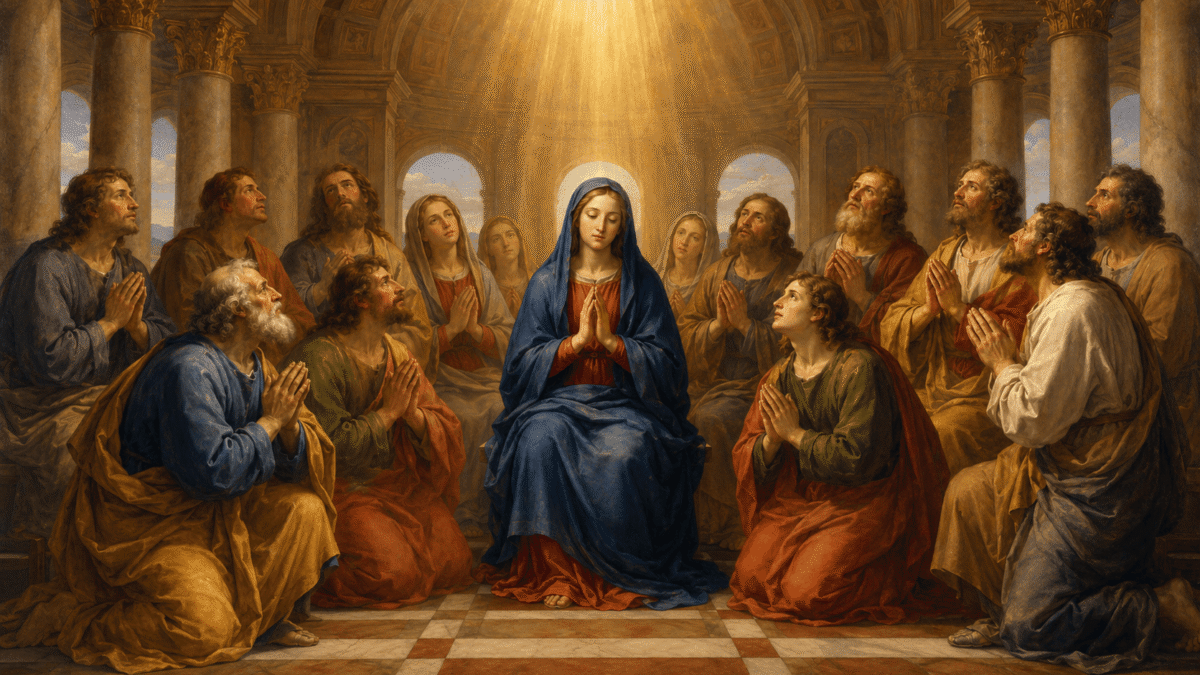
Hi omnes erant perseverantes unanimiter in oratione cum Maria matre Iesu.
Acts 1:14
On the Seventh Sunday of Easter, Year A, between the Ascension and Pentecost, the apostles persevered in prayer with Mary in the Upper Room, awaiting the Spirit. The three liturgical texts are organized around prayer and waiting. Acts 1:12-14 recounts the return of the apostles to the Upper Room after the Ascension: they persevered with one accord, with the women, with Mary, the mother of Jesus, and with his brethren. 1 Pet 4:13-16 invites us to rejoice in sharing in the sufferings of Christ, because the spirit of glory rests upon those who suffer for his name.
Jn 17:1-11a presents the priestly prayer of Jesus: the hour has come, glorify the Son, eternal life is to know the Father and the one he sent, keep them in your name. The three texts describe the same span of time between the departure of Christ and the gift of the Spirit, in which the apostles persevered in prayer and in waiting.
I. They Persevered in Prayer in the Upper Room: Acts 1:12-14
After the Ascension, the apostles return from the Mount of Olives to Jerusalem. They go up to the Upper Room: Peter and John, James and Andrew, Philip and Thomas, Bartholomew and Matthew, James the son of Alphaeus, Simon the Zealot, and Judas the son of James. “All of them persevered with one accord in prayer, together with the women and with Mary, the mother of Jesus, and with his brethren” (Acts 1:14).
This verse is the only place in the whole Book of Acts where the Virgin Mary is mentioned by name. Her presence is not marginal: she is at the heart of the praying community that awaits the Spirit. The Upper Room between the Ascension and Pentecost is the model of the whole Church in every age: a united community that perseveres in prayer, awaiting the gift of the Spirit that Christ promised.
II. The Second Reading: 1 Pet 4:13-16
“Rejoice insofar as you share in the sufferings of Christ, so that, when his glory is revealed, you may also rejoice with great joy” (1 Pet 4:13). Sharing in the suffering of Christ is not defeat: it is the path that leads to sharing in his glory.
The Apostle adds: “If you are insulted for the name of Christ, blessed are you, for the spirit of glory and the Spirit of God rest upon you” (v. 14). To suffer as a Christian is not a disgrace: it is an occasion for glorifying God (v. 16). The Seventh Sunday, between the Ascension and Pentecost, is the time in which the Church perseveres in prayer and in waiting, while it bears the pressure of a world that does not recognize what it awaits.
III. Evangelium: Jn 17:1-11a
On the night of the Last Supper, Jesus lifts his eyes to heaven and prays: “Father, the hour has come. Glorify your Son, that the Son may glorify you” (Jn 17:1). The hour is the hour of the Passion that leads to the Resurrection, and the glorification is mutual: the Son glorifies the Father by his obedience unto death, and the Father glorifies the Son by the resurrection.
“This is eternal life: that they may know you, the only true God, and Jesus Christ whom you have sent” (v. 3). Jesus recounts what he has done: he made known the name of the Father to those whom the Father had given him. “The words that you gave me I have given to them” (v. 8). Now he asks the Father to keep them: “Holy Father, keep them in your name, which you have given me, so that they may be one as we are” (v. 11a).
The priestly prayer of Jesus is the model of how the disciples persevere in prayer: interceding for those who have been entrusted to them, asking for unity, making known the name of the Father, revealing that eternal life is Trinitarian knowledge and love.
IV. Mary and the Apostles Persevere in Prayer
Acts 1:14 places Mary at the heart of the praying community between the Ascension and Pentecost: it is the only text in Acts that explicitly mentions the Virgin Mary. Her presence in the Upper Room is not decorative: it is the foundation of a contemplative tradition that sees in Mary the model of all the prayer of the Church. Mary had already received the Spirit at the Annunciation, but she now awaits, together with the community, the gift of the Spirit for all.
1 Pet 4 speaks of sharing in the sufferings of Christ: Mary shared in the sufferings of Christ at the foot of the Cross in a unique way, and for that reason she was raised to glory in the Assumption. Jn 17 is the priestly prayer of Jesus: in asking “keep them in your name,” Jesus included Mary in an eminent way, for she was the one who most fully belonged to the name of the Father, full of grace from the beginning.
On the Seventh Sunday of Easter, the Church does what the apostles did in the Upper Room: it perseveres in prayer with one accord, with Mary presiding over the waiting, until Pentecost comes and the Spirit transforms the waiting into mission.
Postgraduate Program in Mariology
Would you like to deepen your formation in Mariology? Discover the Postgraduate Program in Mariology of Locus Mariologicus — an academic formation that unites theological rigor, spiritual life, and the living tradition of the Church.





Responses