Sequere me: The Marian Saturday and the Demands of Discipleship
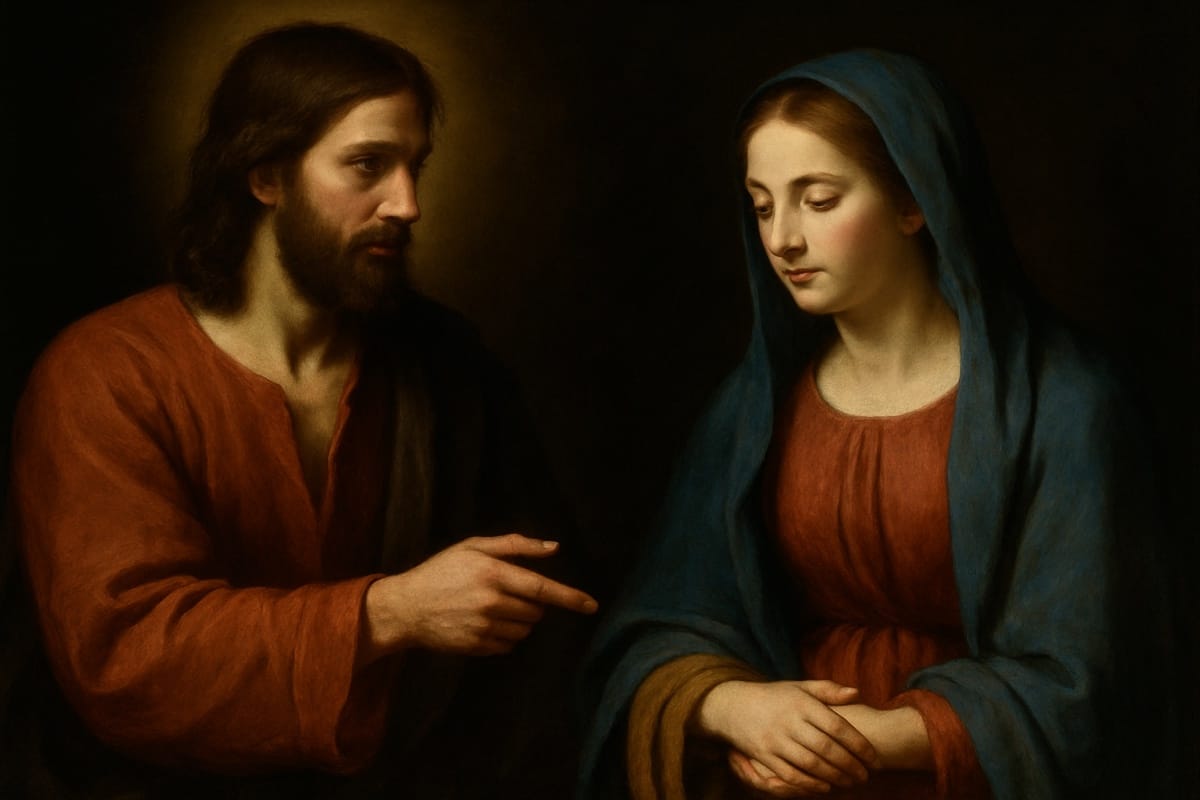
Et accedens scriba dixit ei: Magister, sequar te, quocumque ieris. Et dicit ei Iesus: Vulpes foveas habent, et volucres caeli tabernacula. Filius autem hominis non habet ubi caput reclinet.
Mt 8:19-20
Saturday of the Twelfth Week in Ordinary Time is, in the Latin liturgical tradition, Our Lady’s Saturday, the day dedicated to the memorial of Mary that Alcuin introduced in the ninth century and that Cistercian monastic devotion, under the influence of Bernard of Clairvaux, made widespread in the twelfth century. The Gospel pericope that the weekday liturgy presents on this Saturday, Mt 8:18-22, on the demands of following Jesus, offers an unexpectedly rich key for Marian contemplation: the two conditions that Jesus sets before the scribe and the disciple who wanted to follow Him are precisely those that define the profile of Mary’s exemplary following.
The two encounters in Mt 8:18-22 describe two temptations of an incomplete following. The scribe who says, “Teacher, I will follow you wherever you go” (Mt 8:19), expresses a genuine but untested enthusiasm; he does not know the implications of the “wherever you go,” which include homeless itinerancy, economic insecurity, and social marginality. The disciple who asks, “let me first go and bury my father” (Mt 8:21), has an understandable impediment, but one that reveals a hierarchy of priorities in which following Jesus is subordinated to family obligations. Jesus answers both with the radical demand that defines authentic discipleship: no permanent home, no postponements.
I. “I Will Follow You Wherever You Go”: Enthusiasm Put to the Test
The scribe of Mt 8:19 is remarkable for his enthusiasm: unlike the fishermen and Matthew, who were called by Jesus, he takes the initiative himself. “I will follow you wherever you go”: the declaration has no conditions, no exceptions, no expiration date. It is the most generous statement a disciple can make. Yet Jesus does not immediately encourage him: He responds with a description of the concrete condition of what following entails, “Foxes have holes, the birds of the sky have nests. But the Son of Man has nowhere to rest his head” (Mt 8:20).
“The Son of Man has nowhere to rest his head”: this statement of Jesus about Himself is one of the most sober and most revealing in the Gospel of Matthew. Jesus, who was the son of Joseph the carpenter, had probably had a home in Nazareth. But when He began His public ministry, He renounced the security of a home: He depended on the hospitality of His disciples, of the women who followed Him and served Him (Lk 8:1-3), of the households that welcomed Him. Jesus’ radical itinerancy, which the Franciscan tradition would take up with special emphasis, is part of His identification with the poorest and most vulnerable members of society.
Jesus’ answer is not a rejection of the scribe’s enthusiasm; it is a preparation. The “I will follow you wherever you go” needs to know what is included in the “wherever you go”: it includes the twelfth week of the journey from Capernaum to Jerusalem, it includes Calvary, it includes the post-Easter persecution. Enthusiasm that does not know the implications of following is fragile, the house built on sand in Mt 7:26 that collapses when the storm comes. Enthusiasm that knows the implications and accepts them is the house built on rock that Mt 7:24 celebrates.
In this context, the Marian Saturday is the day for reviewing one’s enthusiasm: “Where does my following of Jesus stand after this week? Does it match the ‘I will follow you wherever you go’ that I pronounced on Sunday? Or has it been conditioned by comforts, by conveniences, by the fears that made my following more selective than my initial declaration?” Mary is the model not of Sunday enthusiasm but of a lifelong following: the “fiat” of the Annunciation was renewed at every stage: at the Visitation, in Bethlehem, in Egypt, in Nazareth, on Calvary, in the Upper Room.
II. “Let the Dead Bury Their Own Dead”: The Primacy
The second encounter (Mt 8:21-22) is even more unsettling: “Lord, let me first go and bury my father,” a reasonable request, committed to the most basic family obligations. Jesus’ answer, “Follow me. Let the dead bury their own dead,” seems to contradict the honor due to parents (the fifth commandment) and the filial piety that the Old Testament celebrates. The exegesis of this saying is a matter of debate: some interpreters suggest that the father had not yet died and that the disciple was asking to postpone following Jesus until his father’s death (possibly years in the future). Others take the saying literally.
The interpretive key lies in the “let the dead”: the “spiritually dead,” those who have not responded to Jesus’ call, can perfectly well fulfill the funeral obligations. The disciple who has received Jesus’ call has a responsibility that the “dead” do not have: the urgency of proclaiming the Kingdom admits no indefinite postponement. This principle, the primacy of following Jesus over family obligations, not because family does not matter but because the Kingdom is urgent, is the same one Jesus set forth in Mt 10:37: “whoever loves father or mother more than me is not worthy of me.”
Mary understood this primacy in an exemplary and doubly paradoxical way. It was Mary who, at the foot of the Cross, received from Jesus the beloved disciple as her “son” (Jn 19:26-27): the reconfiguration of the biological family into a spiritual family. But it was also Mary who, in the scene of Mk 3:33-35 (“Who are my mother and my brothers?”), saw the maternal bond redefined not as a relationship of blood but as a relationship of discipleship: “whoever does the will of God is my brother, my sister, and my mother.” Mary did not feel excluded by this declaration; she was included, and more profoundly so: not only as biological mother but as a disciple who does the will of God.
“Let the dead bury their own dead” also has an application in ordinary spiritual life: the “dead” are the projects, the ambitions, the securities that hold me back in my following. The “death” I need to leave behind is not necessarily the biological death of a family member; it may be the death of a life project I pursue because it is “what everyone expects,” the death of an economic security that ties me down when the call asks me for mobility, the death of a reputation that keeps me from committing myself visibly to the Gospel. The Marian Saturday is the day to examine what I am being asked to “leave behind first” before following.
III. Mary, Itinerant in Following
Mary’s itinerary throughout the Gospel is that of a woman who followed, without knowing the final destination, every step that her Son’s mission required. From Nazareth to Ain Karim (the Visitation), from Ain Karim to Bethlehem (the Nativity), from Bethlehem to Egypt (the flight), from Egypt to Nazareth (the return), from Nazareth to Cana, to Capernaum, to Jerusalem, and finally to Calvary and the Upper Room. This itinerary was not planned by Mary: it was lived in obedience to the mission of her Son, who “had nowhere to rest his head,” and whose mother learned to have nowhere to rest her attention fixedly, always available for the next movement that her Son’s mission would require.
The spiritual tradition has seen in Mary the model of the “pilgrim of faith,” an expression the Second Vatican Council used in Lumen Gentium 58: “the Virgin advanced in her pilgrimage of faith.” The pilgrimage of faith is not a seasonal excursion to a shrine; it is the way of being of one who never settles permanently into any created security, who always walks “toward” what God promises but has not yet fully revealed. Mary lived this pilgrimage without the complete map: she did not know for certain where the “fiat” would lead her, but she knew Who was leading her.
Mariology identifies in Mary’s “itinerancy” one of the dimensions of her co-redemptive mission: her presence on Calvary (Jn 19:25, “stood by the Cross”) was not accidental; it was not the visit of a mother who went to watch her son die. It was the presence that brought the “I will follow you wherever you go” to completion in its most extreme sense: all the way to Calvary, to the moment no other disciple (except John) had reached. Mary arrived where the others did not, because her following did not carry the conditions and the “let me first” that the others had set.
The Marian Saturday, as a day for contemplating this itinerancy, has a precise spiritual function: it is the day on which the faithful examine their own following (“Where did I stop? Where did I set the conditions that the Jesus of Mt 8:21 did not accept?”) and ask Mary to help them renew the “I will follow you wherever you go” more completely, with fewer conditions and with greater availability for the itinerancy that the Gospel demands.
IV. Holy Saturday: Mary, Guardian of the Faith
The liturgical tradition that dedicated Saturday to Mary sees in this day a connection with Holy Saturday, the day between the death and the Resurrection when the disciples fled and Mary remained. Holy Saturday is the most radical day of the “has nowhere to rest his head”: the Son was dead, the plan seemed destroyed, faith had nothing to lean on but itself. The disciples shut themselves in “for fear of the Jews” (Jn 20:19). Mary, tradition affirms, kept the faith alive where all the others had lost it.
The Marian Saturday is the weekly liturgical participation in that Holy Saturday: the day “in between,” when the week with its difficulties has been left behind and Sunday with its promise has not yet arrived. The faith that perseveres on Saturday, without the consolation of the Sunday Eucharist, without the enthusiasm of the Sunday assembly, is the purest faith, a faith that does not depend on external consolations. Mary is the model of this Saturday faith: she who “kept” (Lk 2:19, dietērei) not only the words but also the experiences she did not understand, treasuring them in the hope that the Father, who governs all things, had a plan that went beyond what she could see.
“I will follow you wherever you go”: the Marian Saturday is the day on which this promise is examined, renewed, and entrusted to Mary so that she may sustain it. The faithful who end the week with the Saturday prayer to Mary do not ask Mary to take the place of their following; they ask her to sustain it where their own strength fails. Like John, who “from that hour took her into his own home” (Jn 19:27), the disciple who welcomes Mary on Saturday receives the same presence that sustained faith on Holy Saturday, the presence of the woman who followed to the end and who knows, from experience, that the end is not death but the dawn of the approaching Sunday.
Postgraduate Program in Mariology
Would you like to deepen your formation in Mariology? Discover the Postgraduate Program in Mariology of Locus Mariologicus, an academic formation that unites theological rigor, spiritual life, and the living tradition of the Church.
Would you like to study Mariology seriously?
This article grows out of the works in the Locus Mariologicus library. The Postgraduate Program in Mariology takes you to the same source, with academic guidance: Scripture, the Fathers of the Church, and the Magisterium, from the first dogma to contemporary questions.





Responses