The origins of intercession in the iconography of the Virgin Orans

The origins of intercession in the iconography of the Virgin Orans
The Virgin Orans
The possible variants concern the composition itself.
The Virgin Orans may be represented by herself or in relation to a historical-salvific theophanic event:
autonomous representation: she appears alone or accompanied by other figures (angels, apostles, martyrs and/or saints).
an Old Testament theophany.
a New Testament theophany: the Ascension.
a timeless theophany of Christ.

Virgin Mother praying among the Eleven, Saint Matthias and Saint Paul, beneath an Old Testament theophany, apse, Monastery of Saint Apollo, Bawit, sixth century.

Virgin Mother praying among the apostles Peter and Paul, six martyrs and the donor, beneath a timeless theophany of Christ the Lord represented at half-length and flanked by two angels. Apse, mosaic, chapel of S. Venanzio (Baptistery of S. Giovanni in Laterano), Rome, mid-seventh century.
Non-apsidal compositions relating to the type in question
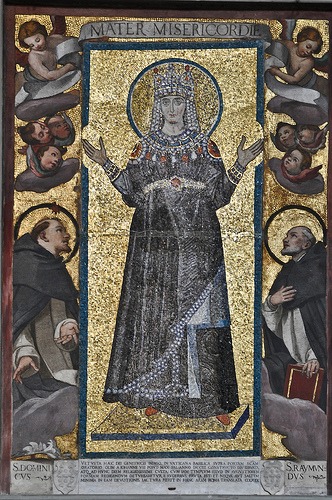
Virgin Mother praying (“Regina”), Oratory of John VII, from Old St. Peter’s, S. Marco Museum, Florence, AD 707
Observations
The ancient gesture of the raised hands with the palms turned upward, symbolizing the attitude of religious man and, once taken up by Christian iconography, that of the faithful, applied to the Virgin Mary, becomes an expression of the mystery of the Incarnation. Even when she is alone, with her arms raised toward heaven, she represents the Mother of God, for this gesture corresponds to the idea of grace in the act of descending upon her, that is, the conception and the beginning of the Incarnation.
The considerations to be made about the representation of the Virgin Orans in the scene of the Ascension are interesting, starting from the observation that in this scene the Virgin Mother is portrayed at the center of the Apostles, while neither the Gospel nor the Acts makes any reference to her presence. Now, the fact that such dignity belongs to Mary by virtue of her divine motherhood is not sufficient to justify her presence at the center of the Apostles. In fact, the iconography of the undivided Church does not proceed allegorically, but it is the iconography that suggests the meaning of that presence: by inserting into the composition the star of the Incarnation (represented as a sphere) or the dove of the Spirit (as happens in the Cave of the Pantocrator on Latmos), it points to a relationship between the mystery of the Ascension and that of the Epiphany. This connection is bound to a historical fact: the celebration of the Vigils and of the Mass of the Ascension in the Basilica of the Nativity in Bethlehem, since, before the end of the fourth century, the feast in Jerusalem had been separated from Pentecost and brought forward to the fortieth day. Thus the beginning and the conclusion of the history of salvation were mutually ordered in a single celebration.
The literary sources, for their part, confirm that the Fathers, such as Cyril of Jerusalem (Catechesis XIV) and John Chrysostom (In ascensionem Domini), liked to associate the two mysteries of the Incarnation and the Ascension. The combination of the theme of the Epiphany (expressed by the group of the Virgin Mother with the Child) with the glorifying theophany of the Ascension and, as often happens in the Coptic apses, with the Old Testament theophanies reinterpreted in a Christological way or even with a timeless theophany were the occasion for seeing that the figure of the Virgin Orans is interchangeable with that of the Mother of God enthroned with the Child.
But the Ascension is not only the final term of that movement which, from the descent of the Incarnation, reaches the final elevation/glorification of the Son: it is also the moment of the birth of the Church. As the Fathers of the Church teach, when Christ returns gloriously to the Father, it is humanity as Church that is raised with Him to Heaven. Thus the mystery of the Ascension and the birth of the Church are intimately related to the Incarnation. All these elements are found together in a passage of Saint Irenaeus: “there is in fact one and the same Spirit of God, who announced to the apostles that the time of filial adoption had come [cf. Gal 4:4-5; that is, the birth of the Church], that the kingdom of heaven is near and dwells among the men who believe in the Emmanuel born of the Virgin”.
In the iconography of the Ascension, the Virgin Orans is the image of the earthly Church. Her gesture signifies the Incarnation and the Redemption of which she is the instrument, and at the same time it symbolizes that function of the Church which consists in assuring God an incessant prayer on the part of the faithful. Here we come upon one of the most important ideal paths that link the historical figure of the Virgin Mother Mary to the sacramental figure of the Virgin Mother Church. A depth of meaning that is preserved even when the praying Virgin appears alone outside a theophanic scene (fig 3).
Virgin Mother of intercession, in profile, hands raised and face in 3/4
In monumental compositions, the standing module, with the body in profile, presupposes the presence of at least a second figure, Christ, toward whom the movement of the Virgin is directed. Most often, however, the Virgin in this posture is part of a trimorphic composition at the center of which is Christ the Lord, while the Mother, placed at His right, turns toward Him and another saint, symmetrically arranged, does the same as a pendant: often, but not necessarily, it is Saint John the Baptist. From the point of view of compositional structure, the trimorphic module is a centered module, very balanced and therefore particularly solemn, with numerous precedents in late-antique iconography: hence the success and the frequency of its use in the apses. Compositionally, in fact, the Mother-Son group flanked by two angels or the analogous group of Christ the Lord between Saint Peter and Saint Paul also presents the same structure.
The early date of the literary evidence relating to the apsidal compositions that contain this module allows us to consider it the origin of the Byzantine composition called Deesis.

Virgin Mother interceding, apse, mosaic, Chapel of S. Zenone, Santa Prassede, Rome, 9th c.
Two literary testimonies
The church called La Daurade in Toulouse: the apse of the fifth-century church housed a representation of the Virgin before the Savior.
The church known as the Tetrapylon in Alexandria: Sophronius of Jerusalem (early seventh century) describes a composition that was found in this church located in the center of the city. From his description it can be inferred that it was an apsidal composition and that it was a mosaic: Christ the Lord occupies the center. He was flanked by the Holy Mother and Saint John the Baptist.
Non-apsidal compositions relating to the type in question

Virgin Mother interceding, Monasterium Tetriput (Oratory of the Rosary on Monte Mario). Seventh-eighth century.
Conclusion
The intercessory function of the Virgin Mother is expressed by her simple being-at-the-side-of-the-Son, in an immobility that the gesture of the forearm does not interrupt: the iconography is therefore independent of any affective connotation. And it may be observed that this same immobility signifies at the same time the perennial relevance of the intercessory function of the Virgin Mother in the liturgical present.
In the Byzantine East, when she is part of the trimorphic composition of the same name, this type is called the Virgin of the Deesis: when instead the Virgin, standing or at half-length, as is most frequently the case with portable images, is represented alone or together with a supplicant, with or without a scroll in her hand containing the text of the supplication, she is called Ele Paraclesis, that is, the Intercession, or she is called Mother of God Aghiosoritissa. In the West, and particularly in Rome, where several icons of this type in which the Virgin appears alone are venerated, the name is Vergine Avvocata.
Postgraduate Program in Mariology
Would you like to deepen your formation in Mariology? Discover the Postgraduate Program in Mariology of Locus Mariologicus – an academic formation that unites theological rigor, spiritual life and the living tradition of the Church.
Discover the oldest Marian image in the Catacomb of Priscilla.
Would you like to study Mariology seriously?
This article is born from the works in the library of Locus Mariologicus. The Postgraduate Program in Mariology takes you to the same source, with academic guidance: Scripture, the Fathers of the Church and the Magisterium, from the first dogma to contemporary questions.




Responses