And the disciple welcomed her into his own intimacy (Jn 19:27)

Jn 19:25-27 is one of the densest verses of Johannine theology: “When Jesus saw his mother and, beside her, the disciple whom he loved, he said to his mother: Woman, behold your son. Then he said to the disciple: Behold your mother. And, from that hour, the disciple welcomed her into his own intimacy (ta idia)”. Jesus’ gesture on the Cross is not an act of filial piety, but a founding theological act: it institutes Mary’s spiritual motherhood over all the disciples of Christ, which theology calls Mary’s ecclesial motherhood.
It is from this verse that the spirituality of totus tuus is born, the total consecration to Mary that Saint John Paul II took as his motto.
Jesus’ testament on the cross: the gesture, the context of the “hour” and the expression “eis ta idia”
On Calvary, before dying, Jesus speaks two sentences that change everything. To his Mother: “Woman, behold your son”. To the disciple: “Behold your mother”. And the evangelist adds: “And from that hour the disciple welcomed her into his own intimacy” (Jn 19:27). Why does he do this? Because Jesus was dying alone, with no brothers present, and was entrusting his Mother to someone who would love her? Or because this gesture has a meaning that goes beyond filial care and founds something new? The evangelist John is not narrating an episode of family piety. He is revealing the birth of Mary’s spiritual motherhood for the whole Church.
Welcoming the Mother of the Lord is one of the characteristics that define the true disciple of Christ: “from that hour, the disciple welcomed her into his own intimacy” (Jn 19:27), he welcomed her into his life, into his spiritual experience inseparably bound to and blessed by the memory of the Master.
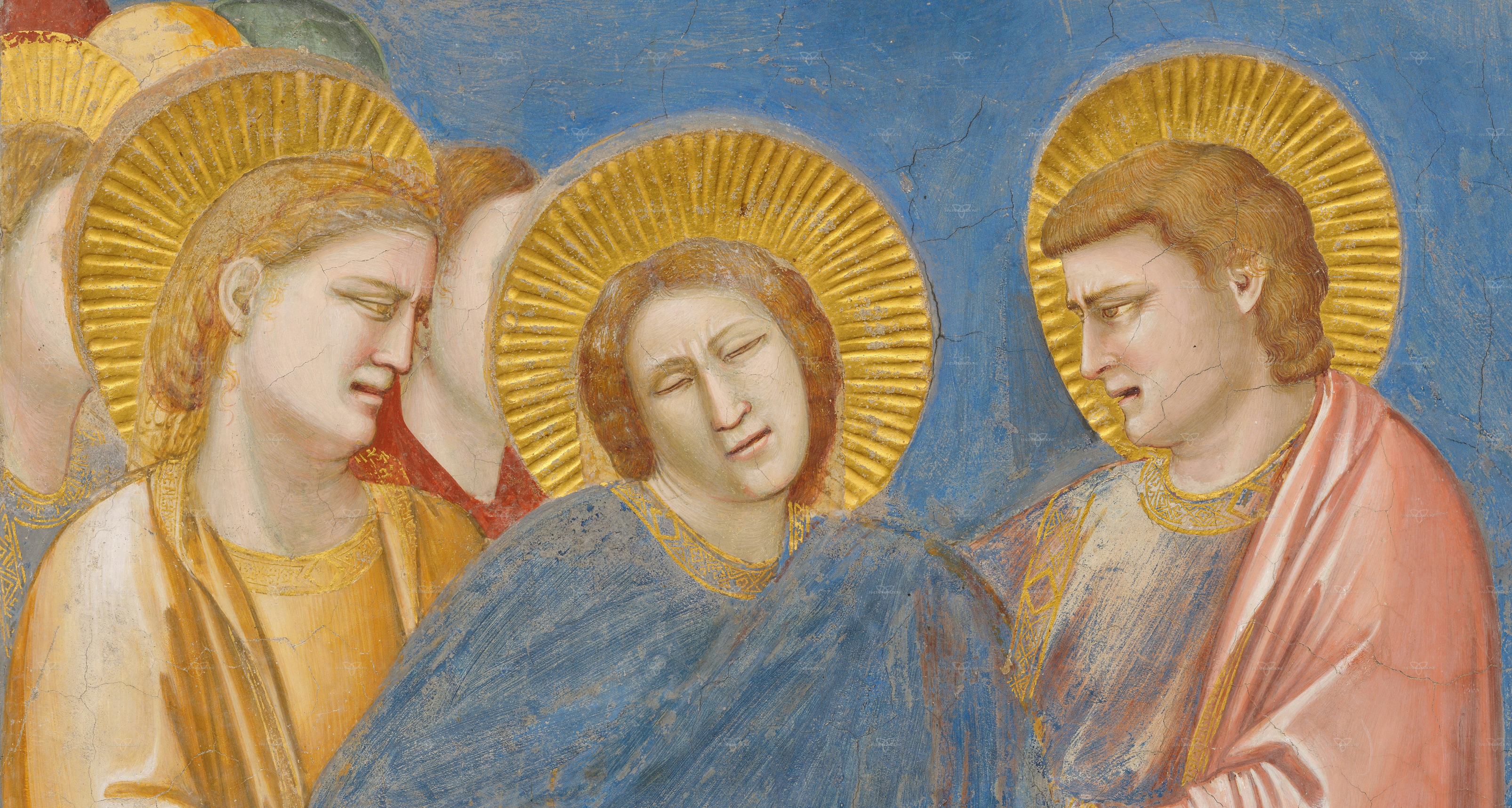
The identity of the beloved disciple: the state of the exegetical question and its secondary relevance for the theological meaning of Jn 19:27
Exegetes have arguments for and against, and, not being an exegete, I do not feel able to enter into this controversy, which in any case is of secondary interest in relation to the meaning of the text. We will therefore use both interpretations indifferently. In the Gospel text, it is said that the disciple was entrusted to Mary, as if he still needed attention, but it is not observed that he accomplished anything. In the final analysis, it is a bit like Lazarus: we are not told that he did anything, we only know that Jesus loved him: “The sisters sent word to him: ‘Lord [ … ], your friend is ill‘. ‘Then the Jews said: ‘See how he loved him!‘” (Jn 11:3, 36).
The disciple at the foot of the cross has, as his only title of nobility for entering fully into the Scriptures, Jesus’ preferential love and friendship for him. This is his greatness: “If anyone loves me, he will keep my word, and my Father will love him, and we will come to him and make our dwelling in him” (Jn 14:23). This is the interior and spiritual space, the vital environment that characterizes the existence of the beloved disciple as a disciple of the Lord. In him, each of us feels worthy and truly represented. Indeed, we are what we are because Jesus loves us, this is our greatest nobility, our security, our rock, our strength, our dignity and inheritance. All the rest is our program, which can be belied by circumstances.
The act of entrustment: “eis ta idia” as an investiture of mission and an ecclesiological type
When Jesus, before dying, entrusted Mary to John, he clearly established a relationship of filiation and motherhood. Instead of recommending that John take care of the Mother who would be left alone, Jesus said: “Behold your son [ … ]. Behold your mother“. It is a relationship equal to the one that exists between Mary and Jesus.
It is significant that no other relationship of this kind is established for any other woman. And yet, beneath the cross were Mary of Magdala, Mary the mother of James the younger and of Joses, Salome (cf. Mk 15:40), Mary of Clopas (cf. Jn 19:25). Nevertheless, Jesus establishes between the Mother and the beloved, preferred Disciple a privileged and reciprocal relationship, which must then be extended to all the disciples of the Gospel. Recent studies on the verse of Jn 19:27b observe that the original Greek text of the Fourth Gospel does not say that the disciple welcomed Mary into his home, as was generally understood, but rather “among his own things (eis tà idia).
The Greek word in Latin is “proprius“, which, by itself, is not a comparative of “prope” (near), but comes from the Latin juridical expression “pro vivo“, that is, for private use, for my use. “Proprius” then indicates what belongs to me, what concerns me directly and personally. The disciple did not simply take care of the Mother of the Lord, but “received her among his own things (eis tà idia), into his home“.
What does this mean?
If he was a disciple who followed Jesus, even though the gospel does not mention his name, one generally thinks of John, he had no house of his own, at most he used the house of relatives. With the expression “eis tà idia“, a much broader, greater, more mysterious reality is understood: a profound communion of purpose, spiritual and apostolic. This is why we are not surprised to see the Mother of Jesus in the upper room with Apostles and disciples (cf. Acts 1:1-2).
“Ta idia”: Johannine semantics, the parallel with Jn 1:11 and what John “received” from Jesus
The expression “one’s own things” allows us to intuit how the things among which the disciple welcomed the Mother of Jesus indicate the various gifts that the disciple received from the love of the Lord Jesus and that therefore became “his own things“, that is, his spiritual inheritance. Among these gifts is also Mary of Nazareth, mother, witness and servant of the Lord. The meaning of this iconic expression can be identified as a welcoming of the Mother of the Lord among the most personal things we possess, because the relationship with her, the disciple of the Kingdom, is constitutive of the personality of every disciple.
Mary is one of the many most precious moral and spiritual goods that the disciple inherits from Jesus, his teacher and Lord (cf. Jn 13:13). Until that moment, she was only the mother of Jesus, but from that Hour, that is, from the paschal mystery, she also becomes the mother of the disciple, who represents all the disciples. On the brink of death, about to pass from this world to the Father (cf. Jn 13:1), Jesus wished to show the fullness of his love by stripping himself of everything and thus giving away the only good that remained to him, his Mother.
Pope Wojtyla commented in a general audience on November 23, 1988: “in his Passion, Jesus saw himself stripped of everything. On Calvary, the only thing left to him is his Mother. And with a gesture of supreme detachment, he gives her too to the whole world, before fulfilling his mission with the sacrifice of his life. Jesus is aware that the moment of his consummation has come, as the evangelist says: “After this, knowing that everything was consummated…” (Jn 19:28). And he wants this gift of the Mother to the Church and to the world to be among the ‘consummated’ things as well”.
Mary’s ecclesial motherhood: from the Johannine “hour” to Lumen gentium (LG 53-65) and its patristic and modern reception
Mary’s maternal experience became vast and intense beyond all measure on the Cross: to her motherhood in relation to Christ was added her motherhood in relation to the Church. It is there, from then on, that, like the jars at Cana (cf. Jn 2:7), her womb was filled by the will of the same Lord who changed the water into wine, to the brim. Therefore, the disciple welcomes the Mother of Christ and recognizes her as his mother, in obedience to the will of the Lord Jesus. In this sense, welcoming Mary is not an optional choice for those who feel particularly devout, but is an obedience to Christ Jesus, recalling the paschal gift that Jesus Christ gave to each of his disciples.
The Johannine doctrine on the welcome to be given to the Mother of Jesus, within the sphere of faith, is of the utmost importance both for the personal witness of every believer and for the ecumenical dialogue among the Christian confessions. The person of Christ remains the center of our faith: ‘I am the Gate‘ (Jn 10:9). Nevertheless, in order to welcome Christ with full consent (cf. Jn 1:12), we must also receive all the gifts, including Mary, with which He wished to enrich His Church and to establish among them the correct and fruitful harmony already outlined by the Johannine writings as well.
Does all this mean adopting a purely spiritual and disembodied perspective, or something more?
It cannot be reduced to a principle that is simply stated, steeped in some passing sentiment. To welcome Mary into our life is to have her as a model of life, as well as a refuge in daily difficulties and uncertainties; it means understanding the lines of force of her life and letting them pass into our own. In the school of Jesus, Mary grew as a disciple; through the perfection of her apprenticeship, Mary became a teacher, or, if we prefer, a guide of Christians.
The metaphor of the guide, in turn, also evokes that of the star, which is most significant and beautiful for summing up the many lights that Mary, illumined by Christ, the sun that never sets, radiates over the territory of values. The Mother of Jesus is a gift of the Lord, offered to every believer: to welcome her into our life and to trust in her, to venerate her with the liturgy of the Church and with the genuine piety of the faithful, means repeating the gesture of the beloved disciple and doing so out of an interior necessity, a necessity born of obedience to Christ’s command.
Mary’s ecclesial motherhood revealed in Jn 19:27 is explored in depth in the encyclical Redemptoris Mater by John Paul II, which analyzes Jesus’ gesture on the Cross as the foundation of Mary’s universal motherhood.
Deepen your studies: explore Mariology, Marian Theology, Marian apparitions, and the Postgraduate Program in Mariology.
Postgraduate Program in Mariology
Would you like to deepen your formation in Mariology? Discover the Postgraduate Program in Mariology of Locus Mariologicus – an academic formation that unites theological rigor, spiritual life and the living tradition of the Church.
See also: Mary in the Bible: From Genesis to Revelation – The Complete Guide





Responses