The Relationship of the Trinity with Mary
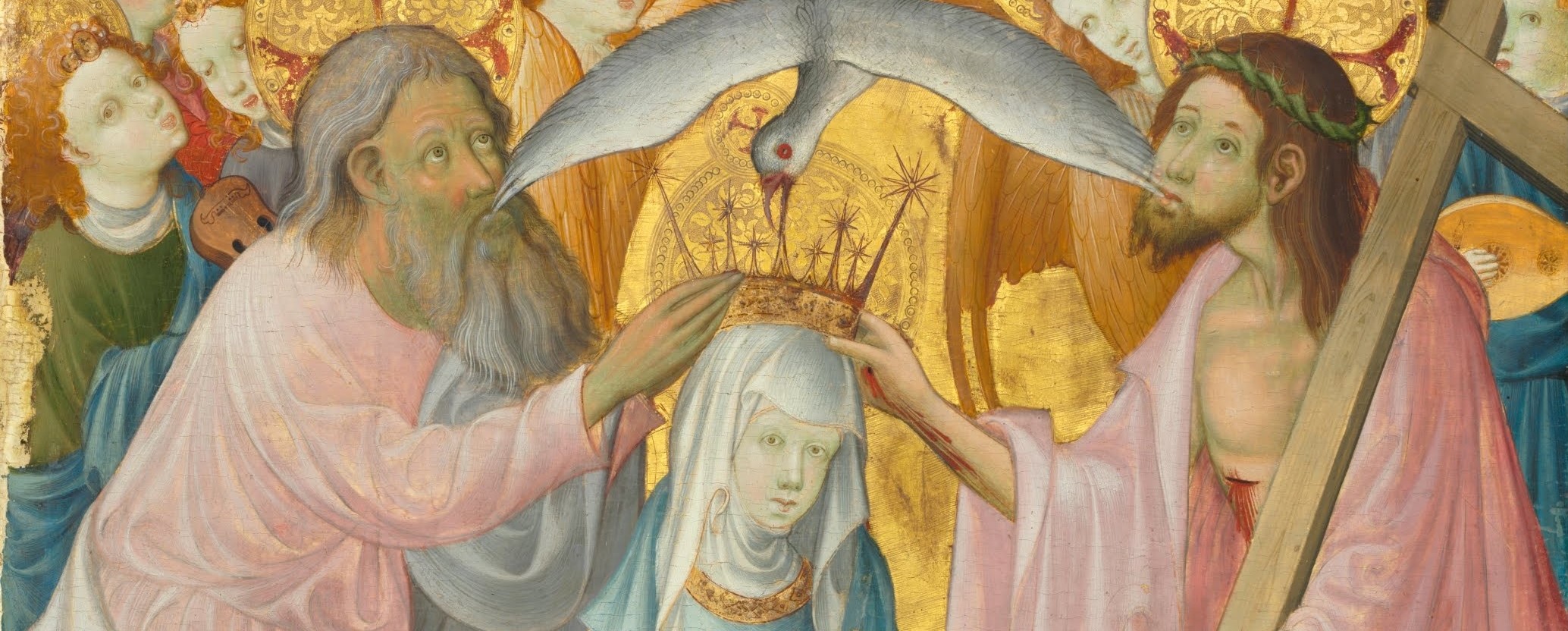
Mary’s relationship with the Most Holy Trinity constitutes one of the structural axes of the Mariology of the Second Vatican Council: the Father who predestined her from eternity (Eph 1:4), the Son who took flesh from her by the power of the Holy Spirit (Lk 1:35), and the Spirit who configured her as the living Temple of the divinity. Lumen Gentium (chap. VIII) integrated this Trinitarian structure into the heart of ecclesiology for the first time, overcoming the isolated Mariological model that had prevailed before the Council.

Mary’s Relationship with the Trinity in the Theology of Vatican II (Lumen gentium 53): Overcoming Pre-Conciliar Mariological Isolation
Until some time ago, discussing this theme was considered the highest sublimation of all Mariological study. Perhaps the past excesses in praising Mary, to whom titles such as “Domina of all after the Trinity,” or “Theotokos” and “agnus Dei,” were attributed, may today seem outdated and useless for theology. In the face of other expressions of this Trinitarian aspect of the Marian figure, one could even speak of theological violations of the limit, such as, for example, the conception that arose in the seventeenth century of “Mary as an exterior complement of the Trinity.”
Nevertheless, in the face of these extreme statements (which testify more to a failure before a difficult theological object than to a formally “Mariolatrous” intention), it would be appropriate not to refuse the debate on such a question. It has found serious authors down to the present day and has been summed up in concepts that undoubtedly seem more adequate to reality. Thus, Mary has been called a member of the “family” of the Trinity or “taken up into the circle of the divine Persons.” Or one has simply spoken of the “Trinitarian character” of Marian veneration (as well as of the Marian figure). The motivation for this theme, according to the current state of the consciousness of faith, does not correspond to a heightened tendency toward veneration or to an ever greater glorification of the Marian figure.
On the contrary. We start from the presupposition (which today would no longer meet with universal acknowledgment, but which is in itself necessary) that the Marian figure and Marian doctrine cannot be excluded from theological thought. The Marian mystery represents an eminent factor and a focal point of the Catholic faith in which all these essential truths of dogma meet and converge. But Marian doctrine also sheds new light on the fundamental truths of the faith. For this reason, the question of the specific bond of the Mother of God with the Triune God is indispensable. In a period in which even the concept of “Mother of God” is again criticized and refuted with long-superseded Nestorian arguments, one might consider this bond of the Marian mystery with the mystery of the Trinity to be outdated, contenting oneself instead with a Marian residue that sees in Mary an ordinary example of Christian faith.
Thus it is presumed that she had “no special faith,” because for her too “the obedience of faith constitutes the leitmotiv.” In reality, even this residue (as the examples reported show) cannot be salvaged if the “turned toward God” being of the Marian mystery is not respected and if its property is not emphasized. A theology that sees Mary “only in a human way,” that is, one that understands Mary merely as an important historical example on account of a generic human or Christian attitude, cannot explain or maintain Mary’s special position in the history of salvation. Here it is necessary to demonstrate her particular relationship with God, her exceptional relation to the Trinity, even if in this demonstration the limits of creatureliness in Mary must not be exceeded.
A theology that no longer considers this “divine side” of the Marian mystery, or that consciously denies it, also deprives itself of the exceptional possibility of illuminating a determined point of salvific reality and of vividly illustrating the reality of the Trinitarian mystery, the property of the Three divine Persons, their relationship with the world and their action in the world. Today there is much talk of the “economic Trinity” that reveals itself within the history of salvation in God’s self-communication to the world and that must here become an “experience of salvation history.” But, in the final analysis, these attempts often result only in purely formal statements about the Incarnation of the Word and about the sanctification of the world through the Spirit.
From this it follows that in the question of the relationship of God’s self-communications with human beings as well, the personal character of these relationships remains strangely abstract and unilluminated. Here theology does not seriously confront the history of salvation in which these relationships are expressed with a singular concreteness in a human person, nor does it consider that this paradigm of God’s personal self-communication to human beings should illuminate the believing understanding of the Trinitarian mystery that extends over the created order. Thus, the question of the Trinitarian aspect of the Marian mystery is far from serving one-sidedly the exaltation and glorification of the Marian figure.
It finds its deepest motivation, rather, in rendering the figure of Mary transparent in her referential function and in her expressive force in relation to the fundamental mystery of Christianity. Here the serving position of the Mother of God can show itself under a new profile within salvific reality: now not only before the God-man, but also before the Trinitarian mystery of God as a whole. It is no accident that the mystery of the God-man is likewise emptied and the Trinitarian mystery itself is stunted wherever the special theological relevance of the Marian idea is denied. From this perspective, there is no need to underline the fact that such attention to the “divine-Trinitarian side” of the Marian figure also offers stimuli to the anthropological-existential part of the pro me of man.
Nevertheless, this Trinitarian theology that shines forth in the Marian mystery cannot be identified simply with anthropology (according to the hasty identification between theology and anthropology), but is directed (precisely through Mary’s mediation) immediately to the human being as such.
Mary as the Mirror of the Trinitarian Relations: Jean Ambroise Saint-Cyran (†1643) and God’s Intra-Divine Self-Communication in the History of Salvation
According to Jean Ambroise Saint-Cyran (†1643), Mary is “the most perfect mirror of the divinity, a mirror in which the ineffable intra-divine relations shine more than in any other creature.” This statement, although correct, should be completed in the sense that such relations are manifested in the history of salvation. Hence arises the question of the event of salvation history in which they shine most intensely. From this event the Trinitarian contemplation of the Marian mystery should begin. Leaving aside the (here irrelevant) problem of the fundamental Mariological principle, we can say that all the lines of content lead back to the event of the Incarnation of the Son, to whom Mary gave human nature.
In the bond of the Word with the human nature assumed from Mary, not only was the personal filiation of the Word realized outward and toward humanity in a unique and proper manner, but a unique relationship was also established with the virginal Mother of God. A relationship that, however, is not perfectly described under the Trinitarian aspect by the concept of “divine motherhood.” In fact, even if a new relation is established between Mary’s motherhood and the divine person of the Word, in this relationship so named the reciprocal relationship of the incarnate Word with the Mother of God is not adequately expressed.
By the name “mother” one understands principally a relationship of dependence between a mother and her son, a relationship that forms part of the mystery of the kenosis of the Son of God in humanity, but that does not yet permit one to express the content of the majesty of this Son, of His superiority before the mother, of His position as head in relation to her, and of His redeeming power, which He brought to the mother in the particular manner of “pre-redemption.” In the face of this reality, theological thought has rarely expressed the personal relationship between the Incarnate One and the Mother of God with the indication of motherhood alone, but has completed that expression so as to integrate into this relationship the higher reality of the Son of God.
This happened, for example, through the attribution to Mary of the title “spouse” (already in Cyril of Jerusalem, Catech. XII, 26), then through the title “bride” (of Christ), but also through the attribution of the title “perfect image of the eternal Son” (M. J. Scheeben). All these titles mean to indicate that the mother’s relationship with the eternal and incarnate Son implies a wholly special union in which are inserted at the same time the essential dependence on the Son, the most profound communion with Him, the being a perfect image, and the natural-human motherhood with all its consequences before Christ Jesus. The analysis of these Christological personal relations of Mary shows in the mother-Son relationship a depth that fully merits the analogy of the bond of the Word with human nature, the analogy with the hypostatic union.
Although Mary is not raised to the order of the hypostatic union of the Word with a human nature, and even though she evidently remains a human person before the incarnate Word and in an ineffaceable subordination, she can nevertheless be recognized as mater-sponsa, as soror and adiuncta Christi in a profound moral union with His person, in a communion that proceeds from the hypostatic union and that finds here its immediate exemplar. This becomes still clearer if we look at Mary’s relationship with the other two divine Persons, a relationship that evidently, through the relation with the Son, is also directed to the Father and to the Holy Spirit.
In determining these relationships of Mary with the other two divine Persons, however, an apparently insuperable difficulty arises for theological thought. In the testimonies of tradition on this aspect, it is striking that generally the same attributions are chosen that were used to characterize the relationship between Christ and Mary. Thus, Mary is also called sponsa Patris or image of the Father, but also spouse of the Holy Spirit or His image and “icon.” The possible objection arises that the precise determination of Mary’s Trinitarian relationships leads, owing to a lack of discernment, to repetitions and to purely verbal designations that offer nothing to the believing knowledge of the Trinitarian mystery.
At this point, it should be answered that, evidently, before the unity of the three Persons and before their intimate union in the event of the redemptive Incarnation in Mary, each attribution of Mary’s relationship with one Person also refers to the whole Trinity. In this way, the relationship with another Person is also touched upon. It is not a logical error if traditional theology used the indications for Mary’s relationship with the divine Persons interchangeably, but rather a sign of the profound unity of the three Persons that makes itself felt likewise in the external relationships and in human attributions. Moreover, it cannot be forgotten that (both because of the analogous character of our words and because of their semantic function) the same name (spouse, image, dwelling, sanctuary) can receive, according to the context, a different nuance and a specific meaning. For the Trinitarian context this implies that the attributions given to Mary by her relationship with one Person receive another specific meaning when they are expressed in relation to another divine Person and to His personal property.
One does not understand the same thing when speaking of Mary as “spouse of the Father” and as “spouse of the Son.” In the first case, one perceives a relationship that arises from the fact that Mary participated (in an analogous manner) in the generation of the Son, just as the Father accomplishes the eternal generation. Here, however, the transfer of the concept “spouse” to Mary’s relationship with the Father already shows its problematic character. To use this title for Mary’s relationship with Christ brings to the foreground the idea of the Son’s self-giving to the mother, of His profound covenant with her, and of Mary’s subordinate involvement in the life and action of the Son. In the context of the problem of interchange and of the apparent imprecision of Mary’s Trinitarian personal relationships, one last argument must also be taken into account, which shows how throughout the history of theology a precision of these titles and an interwoven harmonization prevailed, restricting the reciprocal interchange and taking concrete form, among others, already in the ternary of Rupert of Deutz (†1135): Mary is “spouse of the Father, spouse and mother of the Son, temple of the Holy Spirit.”
In no way should the existence of these personal relationships of Mary with the divine Persons be doubted on account of these objective difficulties still to be resolved, even if the question of the strictly proper character of the relationships of a divine Person with a creature is not yet resolved. As for Mary’s special relationship with the Father, it derives from Mary’s singular union with the Son, in which the mother is united to the Son of the Father in the most perfect manner possible between a divine Person and a human person. If the property of the Father in the Trinity consists in His being absolutely unbegotten, in His being principle, and in His paternity in relation to all uncreated and created realities, one can explain how Mary, by means of her singular relationships with the only-begotten Son of the Father, enters into a special relationship with this Father as well. This relationship should not be derived so much (as criticized above) from the parallelism between eternal and temporal generation, for this could dangerously lead us to place Mary almost alongside the Father.
In reality, Mary receives her special affinity to the first divine Person precisely through her direct and formal subordination to the paternity that is prolonged in the mission of the Son in the flesh. Since this mission was for Mary an event of grace, Christian tradition, with due regard for the measures and the limits to be observed, defined Mary’s relationship with the Father initially as filiation, more precisely as adoptive filiation. Nevertheless, tradition worked out the difference from the adoptive filiation of all other human beings endowed with grace, inasmuch as it added that Mary as “daughter of God” or as “daughter of the Father” is distinguished not only by a particularly intense participation in the eternal filiation of the Word whom she generated according to humanity, bearing Him within herself in body and spirit, but that with this generation there also comes a special likeness to the Father.
From Mary’s ontological union with her Son, the Virgin was able to participate in a superior manner in this filiation and could also be called (around the Carolingian era), through the application of sapiential passages of the Old Testament, “the created wisdom” of the Father, which is set over against the Father together with the Son as “the uncreated wisdom,” while being nevertheless like the Father through a particular imago Patris. This affinity of Mary with the Father through participation in the filiation of the Son was legitimately underlined by theology also with the idea that the eternal decree of the Father for the Incarnation of the Son through the Virgin Mother was joined to the decree to create Mary as sedes et vas Sapientiae. This singular relationship of origin with God constitutes an exceptional filiation of the human person of Mary in relation to the Father in the order of grace, which is an immediate reflection of the filiation of the Word and which unites the Mother of God with the Father in a communion that surpasses the created measure. Mary, because she owes her origin to the special love of the Father and of the Son, also draws near to the Holy Spirit, the love become person between Father and Son.
Nevertheless, it is not only this likeness of origins that gains for Mary a special relationship with the Holy Spirit. More fundamental for the constitution of this relationship with the Spirit is once again her union with the incarnate Son, the divine Word from whom the person of the Holy Spirit proceeds. Christian tradition had no scruple in calling her also mater Verbi (incarnati) spirantis Spiritum, even if the relationship with the Spirit is here expressed only on the mother’s side and in a one-sided manner. The other side is shown through the function of the Spirit of God in the Incarnation of the Son, a fact attested with a wealth of meanings in the words of the angel to Mary. Although the statement that the Holy Spirit would descend and the power of the Most High would overshadow her leaves open in exegesis the question of the personality of the Spirit (Lk 1:35), it cannot be doubted that in these words of Scripture, oriented to the economy of salvation, the Holy Spirit is presented as the productive principle of the Incarnation of the Son through the Virgin, a principle that also creates the unity of the mother with the Son, without performing the function of a human father.
This action of the Spirit must be understood as an act of a perfect and sanctifying love, in which Love, become person of God Himself, extends His Trinitarian force of union and cohesion over a human person who is drawn into the Trinitarian life of divine love through the personal nexus of union that the Holy Spirit is within the Trinity. From the fruitfulness of this love, Mary generates the humanity of the God-man. The Spirit is, within the Trinity, the principle of the most sublime summit of mutual knowledge and an ecstasy of love and of fulfillment in a “suprapersonal we” of the Persons. He accomplishes this function in the Incarnation of the Son also ad extra, in Mary.
Since the Mother of God opens herself perfectly to this effect, there enters into her not only the fullness of created grace (cf. Lk 1:28), but she is also led to union with the grace of God become person, a union without precedent in the history of creation and of salvation. Thus it becomes understandable why tradition, in order to determine Mary’s personal relationship with the Holy Spirit, again chose the title sponsa as well. This name, however, does not seem very adequate, because it has already been used in the Christological relation (even in the form of mater-sponsa) and because it is not entirely compatible with the power of the Holy Spirit that penetrates all things, that surpasses every “standing before,” and that impels Him to communicate Himself and to vivify all things.
Tradition was aware of this, if for this relationship it chose the Marian title sacrarium Spiritus Sancti, or that of “organ” or “vessel” of the Holy Spirit, even though these designations do not give a wholly convincing description of the person of Mary. For this reason, preference should be given to those titles that describe Mary as the most perfect human-personal image of the Holy Spirit, as human irradiation of the Spirit, as “icon of the Spirit” in human-personal form, as human representative of the love, the beauty, and the purity of the Spirit of God. There is no need to demonstrate that these personal relationships of Mary with the divine Persons are evidently directed also to the whole Trinity and raise Mary to the maximum participation of a human person in the Trinitarian life.
This description surpasses the explanatory possibilities of the traditional psychological doctrine of the Trinity. It also surpasses the scope of a modern existential conception in which the Trinity is to be understood only through the fundamental human acts of living together and of loving. More important, however, is the question of the manner in which this Trinitarian aspect of the Marian mystery is also anthropologically relevant, so as to be able to say something to man.
The Anthropological Reflection of Trinitarian Mariology: Mary as the Model of God’s Self-Communication to the Human Being
The demonstration of such an anthropological reflection is clearly comprehensible to one who still sees himself theologically, that is, from the relation with God (which is potentially valid for every human being). The objection may arise here that a determination of this relation according to the long-perpetuated scheme of the “I-Thou,” in which God in a unitarian and totalizing manner takes the place of the absolute Thou, does not satisfy deeper theological thought or the demand of the believer. In this way, only the opposition of God to man is established, the ineffaceable distinction, and a monotheism is constituted that cannot grasp or express the fullness of the Christian Trinitarian mystery.
Recent theology has long sought to remedy this lack, demonstrating also that each of the three divine Persons enters into a proper and unique relationship (and not merely an appropriated one) with the human being endowed with grace. At first sight, it may not be easily comprehensible what the anthropological and practical-religious relevance of this highly speculative theme of the proper personal relationships of the divine Persons with the grace-bearing human being might be. But with a deeper look, it can become clear that what is principally at stake is a deepened communion of the life of faith with the Trinitarian mystery. And it is only through the verification of these proper personal relationships that the human being endowed with grace is bound directly to the inaccessible primary cause of the Father (as the “God above us”), to the Son who proceeds from the Father toward the world (the “God with us”), and to the Spirit who permeates and vivifies all things (the “God in us and around us”). It is clear why these last subtle bonds are grasped by the human spirit with extreme difficulty. But in Mary they were opened in a singular manner and presented to the sight of the believer.
The Trinitarian-Marian aspect conveys, first of all, with regard to the relationship with the Son, the event that the hypostatic union of the Word with a human nature, which took place in Mary, places the mother in a singular relation with the Incarnate One. A relationship that must be established precisely by the Word, because here the second divine Person extends His property as Word, revelation, and splendor of the Father over a human person, binding Himself to her in a unique way. Although the cause of the Incarnation, seen as actus ad extra, was strictly one with respect to the Persons, it nevertheless led to a formally different relationship between the Word and humanity. For this reason, the Incarnation too is attributed not in an appropriated manner, but in a manner proper to the Person. This must hold also for Mary, who appears almost as a correlate of the Son in the Incarnation. From the moment a proper personal relationship of a divine Person with the human is established, such a relation cannot be denied to the other Persons, even if their union with the grace-bearing human being does not occur by means of the hypostatic union.
Mary’s maternal-spousal bond with the Son already implies also a strictly personal relationship with the Father (and vice versa), but equally a corresponding personal relationship with the Spirit as “Spirit of the Father and of the Son,” the Spirit who pours out upon Mary all His divine fruitfulness and thus fulfills in her His own Trinitarian function. For this reason, Mary is the exceptional paradigm of the most profound intimacy by which the divine Persons grant a human person a share in their relational character and enter with her into a relationship corresponding to their very being.
Thus, Christian tradition did well to attribute to the Trinitarian-Marian relational concepts predominantly a specific meaning proper to the Persons. There remains open, however, the other question concerning the anthropological use, that is, whether the Marian figure as so singular a speculum Trinitatis can be relevant also for the whole of humanity. Here one must first consider the boundary that exists between a Trinitarian structure and a participation (of Mary) mediated through participation in the hypostatic union, and a Trinitarian relationship of other human beings constituted only through a simple communication of grace and of the divine nature.
But this difference, on the other hand, cannot be so strong as to exclude other human beings from such a Trinitarian relationship. Although Mary stands at the summit of humanity with her personal character turned toward God, representing the most intense created realization of the human personal relationship with God, she nevertheless remains a member of the whole and therefore also an effective bond for extending this Trinitarian relationship over all humanity. Precisely from Mary’s Trinitarian relationship, a new argument is to be found for the personal relationship of the divine Persons with the justified. This relation certainly does not find here the same perfection, intensity, and immediacy as in Mary, whose likeness to God represents the highest and therefore unique example of the Trinitarian bond of a human person.
Therefore, this “case” should not be understood as exclusive in its essence (even in its mode of realization). Mary’s Trinitarian relationship, like all her being and acting for humanity, has an inclusive meaning: humanity participates in Mary, the “bridal chamber” in which the “marriage” of the Son of God with human nature was accomplished, in the creation of a specific relationship with the Trinity. This fact carries with it consequences for the theological understanding of man before God. These consequences can all be summed up in the idea that man is not merely set over against the one God, but that he is destined for exchange, for commerce with the infinitely dynamic life of the Trinity, a life that is realized in personal relationships. Already now, man is involved in this relational circuit of the divine life.
The relationship between the Trinity and Mary is examined in greater depth in the encyclical Redemptoris Mater by John Paul II, which explores Mary as the privileged place of God’s Trinitarian self-communication.
Deepen your studies: explore Mariology, Marian Theology, Marian apparitions, and the Postgraduate Program in Mariology.
Postgraduate Program in Mariology
Would you like to deepen your formation in Mariology? Discover the Postgraduate Program in Mariology of Locus Mariologicus, an academic formation that unites theological rigor, spiritual life, and the living tradition of the Church.
Would you like to study Mariology seriously?
This article arises from the works in the library of Locus Mariologicus. The Postgraduate Program in Mariology brings you to the same source, with academic guidance: Scripture, the Fathers of the Church, and the Magisterium, from the first dogma to contemporary questions.





Responses