Wedding at Cana and Calvary archaeology and truth
Wedding at Cana
Let us now consider Cana, likewise linked to the memory of the first miracle of Jesus, at which the Mother was present. Three localities disputed the honor of being identified with the Gospel site of Jn 2:1-12: Khirbet Qana, Khirbet Kenna, and Kefr Kenna. Recent scholarship has identified Cana with Kefr Kenna. The studies of the architectural elements still visible, the occasional excavations, the regular archaeological campaigns, the pottery, the numismatics, the mosaics found, and the Byzantine literature all contribute to this identification.
The Cana of the Gospel goes back to the Bronze Age and reaches down to the present day, still inhabited and situated on the road between Nazareth and Tiberias. The period of Jesus is attested at the site by a coin of Herod I and another of Titus from the years 80-81. There is also a jar with a spherical body and well-fired walls. The best attested period is that of the third and fourth centuries. There are, in fact, two large buildings, separated by a corridor that leads to the courtyard, paved with stones of various sizes. The walls are built of fine stones with a smooth projecting boss like the Herodian ones, probably reused. These buildings were probably visible until the eighteenth century.
Bellarmino Bagatti dated the main building to the third century, comparing it with the elements reused in the Franciscan church or with others discovered by chance. For the scholar, it is a Jewish-Christian synagogue parallel to that of Nazareth. Evidently, there were three types of columns, large, medium, and small, which served for the matroneum and for ornamentation. There were two types of cornices and three doors on the façade. Finally, there were mosaics with cross-shaped floral motifs, common at Jewish-Christian sites, and a marble fragment of an altar table with its small supporting column, indicating its Christian nature. In it, probably, the Table of the Lord was preserved, as at Nazareth and, as we shall see, at Tabgha. Near it, Christ took part in the Wedding at Cana.
The famous Aramaic inscription that speaks of a tabula refers to it. The Piacenza Anonymous celebrated there both the pure supper and the ‘azkarat. Other chance discoveries have made it possible to reconstruct the history of the hill of Karm er Ras, inhabited from Hellenistic times onward, where elements of a second synagogue were found, and a cave in which the Jews prayed and danced. Presumably, then, at Cana there were two quarters and two synagogues, one Jewish and the other Jewish-Christian, as in other places.
Calvary
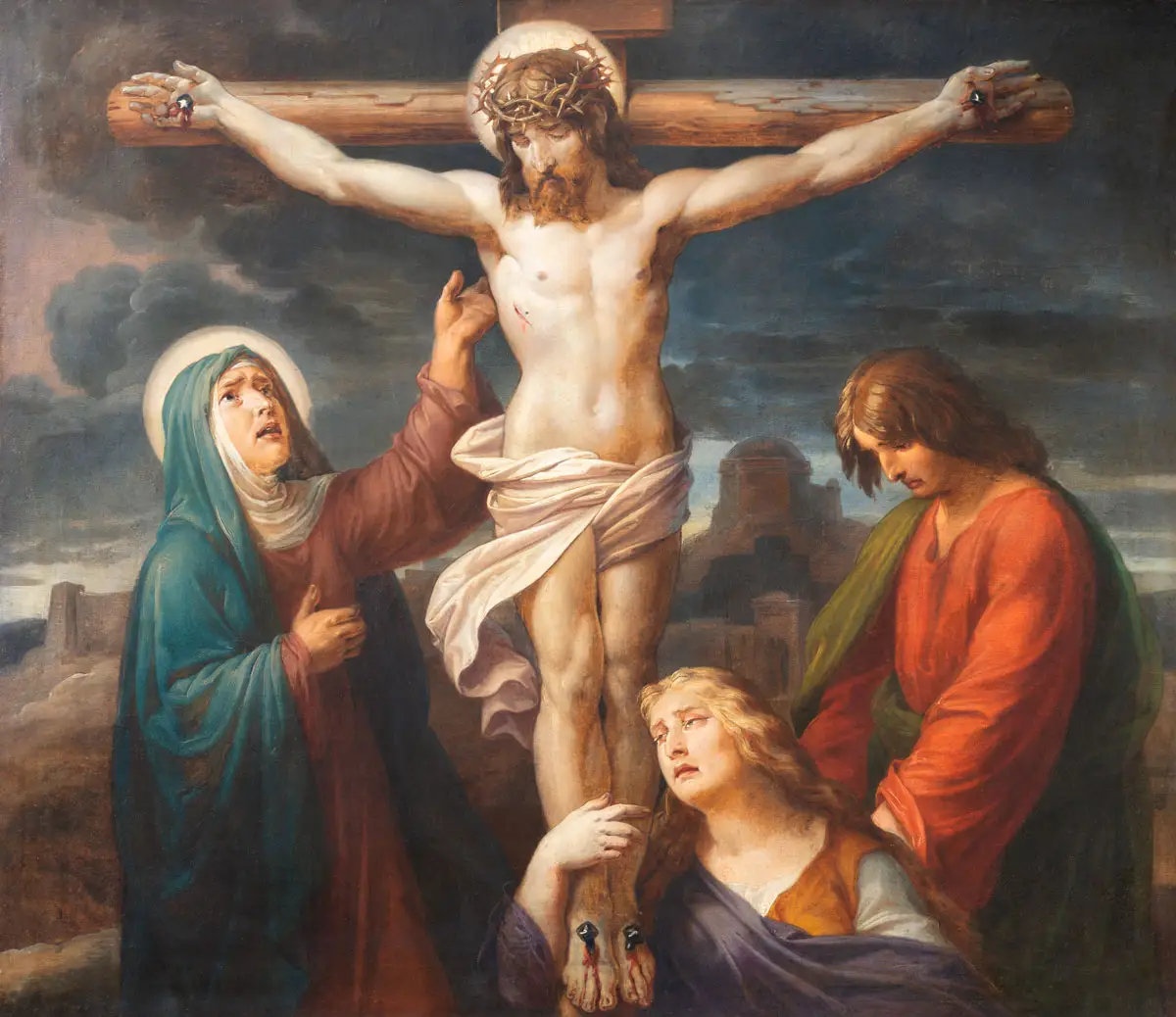
Let us now concentrate on the places of the Death of Christ, at which Mary was also present, that is, Golgotha with the Holy Sepulchre. N. Avigad identified the gate through which Jesus passed to reach the place of His execution, called the Garden Gate. It stood where the Second Wall separated from the First and gave access to a space between them, in the corner, where there was a quarry that protected the Second Wall on the west. Here Herod the Great planted a garden, but the workmen left intact a very friable block of stone that could not be leveled, which was precisely Golgotha, on which various debris accumulated until it was transformed into a hill in the shape of a skull, from which comes its Hebrew and Latin name (Calvary). North of Calvary there was a private garden with some aristocratic tombs hewn in the rock, among which that of Joseph of Arimathea became the temporary tomb of Christ. This one was hewn in the living rock. Composed of a vestibule and a burial chamber with a long shelf in the funerary niche, the tomb was closed by a stone of circular shape, which could be rolled along a kind of track. The surrounding tombs attest to the truth of the location: a cemetery with Jewish tombs and sarcophagi. A tomb today under the Coptic monastery. A burial area under the Syrian chapel, today cut in half by the Constantinian Basilica. Such tombs existed before A.D. 42, when Herod Agrippa I (37-44), by incorporating them into the city with the Third Wall, in fact prevented the appearance of new tombs. In the time of Jesus, therefore, Golgotha lay outside the city. For a certain period the theory spread among scholars that this was not possible, and so Charles Gordon identified the Holy Sepulchre at the site of the hill of es-Sahra, with the so-called “Garden Tomb,” which today is no longer held by anyone. The area has been extensively excavated. The excavations of Mallios and Katsimbinis in 1958 and in 1973-77, carried out by Florentino Diéz, revealed in the eastern part the rock, twelve meters fifty in height, partly cut away and partly carved to receive an almost hexagonal facing wall. Seven meters twenty above the ground, a natural cave two meters high and wide was found, faced with barely dressed stones. Two meters from the facing wall rises another parallel wall. Between them, five meters above the bottom and about two meters below the level of the cave, there is an oven. It is the space called in the texts “post crucem” and the famous Cave of Treasures, in the cracked rock of Golgotha and linked to the cycle of Adam with the tomb of our patriarch and the setting of Christ’s descent into hell, the entrance to sheol being found there. Among the Treasures were the Holy Lance that pierced the Heart of Christ, the sponge that slaked His thirst, and the image of Our Lady of Sorrows. This is recalled in the Passion of Lucian of Antioch. The space was also linked to the Paschal Triduum, with the lament of the New Eve awaiting the Resurrection, as the Dormitio Mariae of the Jerusalemite tradition attests. The oven served as a censer in which aromatic woods were burned during the funeral rites. The excavation has also given back to us the foundation walls of the Temple of Venus, recalling the lament of the goddess to resurrect Adonis. In fact, Hadrian profaned Calvary and the Holy Sepulchre, leveling the original quarry of ten to twelve meters, in order to build upon it the Forum that bore his name in Aelia Capitolina. In it, the Temple of Venus was raised exactly over the Tomb of Christ and dominated the Market Square. A marble statue of the goddess stood on the rock of Golgotha. Eusebius and Sozomen speak of this temple. It was also reproduced on the coins of Aelia Capitolina. In the vicinity of these places, however, the Jewish-Christians kept alive the cultic tradition linked to the Death, Burial, and Resurrection of Jesus. After 325, the bishop of Jerusalem, Modestus, asked that the holy place be freed from the sacrilegious constructions, and Constantine brought to light the Cave of the Tomb. The ancient Jewish-Christian traditions with their relics were preserved in the new imperial constructions. Eucherius contemplated the living rock, whose location we shall discuss today. The Anonymous of the Breviarius de Hierosolyma venerated the Lance. The Piacenza Anonymous reverenced the image of Mary Most Holy, before which Saint Mary of Egypt implored her conversion. Arculf found a Marian chapel linked to the Pietà and the Mater Dolorosa. The first church was raised by Constantine around the Holy Sepulchre in 366. It had the form of a circular mausoleum called Anastasis, which means “Resurrection” in Greek. The Rotunda over the Tomb, called the Great Apse, is flanked by two transepts to the north and to the south. Along the south transept rise the columns of the restoration made by Constantine IX Monomachos. On the eastern side, in front of the Anastasis, is the stylobate of the eastern gallery. In front of the columns, at the angle with the stylobate, are the remains of Calvary. Constantine I had removed the living rock of the Tomb, which is now completely hidden by a nineteenth-century Russian Orthodox superstructure, overloaded with ornaments. Through the atrium, called the Chapel of the Angel, one enters the burial Chamber, a square room about two meters on each side. The stone on which the body of Christ was laid is covered by a marble slab. From the ceiling hang forty-three precious lamps, divided among the various Churches in proportion to the share they possess of the building. Behind the western arches of the Rotunda, the rock-cut tombs mentioned above can be seen. Inside, two steep staircases of fifteen steps lead to the mount of Golgotha, which Constantine carved out of a single block of rock five meters high and six meters wide. The surface was faced with mosaics and divided into two chapels by columns. In the area currently owned by the Franciscans, on the right, are the Tenth and the Eleventh Stations of the Via Crucis, that is, the Stripping of the Garments and the Crucifixion. In the chapel on the left, the Twelfth is commemorated, that is, the Death of Jesus. At the foot of Calvary is the Stone of Anointing, which commemorates the Thirteenth Station, that is, the Deposition. Beneath the altars of Calvary is hewn precisely the Cave of the Chapel of Adam. Here one can see the rock split during the earthquake that accompanied the death of Jesus and that I mentioned. On the east wall of the Adamic Chapel was the Cave of the Jewish-Christians. In the Byzantine period, a courtyard was attached to the Rotunda of the Tomb, in which Calvary was visible in the open air. The five-aisled Basilica was built later. On the eastern side, it was preceded by an atrium accessible from the ancient forum through three doors, some parts of which are still preserved in the Russian Monastery of the Muristan, which was once a hospice for pilgrims. Beyond the proto-Byzantine apse was the crypt of the Constantinian Basilica, which rested on the cistern where Helena, the Emperor’s mother, found the Cross. The Constantinian complex survived almost all the destructions, until the fatal one inflicted by al-Hakim in 1009. Since then, the Basilica has never returned to its original grandeur and completeness. The present plan is the Crusader one, corresponding to the church erected and consecrated in 1149. It connected the Rotunda to a Romanesque church that also included Calvary. The center of this building is today occupied by the Greek Orthodox choir, the katholikòn. An ambulatory with several chapels closes the church on the eastern side, from which, by way of a flight of steps, one reaches the Church of Saint Helena (the ancient Constantinian crypt), situated on a lower level next to the Chapel of the Finding of the Cross, likewise hewn in the living rock. Near this Chapel there is a wall with a famous graffito depicting
a ship. Around it are the foundations of the Byzantine martyrion. Beside it the Armenian excavations were carried out. Above it and adjoining the Basilica stood, in the time of the Crusades, the convent of the Canons of the Holy Sepulchre. On the roof, near the small dome of the Church of Saint Helena, a few remains of arches from that period can be seen, and an Ethiopian monastery with small cells stands there. Since the time of the Crusader reforms, the main entrance is on the south side, reached through an atrium bounded by ancient chapels. The façade is Romanesque, the most complete form of Romanesque architecture in the Basilica. The double arches of the portal, one of which was closed up in the time of Saladin, recall the Beautiful Gate of the Temple. These are the historical places where Christ died, was buried, and rose again.
Deepen your studies: explore Mariology, Marian Theology, Marian apparitions and the Postgraduate Program in Mariology.
On the presence of Mary at the wedding at Cana and on Calvary and its theological meaning, see the Encyclical Redemptoris Mater of Pope John Paul II.
Postgraduate Program in Mariology
Would you like to deepen your formation in Mariology? Discover the Postgraduate Program in Mariology of Locus Mariologicus, an academic formation that unites theological rigor, spiritual life, and the living tradition of the Church.


Responses