Ego sum via, veritas et vita: Mary and the Way That Leads to the Father
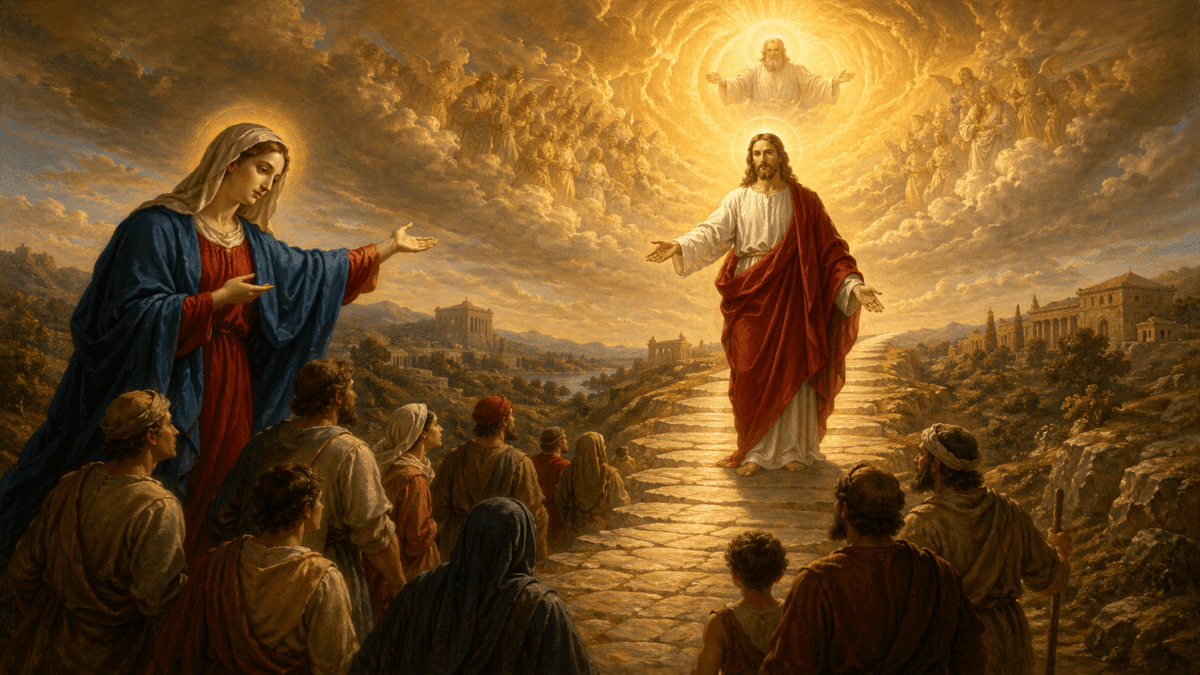
Ego sum via et veritas et vita. Nemo venit ad Patrem nisi per me.
Jn 14:6
“I am the Way, the Truth and the Life. No one comes to the Father except through me”. One of the most celebrated statements of Jesus in the Fourth Gospel, this threefold self-revelation answers Thomas’ question: “Lord, we do not know where You are going. How can we know the way?” (Jn 14:5). Jesus does not merely point out a way; He is the Way. He does not teach a truth; He is the Truth. He does not supply a recipe for life; He is the Life. Mariology has in Jesus-the-Way its absolute point of reference: Mary, who led to the Son, leads to the Father. She who is a model of the Way, not an alternative to it.
I. “I am the way”: The Logic of the Incarnate Way
The “way” (hodos) is a fundamental metaphor in the biblical tradition: “The Lord opens ways in the desert” (Is 43:19), “prepare the way of the Lord” (Is 40:3), “I will teach sinners Your ways” (Ps 25:8). In all these cases, the “way” points to the orientation of human life toward God. In Jn 14:6, Jesus makes an unprecedented statement: He does not point out the way; He is the Way. The direction toward God is not a set of rules or of practices, it is a Person.
This statement has enormous implications for Christian theology: salvation is not a process of self-improvement but a personal relationship. It is not enough to “keep the commandments” in a legalistic sense; one must “follow Jesus”, binding oneself to Him as a disciple binds himself to his master, as a member is bound to the body. The Christian “way” is the way of the imitation of Christ, not the way of the outward fulfillment of a law.
Christian religious life interpreted this “being the way” of Jesus in the light of Marian spirituality. St. Louis Marie de Montfort formulated the classic principle: “to Jesus through Mary” (ad Jesum per Mariam). This formula does not imply that Mary is a “detour” on the road to Jesus, it implies that, historically and spiritually, the way to Jesus frequently passes through His Mother. She who bore Him, who presented Him to the world, who said “do whatever He tells you”, is the one who best points out the Way.
The architectural analogy is illustrative: Mary is like the entrance portal of a cathedral that leads to the altar where the Blessed Sacrament is. The portal is not the destination, it is the access to the destination. But a well-built portal, adorned with images that narrate the history of salvation, one that prepares the visitor for the encounter with the sacred, fulfills an essential function: without it, the passage from outside to inside would be abrupt, without preparation, without due reverence. Mary prepares the human heart for the encounter with the Son who is the Way, the Truth and the Life.
II. “I am the truth”: Mary and the Revelation of the Face of God
Jesus as “Truth” in Jn 14:6 is not the truth of a proposition but Truth as Person, the full and definitive revelation of who God is. “Whoever has seen me has seen the Father” (Jn 14:9). Jesus does not merely “speak” the truth about God: He “is” the truth about God. In His person, in His gestures, in His words, in His death and resurrection, God reveals Himself fully. There is no revelation beyond Jesus; there is only an ever-possible deepening of the revelation that He is.
Mary, who “bore” the Truth, participates in a unique way in its revelation. She who was the first to contemplate the Face of the Son, who saw Him in the crib of Bethlehem, who received Him in her arms, who accompanied Him to the Cross, is the one who most deeply knew the “incarnate Truth”. Her contemplation was not merely exterior: it was interior, progressive, deepened over decades of shared life and of meditation.
The Marian title Sedes Sapientiae, Throne of Wisdom, expresses this participation of Mary in the Truth. She was the “throne” on which eternal Wisdom sat: not only in the physical sense (the womb where the Word dwelt), but in the spiritual sense (the heart where the Truth was contemplated and assimilated more deeply than in any other human being). The Wisdom that Mary bore in her womb was also the Wisdom that she bore in her heart.
The Dominican tradition in particular developed a Mariology of Mary’s “knowledge” that is complementary to the Franciscan Mariology of “grace”. Thomas Aquinas, though careful in his statements about Mary’s “knowing”, recognized that she received extraordinary intellectual graces, not infused knowledge in the manner of the prophets, but a contemplative penetration of the divine mysteries unequaled among human beings. This penetration was the fruit of her unique relationship with the incarnate Truth.
III. “I am the life”: Mary and the Source of the Life She Bore
Jn 14:6: “I am (…) the Life”. Jn 1:4: “In him was the Life”. Jn 5:26: “The Father has life in Himself and has granted the Son also to have life in Himself”. Johannine “life” (zoe) is not biological life (bios), it is divine life, the life that comes from God and that leads to God, the eternal life that begins already in the present for whoever believes. Jesus has this life “in Himself” as a gift of the Father, and communicates it to those who believe in Him.
Mary, who bore the Son who “is the Life”, participated in a unique way in this communication of life. The Incarnation is the moment when eternal Life “entered” human history: the eternal Son assumes human mortality so that mortals may share in His immortality. Mary is the “point of entry” of this exchange of life: she, who was mortal, gave the Son her mortal flesh. The Son who is immortal communicates to her, and to all who are His, His divine life.
The monastic tradition developed the contemplation of Mary as “fountain of life” in the context of lectio divina on the Song of Songs: the “sealed fountain” of Song 4:12 was interpreted as Mary, from whom springs the water of life that is Christ. Rev 21:6 places on the lips of the Father the promise: “To the one who thirsts I will give freely from the fountain of the water of life”. Mary, as “channel of grace” (an expression that modern theology prefers to that of “fountain”, in order to preserve the uniqueness of Jesus as Fountain), participates in the distribution of this water of life.
The Assumption of Mary in body and soul is the most visible confirmation of her participation in the “Life” that Jesus is. The body that bore the Son, the body that was the “tabernacle” of Life, could not be subjected to definitive corruption. The logic of the Incarnation required that Mary’s body share in the Life that she bore: not only the soul, but the body, because it was with her body that she cooperated in the Incarnation of Life.
IV. “No one comes to the Father except through me”: The Exclusivity of Christ and the Role of Mary
Jn 14:6 ends with an affirmation of exclusivity: “No one comes to the Father except through me”. This exclusivity is the central affirmation of Christianity: there is no other Mediator, no other Way, no other Truth, no other Life that leads to the Father. All the other religious or philosophical “ways” that lead to God, if they truly lead there, do so by virtue of the unique mediation of Christ, explicitly or implicitly, visibly or invisibly.
This exclusivity of Christ does not annul Mary’s role, it integrates it. Catholic Mariology has always affirmed that Mary is “mediatrix” in a subordinate and participated sense, not in competition with the mediation of Christ. The Second Vatican Council (LG 62) carefully formulated this principle: “The maternal function of Mary toward men in no way obscures or diminishes the unique mediation of Christ, but rather shows its power”. Mary is not “another way” to the Father, she is the creature who most fully walked the one Way that is Jesus.
The formula ad Jesum per Mariam must be understood in exactly this sense: not that Mary is an autonomous way to God, but that, in the concrete history of each Christian, the veneration of Mary can be the means by which he opens himself to the Son. The great converts of history, Augustine (through Monica, who prayed so much beside the Cross), Pascal, Claudel, bear witness to this fact: the encounter with Mary prepared or deepened the encounter with Christ. But the final destination is always the same: the Father, through the one Way that is the Son.
Mary, who walked entirely the Way that is the Son and who points us to “do whatever He tells you”, leads not to herself but to the Father, through the one Way that is Jesus.
References
- Second Vatican Council, Lumen Gentium, n. 62 (1964).
- St. Louis Marie de Montfort, Treatise on True Devotion, n. 55-89.
- John Paul II, Redemptoris Mater, n. 38-47 (1987).
- R. Brown, The Gospel According to John, vol. II (1970).
- X. Léon-Dufour, Lecture de l’Évangile selon Jean, vol. III (1993).
Postgraduate Program in Mariology
Would you like to deepen your formation in Mariology? Discover the Postgraduate Program in Mariology at Locus Mariologicus – an academic formation that unites theological rigor, spiritual life and the living tradition of the Church.
Would you like to study Mariology seriously?
This article is born of the works in the Locus Mariologicus library. The Postgraduate Program in Mariology brings you to that same source, with academic guidance: Scripture, the Fathers of the Church and the Magisterium, from the first dogma to contemporary questions.




Responses