The Epitaph of Abercius and Mary: the oldest Marian epigraphic testimony
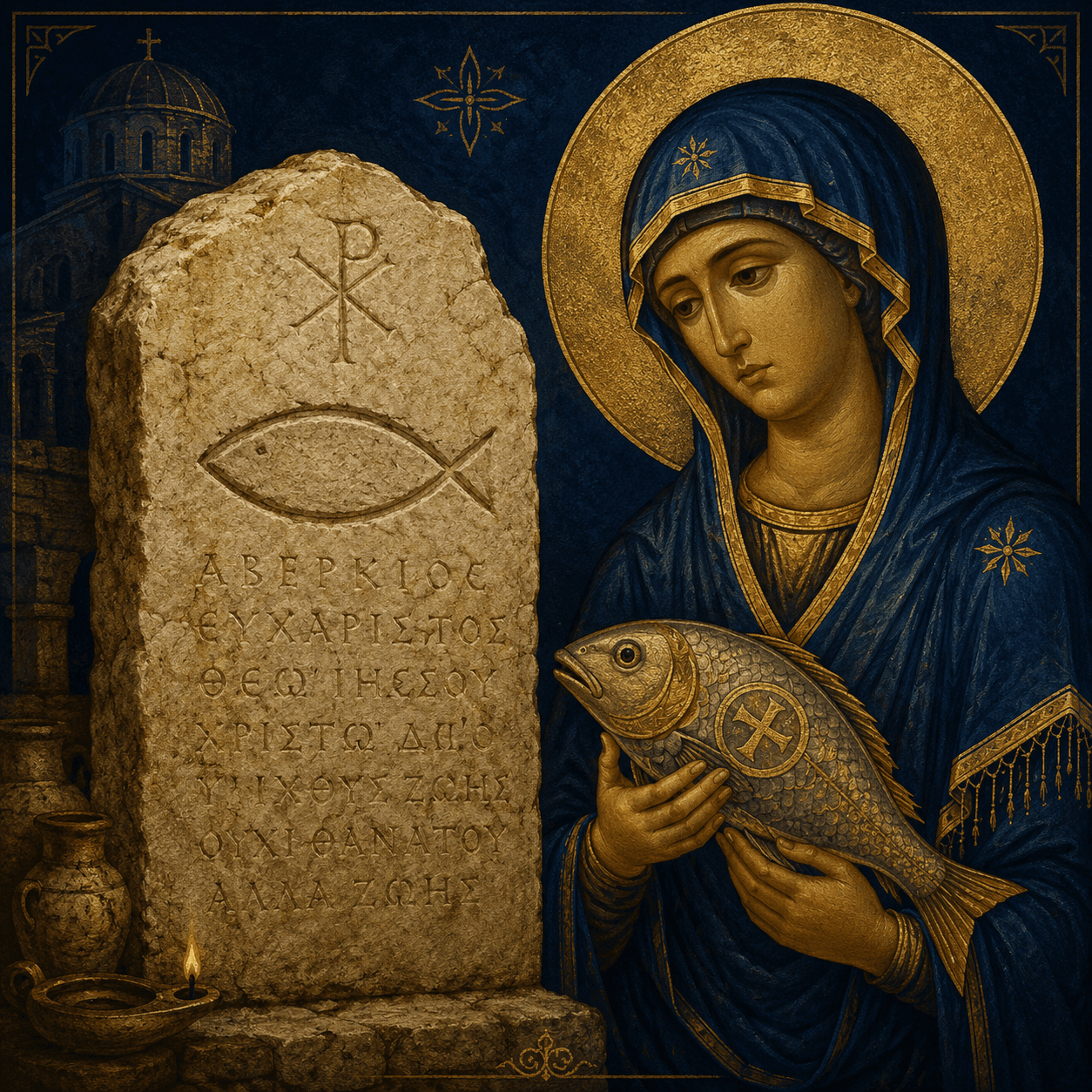
Abercius of Hierapolis, bishop of Roman Phrygia in the second half of the second century, holds a singular place in the history of Marian testimony. His Epitaph, a funerary inscription in Greek discovered in 1883 and today preserved in the Vatican Museums, is the oldest known epigraphic document explicitly associating the figure of the Virgin with the mystery of the Incarnation. Its value is all the greater in that the testimony is not literary but lapidary: these are words carved in stone by a Christian bishop of Asia Minor, at the end of the second century, intended to endure beyond death.
I. The Epitaph of Abercius and its historical singularity
The Epitaph of Abercius was discovered in 1883 in the excavations of Hierapolis in Phrygia Salutaris, in present-day Turkey. Three years later, in 1886, the funerary stone was offered to Pope Leo XIII and installed in the Vatican Museums, where it remains one of the most precious documents of Christian antiquity. The inscription, written in Greek and filled with symbolic and veiled language, was composed by Abercius himself before his death, around AD 180-190, thus becoming a spiritual testament carved in stone.
The singularity of the Epitaph of Abercius lies in the fact that its author did not resort to the open and direct language of the literary texts of his time. In an age of intermittent persecutions, cryptic and symbolic language functioned as a code of recognition: only the initiated faithful were able to decipher the full meaning of the images evoked. The funerary stone of Abercius is therefore not a simple biographical epitaph, but a compendium of Christian faith in which the figure of the Virgin occupies a structural place.
II. The “chaste Virgin” in the epitaph: the Mariological core of the inscription of Abercius
The central passage of the Epitaph of Abercius for the history of Mariology is the description of a “chaste virgin” who catches the fish from the spring and distributes it to friends as eternal food. The text, in its English translation, proclaims: “faith gave me as food a fish from the spring, very great and pure, which a chaste virgin caught and distributed to friends to eat forever”. The expression “chaste virgin” is, in the context of the Christology and the Mariology of the second century, an unequivocal reference to Mary, the virginal mother of the Lord.
The double qualification, virgin and chaste, is not a rhetorical redundancy. The noun “virgin” designates the state of original integrity, the absence of any human contact that could compromise the divine origin of the conception. The adjective “chaste” adds the moral and spiritual dimension: the purity that Abercius attributes to Mary is not merely anatomical but ontological, consonant with the divine election that precedes and constitutes her. This apparently subtle distinction anticipates categories that later theological reflection would make precise in the doctrine of the Immaculate Conception.
III. The ICHTHYS and Mary’s function in the Incarnation according to Abercius
The image of the fish in the Epitaph of Abercius is not a decorative ornament: it is a theological acronym of high density. The Greek word ichthys (fish) condenses, read vertically like a crossword, the complete Christological formula: Iêsous Christos Theou Huios Sôtêr, Jesus Christ Son of God Savior. The fish is therefore Christ Himself. And it is this Christ whom the “chaste virgin” catches, that is, receives into her flesh by the operation of the Holy Spirit.
The metaphor of fishing is theologically precise. To fish means to go out to meet something that exists in the aquatic element, that is, in eternal divine existence, and to bring it to the surface, into the human and historical dimension. Abercius thus describes the mystery of the Incarnation with an image of extraordinary effectiveness: the Virgin does not create the Son of God, but welcomes Him, receives Him from the spring and makes her flesh the means by which the Savior becomes accessible to men. Without the chaste Virgin, the fish would remain in the depths of an inaccessible divinity.
IV. The Eucharistic and ecclesial dimension of the inscription of Abercius
The Epitaph of Abercius does not exhaust its Mariological scope in the affirmation of Mary’s virginity. The inscription continues with an image of Eucharistic character: the Virgin distributes the fish she has caught to the friends of Christ, so that they may eat it forever. This distribution prolonged in time points to Mary’s function in the sacramental economy of the Church: she does not merely conceive the Son of God once in history, but continues to be the mediatrix of His presence among the faithful, along the lines of what the orthodox Mariological tradition would call universal spiritual motherhood.
The inscription further adds that there is an excellent wine that is given mixed with bread, an image that directly evokes the Eucharist celebrated in the early Christian communities of Asia Minor. For Abercius, Mary, the fish and the Eucharistic banquet form an indissoluble whole: the Incarnation brought about by the chaste Virgin is the sacramental foundation of all Christian life. This intuition, expressed in symbolic language on a funerary stone of the second century, anticipates the theological reflection that later centuries would develop in the doctrine of Mary’s association with the redemptive sacrifice of her Son.
V. The Mariological legacy of the epitaph of Abercius
The Epitaph of Abercius represents a point of confluence among several currents of early Mariology. The “chaste virgin” who catches the ICHTHYS unites in herself the confession of virginal motherhood, mediation in the Incarnation and association with the Eucharistic banquet. All of this is condensed in a lapidary inscription of cryptic scope, written by a bishop of Asia Minor around AD 180-190, in a language that only the initiated could fully decipher.
The fact that the document is epigraphic, and not literary, is of considerable historical importance. Literature can be copied, interpolated or transmitted with variants. Stone does not lie: what Abercius carved on his tombstone is what he believed at the moment of composition. The Epitaph of Abercius therefore attests that the confession of Mary’s virginal motherhood as the condition of the Incarnation of the Son of God is not a late theological elaboration, but a conviction of faith of the Christian communities of Asia Minor already at the end of the second century. Cf. Lumen Gentium, no. 55: “These prophecies of the Old Testament were fulfilled in her”. The study of patristic Mariology is part of the curriculum of the Postgraduate Program in Mariology at Locus Mariologicus.
Postgraduate Program in Mariology
Would you like to deepen your formation in Mariology? Discover the Postgraduate Program in Mariology at Locus Mariologicus – an academic formation that unites theological rigor, spiritual life and the living tradition of the Church.
Would you like to study Mariology seriously?
This article is born of the works in the library of Locus Mariologicus. The Postgraduate Program in Mariology takes you to the same source, with academic guidance: Scripture, the Fathers of the Church and the Magisterium, from the first dogma to contemporary questions.




Responses