The Virginity of Mary: The Christological Sign of the Mother of God
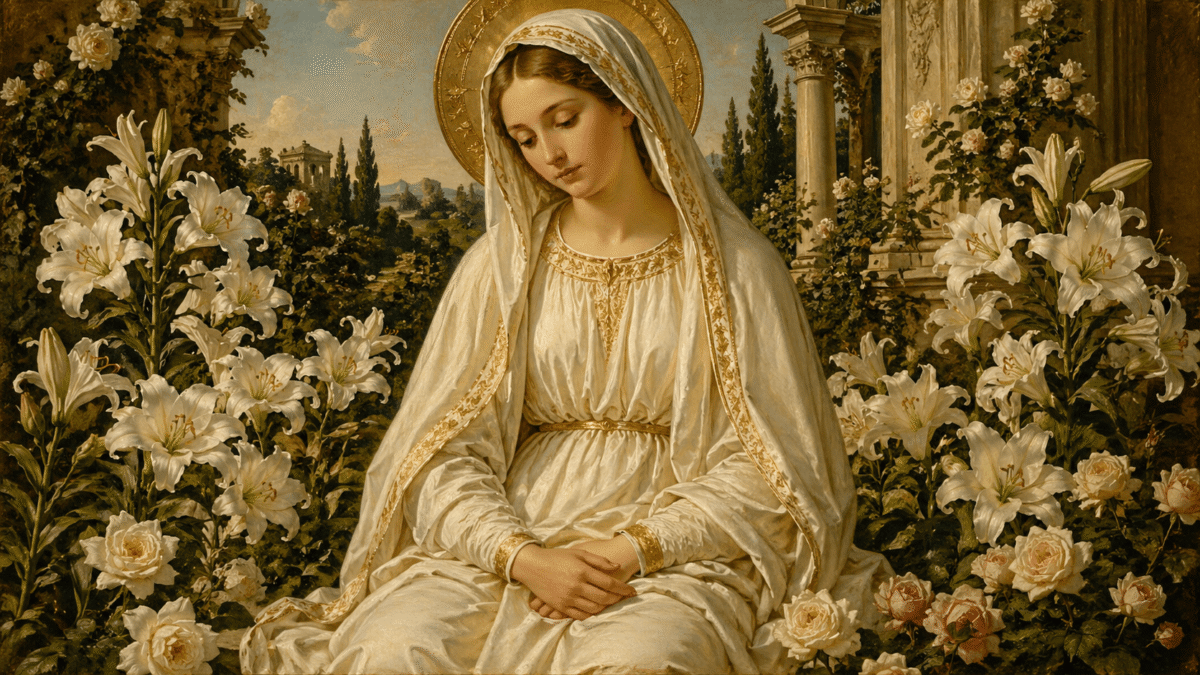
The Virginity of Mary, the Christological Sign of the Mother of God
The virginity of Mary is one of the densest data of the Christian tradition: Scripture and the patristic tradition affirm that Mary conceived virginally, gave birth without the loss of her virginal integrity, and remained a virgin throughout her whole life. Theology distinguishes three moments: ante partum (virginal conception), in partu (virginal birth) and post partum (perpetual virginity). For the complete article: Mariology.
The virginal conception (ante partum)
Matthew and Luke explicitly recount that Jesus was conceived by the working of the Holy Spirit without the intervention of a man (Mt 1:18-25; Lk 1:26-38). The convergence of the two evangelists points to the existence of ancient and independent Palestinian traditions. Paul, in Gal 4:4, in writing that the Son was “born of woman,” uses a paradoxical formulation that remains “positively open” to the virginal conception: the paradox requires that there be something singular in the way in which the Son of God becomes the son of a woman (A. Vanhoye). In Rom 8:3 and Phil 2:7, the expression en homoiômati (“similar”) indicates a similarity that is not identity with natural human generation.
The virginal birth (in partu)
Lk 1:35b, “that which is to be begotten will be called Son of God,” suggests that the generation of Jesus comes directly from the power of the Most High. The Lateran Council (649) defined that Mary gave birth without injury to her virginal integrity. The Second Vatican Council reaffirms this: at the nativity “her firstborn Son did not diminish her virginal integrity, but rather consecrated it” (LG 57). The virginal integrity of the birth is a sign that Jesus is the Son of God who comes from on high and inaugurates a new order.
Perpetual virginity (post partum)
The “brothers of the Lord” mentioned in the New Testament were not sons of Mary. The historiographer Hegesippus (second century), heir to Palestinian traditions, identifies James, Simeon, and Jude as sons of Clopas, a kinsman of Joseph: cousins of Jesus in Semitic terminology, where “brother” (‘ah in Hebrew) covers close relatives. Mt 1:25 (“he did not know her until she gave birth”) uses a Hebrew form that does not imply the contrary after the birth. Lk 2:7 (“firstborn son”) is a juridical title that designated the first son subject to redemption (Ex 13:2), even when he was an only son. Theologically, Mary could not desire anything “more” after having received the Absolute: like the jars of Cana, “her womb was filled to the brim.”
Ecclesial tradition
In the second and third centuries, the virginal conception was defended against the Ebionites (who denied the divinity of Christ), against the philosopher Celsus (who ridiculed it as a myth), and against the Gnostics (who affirmed it but hollowed out her real motherhood). Ignatius of Antioch, Justin, and Irenaeus affirm it as a datum of the apostolic faith. The Second Council of Constantinople (553) and the Lateran Council (649) defined Mary as “ever virgin” (aeiparthenos). The Second Vatican Council received this datum in the constitution Lumen Gentium without entering into disputable details.
Theological meaning
The virginity of Mary is, above all, a word of God about the person of Jesus: He is the Son of the Most High, begotten not by the will of man but by the Holy Spirit. It is also a word of God about salvation: the birth of Christ inaugurates a new order, the eschatological regeneration of the faithful as children of God (Jn 1:13). The virginity of Mary is not a peripheral datum; it stands “at the center of dogmatics” (H.U. von Balthasar). All Mariology presupposes Christology, and the virginity of Mary points directly to the absolute singularity of the Son of God made man.
Deepen your studies: explore Mariology, Marian Theology, Mother of God and the Postgraduate Program in Mariology.
Postgraduate Program in Mariology
Would you like to deepen your formation in Mariology? Discover the Postgraduate Program in Mariology of Locus Mariologicus – an academic formation that unites theological rigor, spiritual life, and the living tradition of the Church.
Delve deeper into the Perpetual Virginity of Mary.
Learn what the Church teaches about Mary, Mediatrix of All Graces.
Would you like to study Mariology seriously?
This article is born of the works in the library of Locus Mariologicus. The Postgraduate Program in Mariology brings you to the same source, with academic guidance: Scripture, the Fathers of the Church, and the Magisterium, from the first dogma to contemporary questions.





Responses