The Virgin of Christmas

Introduction
Among the Christian feasts that do not fall on a Sunday, Christmas is undoubtedly the first and foremost, after the Sundays of Easter and Pentecost. Christmas is a feast deeply loved by the piety of the Church and by popular devotion, and it is also greatly valued by our contemporary culture, despite the abuses of consumerism. For Christians, Christmas is an important moment: it is the celebration of the great mystery of the presence of the Word made flesh in our midst. For this reason, its celebration must take place in a reflective and conscious manner. A Christmas celebrated without penitential preparation, without a joyful and solemn Eucharist, without attention to the poor and the marginalized, without austerity and moderation, without sharing and mutual forgiveness, without supplication to Mary, Virgin of Hope, is a banal Christmas that leaves no mark on life.

Mary in the Christmas Liturgy and in Popular Piety
On December 25, the liturgy celebrates the “Nativity of Our Lord Jesus Christ according to the flesh”, as mentioned in the ancient Latin Martyrology. However, the birth of a son is also a feast of the mother. For this reason, the Christmas Season constitutes a prolonged memorial of the divine, virginal, and salvific motherhood of Mary, whose immaculate virginity brought the Savior into the world (Marialis cultus 5). Antiphons, responsories, and hymns of Christmas Day and of its octave overflow with reverent admiration for Mary’s virginal childbearing and with love for the blessed fruit of her womb: “Today the King of heaven is born for us of the Virgin, to lead lost humanity back to the kingdom of heaven”.
On the octave of Christmas, January 1, the liturgy celebrates the Solemnity of “Mary Most Holy, Mother of God” with profound joy: “Hail, Holy Mother, you gave birth to the King who rules heaven and earth for ever and ever”. (Marialis cultus 5) observes that this solemnity, placed at the beginning of the civil year, celebrates Mary’s role in the mystery of salvation, exalting her singular dignity. It is a fitting occasion to adore the newborn Prince of Peace, to recall the angelic proclamation of “peace on earth to men” and to implore from God, through the mediation of Mary, Queen of Peace, the supreme gift of peace. This celebration broadens the meaning of Mary’s motherhood so as to embrace the whole Church and all humanity, upon which the fullness of peace, in its deepest biblical sense, is implored.
Other Feasts of the Christmas Season
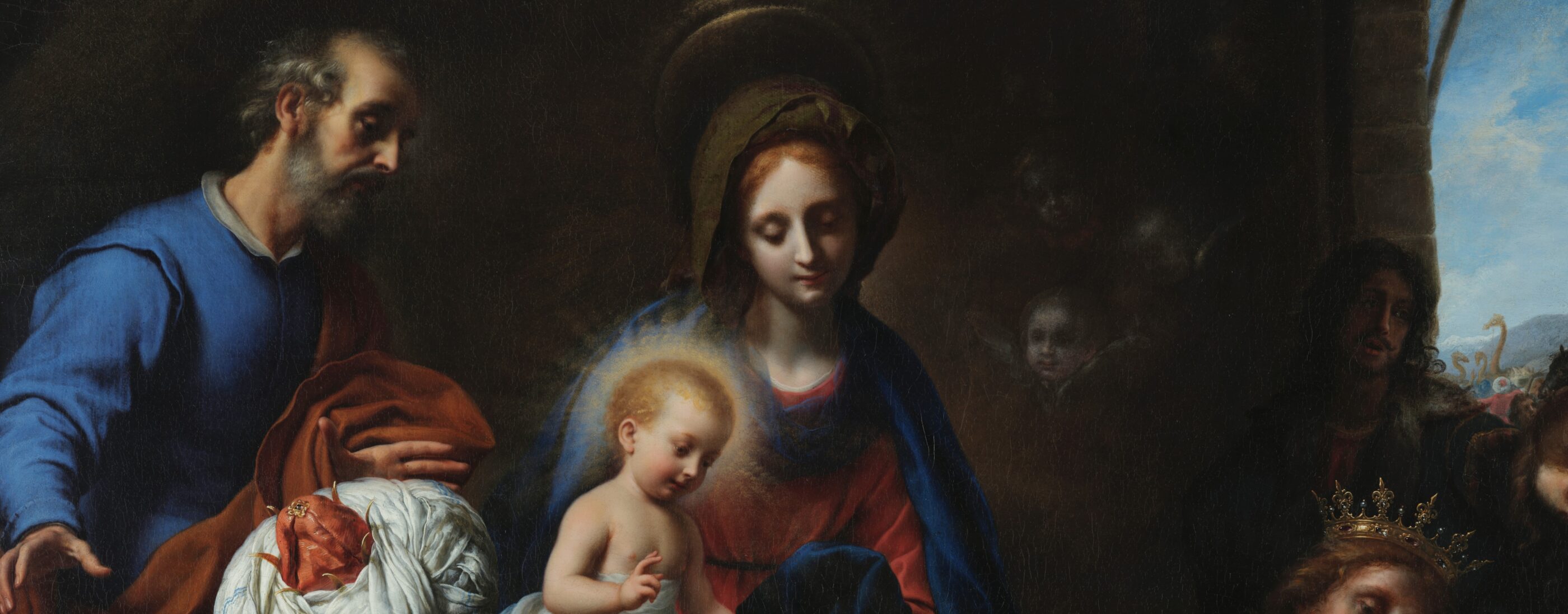
On January 6, the Epiphany of the Lord celebrates the universal call to salvation and contemplates Mary as the true Seat of Wisdom and Mother of the King. In the narrative of the Magi, Mary presents the Redeemer to the Gentiles, who recognize and adore the Child as the Christ, the Messiah (cf. Mt 2:11). Moreover, the feast of the Holy Family of Jesus, Mary, and Joseph (celebrated on the Sunday within the octave of Christmas) celebrates the mystery of the infancy and of the hidden life of the Savior, highlighting Mary in her full role as Mother. In this period of the kenosis of the King of Glory, Mary appears as the keeper of the memories of the words and events concerning Jesus, sharing deeply in His life.
Finally, the Feast of the Presentation of the Lord (February 2), celebrated on the fortieth day of Christmas, recalls the salvific mystery accomplished by Christ in intimate union with Mary, His mother. In this event, Mary places the Child in the arms of Simeon, proclaiming Jesus as a light for the nations and the glory of Israel (cf. Lk 2:32), reaffirming the inseparable connection between the Son and the Mother in the work of salvation (Marialis cultus 7).
Marian Popular Piety in the Christmas Season
In the Christmas Season, “a great part of the rich and complex mystery of the manifestation of the Lord finds wide echo and its own expressions in popular piety” (Directory 108). Let us recall, for example, the Christmas tree, the exchange of good wishes, the gifts, the carols, the Nativity scenes, the kissing of the Child Jesus and His placement in the crib set up in the church or in its vicinity. Some expressions of popular piety have their original inspiration in the events of the Savior’s infancy and are therefore an inevitable invitation to the figure of Mary, His Mother.
The Nativity Scene
The Nativity scene characterizes the Christmas season. Its essential elements are suggested by the Infancy Gospels. Saint Luke recounts the birth of Jesus in Bethlehem and the shepherds who kept watch over the flock, as the young David did on the outskirts of the city. Saint Matthew indicates Bethlehem as the place visited by the Magi, who made their way to the Messiah guided by the star, the geographical symbol of Christmas. The Nativity scene is, in fact, the reconstruction of the Gospel pages that inspired Saint Francis of Assisi, on Christmas night in 1223, to organize in Greccio, a small village in Umbria, the sacred representation of the birth of Jesus, after having obtained the permission of Pope Honorius III. Various figures appear every year in the Nativity scene: the shepherds, who receive the angel’s announcement; the flock resting peacefully; the houses of the town in the distance; the grotto and the manger with the protagonists: Mary, Jesus, and Joseph; and, in slow procession toward Bethlehem, the caravan of the Magi.
The progressive construction of the Nativity scene can take on a pedagogical force. In all probability, it is one of the most effective instruments for visualizing the Gospel scenes, certainly endowed with greater energy than that of modern audiovisual media. It would be extremely beneficial to accompany the construction of the Nativity scene with reference to the Gospel pages. Planning in stages the placement of the figures in their respective groups of scenes could offer the opportunity, in the days that precede Christmas, to read, once each group has been set in place, the corresponding passage of the Gospel: from Luke, for the birth of Jesus and for the announcement to the shepherds; from Matthew, for the Magi. This reference to the Gospels would also help to give the Nativity scene the perspective of Christian faith, preventing it from being confused with a children’s game.
As for the figure of “Mary of Nazareth” in the “crib” scene, in the first centuries of Christianity the Hellenic iconographic typology of the Nativity prevailed, in which Mary is depicted seated. Later, the Syriac typology developed, with the Mother of God reclining, which survived until the fourteenth century. The current placement of Mary in the Nativity scene, of Franciscan derivation, gives evident prominence to her fundamental role as Mother. Mary, kneeling with her head slightly bowed forward, holds her hands joined in a gesture of adoration of the divine Son in the manger. She wears a long pink tunic, typical of ancient Palestine, and “is covered with a blue mantle that covers her from head to foot and bears three stars, one on her head and two on her shoulders, to signify her virginity before, during, and after childbirth and the grace of the divine Trinity that sanctified her in spirit, soul, and body”.
Christmas Carols
In the eighteenth century, Naples stood out for the making of Nativity scenes: from the one made by the very hands of King Charles of Bourbon for the royal palace, through the classics of Somma, Bottiglieri, Cappelli, and especially Sammartino, down to the simplest, but also the most authentic, in the homes of the poor, in the cellars, in the shops, and in the alleys.
In this fervor of sacred craftsmanship, Saint Alphonsus, in the “Christmas Novena,” inserts his meditation inviting the faithful to make of their own heart a manger in which to welcome Christ who comes. In tune with his people, the saint waits, prays, sings, and rejoices at Christmas. With a spontaneity and freshness that secure eternal values for the song, Alphonsus contemplates Mary beside the Child singing Him a lullaby: the cosmos stops, motionless before this miracle of love: “Fermarono i cieli / la loro armonia / cantando Maria / la nanna a Gesù” [The heavens ceased / their harmony / as Mary sang / the lullaby to Jesus]. At least at Christmas, everyone must rejoice and pray. Even the street children. For them, the saint resorts to dialect. This is not irreverence or literary carelessness, but the search for a communication with an intimate flavor: “Quanno nascette Ninno a Betlemme era notte e parea miezo juorno” [When the Child was born in Bethlehem it was night and it seemed like midday]. Yet it was the carol “Tu scendi dalle stelle” [You come down from the stars] that indissolubly linked the name of Saint Alphonsus to the Solemnity of Christmas. The saint traces back to the immense love of Christ, who became a Child, through a rhythm of effective contrasts. True love does not endure distances, and Christ does not limit Himself to contemplating the sufferings of man, but experiences and shares them in His own flesh. He comes down, then, from the stars and comes to a grotto, to the cold, to the ice. To the riches of the Creator of the world, to the eternal feast in the bosom of the Father, He prefers an absolute poverty, even to the lack of clothing and warmth, even to pain and weeping. But behold, between the third and the fourth stanza, the key to the message: “Tu piangi non per duol, ma per amore… Caro, non pianger più, ch’io t’amo, io t’amo…” [You weep not from pain, but from love… Dear one, weep no more, for I love You, I love You…]. The carol then ends, in tune with Alphonsian thought, with recourse to and invocation of Mary, the last hope for setting things right again: “O Maria, speranza mia, se io poco amo il tuo Gesù, non ti sdegnare. / amalo tu per me se io nol so amare” [O Mary, my hope, if I love your Jesus but little, do not be indignant. / love Him for me, if I do not know how to love Him]. Even today, with Saint Alphonsus, it is possible to rediscover the right rhythms for an authentic Christmas atmosphere. The genius of Giuseppe Verdi had already sensed this when, after hearing the saint’s hymn during the Christmas vigil of 1890, at the Doria Palace in Genoa, he exclaimed: “Without this pastorale, Christmas would not be Christmas”.
Rediscovering the Ave Maria
“The solemnity of January 1, eminently Marian, offers a particularly suitable space for an encounter of liturgical piety with popular piety: the first celebrates that event in the ways proper to it. The second, if duly educated, will not fail to give life to expressions of praise and congratulation to the Virgin for the birth of her divine Son, and to deepen the content of so many formulas of prayer, beginning with the one so dear to the faithful: ‘Holy Mary, Mother of God, pray for us sinners’” (Directory 115). Indeed, the Ave Maria, which began, so to speak, with the writing of the Gospel of Luke and was completed, from the liturgical-juridical point of view, only in 1569, when Pius V introduced it into the Roman Breviary, is the best known and most common prayer that the Church addresses to the Mother of God: it is learned from childhood and repeated throughout life. It is a simple and popular prayer that has its origin in the Gospel and yet carries within itself a series of expressions that manifest the human spirit in its concrete situation. It is the prayer that places the one who prays in relationship with the Mother of Jesus and our mother, to whom he presents his greeting and his petitions.
Fruit of divine inspiration and of ecclesial experience, the Ave Maria will always resound as the purest praise and the most intense supplication of children who are sinners, yet confident in the intercession of Mary, from whose virginal womb the Savior of the world was born. As a true treasure of faith, of filial love, of trust, and of sure hope, the Ave Maria is a biblical prayer, because its first part is drawn from the Gospel of Luke. It is an ecclesial prayer, because it reflects the experience of the Church and expresses her faith. It is a liturgical prayer, because it appears evocatively in various celebrations of the Liturgy of the Hours and of the sacred mysteries. It is a popular prayer, because it constitutes the essential core of pious exercises widely diffused and loved by the Christian people, such as the Angelus Domini and the Rosary. It is, finally, a catechetical prayer, because it is an inspiring source of the Church’s teaching and itself an object of her catechesis. What is the Ave Maria if not a necklace formed of two or three pearls, all drawn from the Scriptures, and bound together by a precious stone, the name of Jesus?
The first part is a praise and places on our lips the greeting that God addressed, through the angel, to Mary of Nazareth (Lk 1:28) and the acclamation that Elizabeth addressed to the Mother of the Lord (Lk 1:42-43). It is a rigorous synthesis of the mystery of the Virgin: of her holiness and of the transformation wrought in her by grace (“full of grace”), of her singular election (“blessed among women”), of the favor with which God accompanies her in the mission He entrusts to her (“the Lord is with you”), of her messianic and salvific motherhood (“blessed is the fruit of your womb”).
The second part is a supplication and is the fruit of the experience of the Church: of her faith in the divine motherhood (“Mother of God”), of her trust in the maternal and merciful intercession of the Virgin (“pray for us”), accompanying the Christian, weak and a sinner (“sinners”), on the path of life: “now,” the present, as the concrete expression of life and the unique possibility of acting. And “at the hour of our death,” as the decisive occasion: a moment feared and desired, dark and luminous, of struggle and of rest, of end and of beginning.
Family Entrustment to the Holy Family of Nazareth
“The feast of the Holy Family of Nazareth offers a suitable celebrative setting for the development of certain rites or moments of prayer proper to the Christian family” (Directory 112). This feast may be an occasion for the renewal of the family entrustment to the Holy Family of Nazareth, the blessing of children, provided for in the Ritual, the renewal of marriage commitments, or the exchange of nuptial promises by the betrothed (cf. Directory 112).
As for the prayer formula of the “Act of Entrustment,” legitimately approved, the Directory indicates the attitudes to be adopted, the criteria to be considered, and the modalities of execution: as the Manual of Indulgences indicates, it “must be expressed in a correct manner, along a line that is, so to speak, liturgical: to the Father through Christ in the Holy Spirit, imploring the glorious intercession of Mary, to whom one entrusts oneself entirely, in order to observe the baptismal commitments faithfully and to live in a filial attitude toward her. It must be carried out outside the celebration of the Eucharistic Sacrifice, since it is a gesture of devotion not assimilable to the Liturgy: entrustment to Mary, in fact, is substantially distinguished from other forms of liturgical consecration” (Directory 204).
Recommended reading: Marialis Cultus (Paul VI), an apostolic exhortation on Marian devotion.
Deepen your studies: explore Mariology, Marian Theology, Marian apparitions and the Postgraduate Program in Mariology.
Conclusion
The Christmas Season is marked by a rich integration of liturgy and popular piety, both directed toward celebrating the incarnation of the Word and the unique role of Mary, Mother of God, in the history of salvation. Whether through the solemn liturgy of Christmas and its associated feasts, or through popular expressions such as the Nativity scene, the Christmas carols, or the prayer of the Ave Maria, the figure of Mary is continually exalted as a model of faith, hope, and spiritual motherhood.
In this season, we are invited to contemplate Mary in her fundamental role in the work of salvation, rediscovering the depth of her union with Christ. Just as she welcomed the Savior into her womb and presented Him to the world, we too are called to welcome Him into our hearts and to bear witness to Him in our daily life. May the Christmas celebrations renew our faith and inspire us to live the mystery of Christmas with the simplicity, the trust, and the love that characterize the Virgin Mary.
The Locus Mariologicus Institute is the worldwide academic reference in Mariology. Discover our resources on Marian Theology, Marian apparitions and the Postgraduate Program in Mariology.
Postgraduate Program in Mariology
Would you like to deepen your formation in Mariology? Discover the Postgraduate Program in Mariology of Locus Mariologicus – an academic formation that unites theological rigor, spiritual life, and the living tradition of the Church.
Would you like to study Mariology seriously?
This article is born of the works in the library of Locus Mariologicus. The Postgraduate Program in Mariology brings you to that same source, with academic guidance: Scripture, the Fathers of the Church, and the Magisterium, from the first dogma to contemporary questions.




Responses