John has been decapitated: the death of John the Baptist and Mary on Saturday of the Expectation
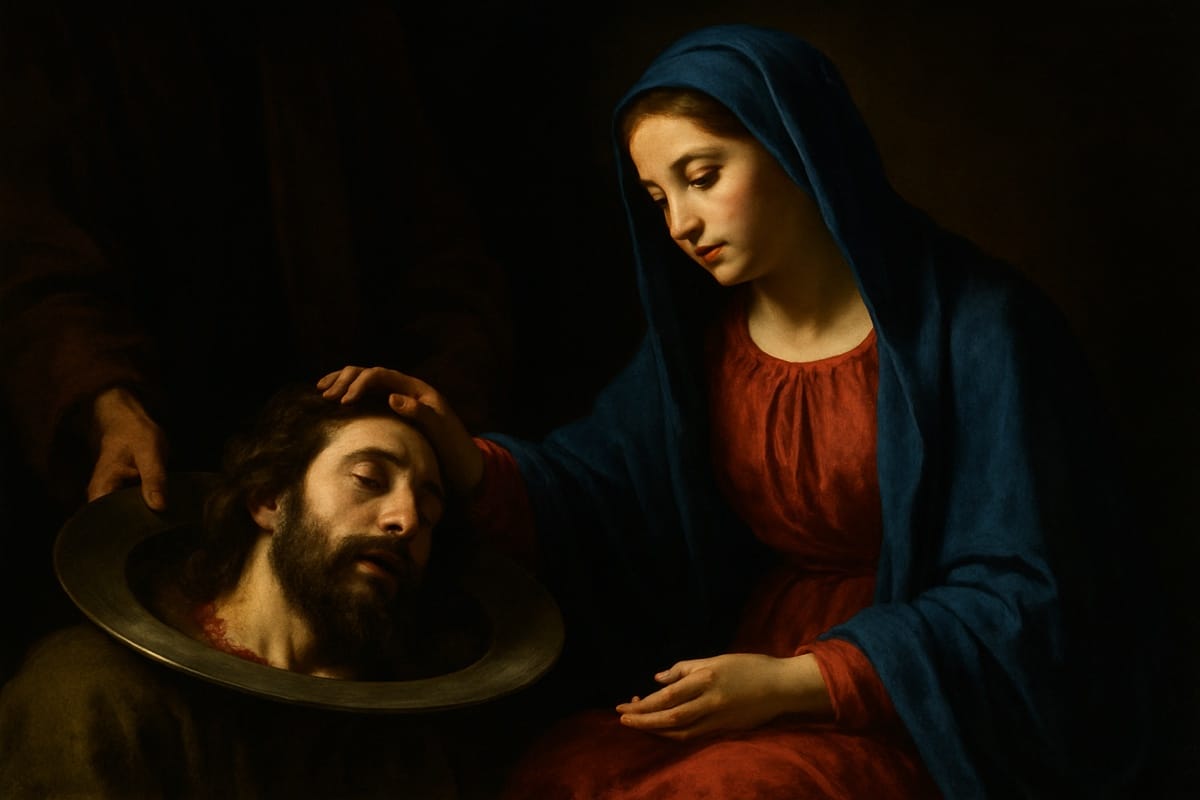
Saturday of the 18th Week of Ordinary Time features Matthew 14:1-12 as the Gospel, narrating the beheading of John the Baptist by Herod Antipas. The scene depicts calculated cruelty: Herodias’ dance (the daughter), Herod’s unreflective oath, the request for John’s head on a platter, and his decapitation in prison.This Saturday is also traditionally the Sabbat of the Blessed Virgin Mary, a memory dating back to the 11th-12th centuries when Saturdays without a feast were dedicated to Mary. The theology of this devotion connects with Holy Saturday: Mary who remained faithful during the only day the body of the Son was in the tomb became the patroness of Saturdays. The coexistence on the same day of the narrative of John the Baptist’s death and Mary’s memory creates a rich meditative context: the precursor’s death and Mary’s fidelity as two forms of resistance to the scandal of death of those who serve God. I. “Decollatus est Ioannes in carcere”: The prophet’s death by caprice“Et misit decollare Ioannem in carcere” (Matthew 14:10). The beheading of John the Baptist is described by Matthew with laconic brutality: an order, an execution, a head on a platter. The scene contrasts with the grandeur of Old Testament prophets who died in battle or natural death. John dies because of an imprudent promise made to a dancer and the rancor of a woman he had correctly rebuked.The apparent randomness of John’s death is theologically significant: God’s greatest prophet does not die from epic confrontation with power, but from absurd death, victim of human caprice. This is the real death of martyrs: rarely epic, often absurd, always caused by the banality of evil that prefers complacency to truth. John was imprisoned because he told the truth about power (Herod could not have his brother’s wife, Matthew 14:4). He was executed because truth disturbed more than an imprudent promise.John’s death anticipates Jesus’ death with the same structure: an unfair trial (Pilate acknowledges Jesus’ innocence, Matthew 27:24), pressure from the manipulated crowd (Herod yields to his daughter. Pilate yields to the crowd), execution as a result of political pressure, not just sentence. John is the miniature mirror of Jesus’ Passion, precursor in death as he was in life.II. “Praecursor Domini in morte”: John, the precursor in death“The Disciples and John’s Burial: A Parallel Narrative in Matthew’s Theology”“His disciples, taking the body, buried it, and went to announce Jesus’ death (Mt 14:12). The disciples of John, burying their master and relaying his death to Jesus, unconsciously mirror the actions of the disciples of Jesus after the Passion: they gather the body, bury it, and communicate the event. The parallel narrative structure between John’s death and Jesus’ death is one of the subtlest articulations in Matthew’s theology.”“John as ‘Precursor in Death'”John, as the “forerunner in death,” has roots in patristic tradition: just as John preceded Jesus at birth (six months prior, Lk 1:36), in ministry (proclaiming what Jesus would accomplish), and at baptism (John baptizing in the Jordan River while Jesus was baptized on the Cross, cf. Lk 12:50: “I must be baptized,”) he also precedes him in death. John’s martyrdom is the prophetic announcement of Jesus’ martyrdom, echoing the same logic of truth spoken to power, the same refusal to remain silent about what is right, and the same fate.“The News of John’s Death Reaches Jesus”The news of John’s death reaches Jesus (Mt 14:13), and he “withdrew by ship to a solitary place” (Mt 14:13). Jesus’ reaction to the death of the precursor is withdrawal: not flight, but mourning, silence, and retreat. The death of John is for Jesus not only the death of a prophet but a sign of what is to come for him. Matthew does not delve into Jesus’ internal reaction, but the movement towards the “solitary place” signifies the need for silence in the face of the violent death of the righteous.“Mary and the Saturday of Expectation: Memory at Saturday”Devotion to Marian Saturday has its theological roots in Holy Saturday, the only day in history when the Son of God was dead. On this “Sabbatum Sanctum,” as the liturgy calls it, the entire human Church was, so to speak, suspended between Friday’s death and Sunday’s Resurrection. Mary, unlike the disciples who fled and hid, remained faithful, guarding her faith even as all others had lost sight of it.The theology of Marian Saturday, developed by medieval scholars (especially within the Dominican tradition), links Mary’s fidelity on Holy Saturday to weekly Saturday prayer: each Saturday is a memorial of Holy Saturday and Mary’s faithfulness. The memory of Mary on Saturday is a celebration of faith that did not falter in the face of the tomb, the faith that ensured, in a sense, the continuity of the Church between Good Friday and Easter Sunday.“John’s Death on Saturday: A Complementary Meditation”The narrative of John Batista’s death in the gospel on Saturday serves as a complementary meditation: just as Mary guarded her faith on Holy Saturday after Jesus’ death, the disciples of John guarded their master’s body and relayed the news to Jesus. The faithfulness of those who guard the dead, who watch, who bury, who announce, is the faithfulness celebrated by Marian Saturday devotion: faithfulness in the darkest moment when the Lord seems absent and the mission appears complete.“The Mother of the Lamb and the Mother of the Precursor: Mary and Elizabeth in the Mystery of the Cross”Isabel, the mother of John the Baptist, is Mary’s cousin (Luke 1:36). The two mothers met during the Visitation when John leaped in Isabel’s womb upon hearing Mary’s greeting (Luke 1:41-44). The joy of the Visitation is the encounter between the two mothers, whose children would share a similar fate: the precursor and the Lamb, both killed by human power.Devotional tradition rarely reflects on Isabel as the mother of a martyr, focusing instead on her joy during the Visitation. However, the parallel between John’s and Jesus’ destinies suggests a connection between Isabel’s grief (as the mother of a beheaded one) and Mary’s sorrow (as the mother of a crucified one). The two women who met in joy ultimately share the pain of having given birth to prophets who died for the truth. The “school of suffering” that the spiritual motherhood of Mary entails is a school taught by both Mary of Nazareth and Isabel of Judea.Devotion to the Marian Saturday, which includes the narrative of John the Baptist’s death, invites reflection on the chain of fidelities that sustains the salvation history: Isabel who generated the precursor, Mary who generated the Lamb. John died first, Jesus came afterward. John’s disciples buried their master, Jesus’ disciples found an empty tomb. Each link in this chain of fidelities is a way to express “fiat,” accepting a mission that involves suffering but ultimately points to the Resurrection that John announced and Mary gave birth to.
Master’s in Mariology
Want to deepen your formation in Mariology? Discover the Master’s in Mariology from Locus Mariologicus, an academic formation that combines theological rigor, spiritual life, and the living tradition of the Church.
Would you like to study Mariology seriously?
This article draws on the works of the Locus Mariologicus library. The Postgraduate Programme in Mariology takes you to the same sources with academic guidance: Scripture, the Church Fathers and the Magisterium, from the first dogma to contemporary questions.




Responses