Irenaeus of Lyon and Mary: The Eve-Mary Antithesis in the Theology of the Second Century
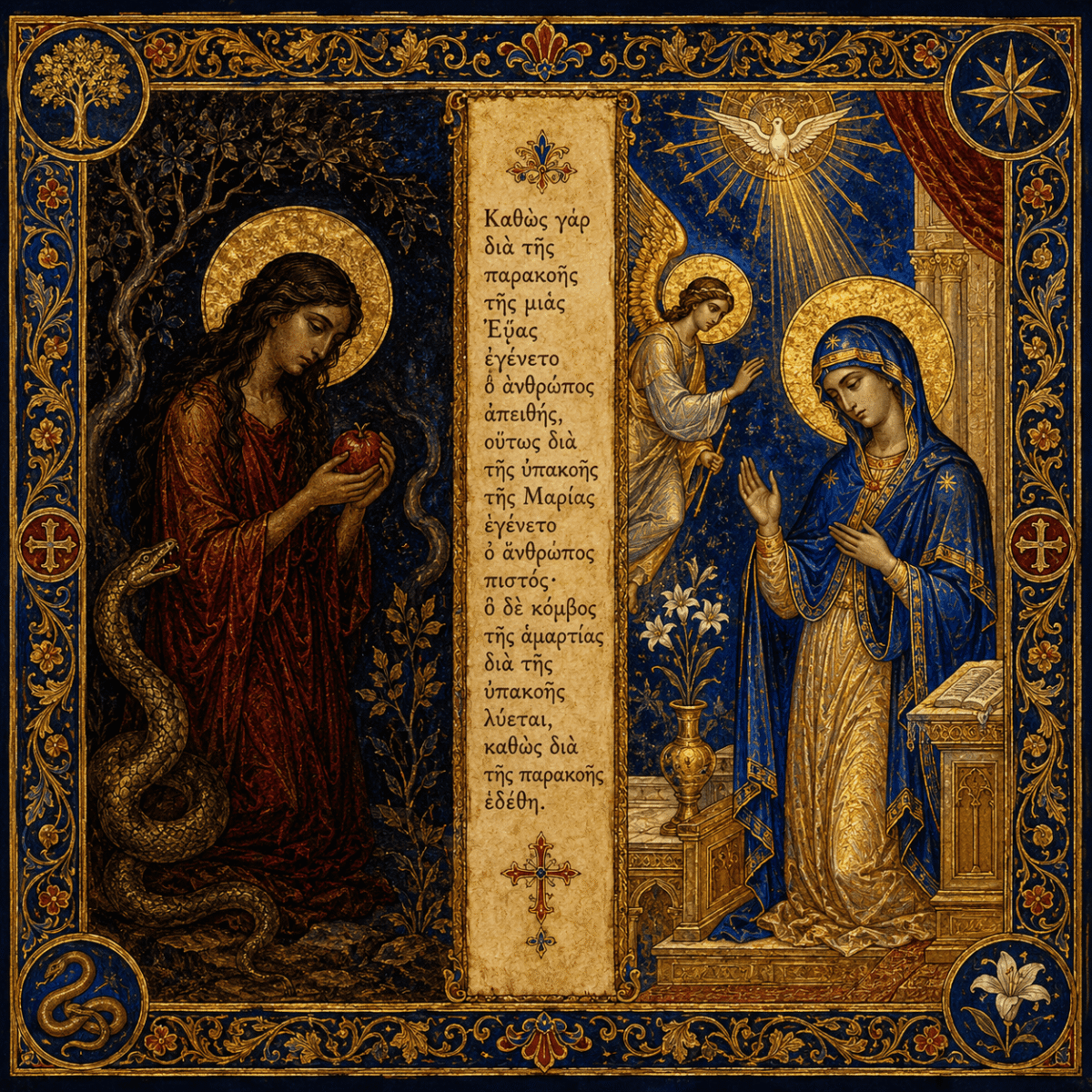
Irenaeus of Lyon, bishop of Gaul who died around the year 200 A.D., is one of the most decisive figures for the understanding of patristic Mariology. A disciple of Polycarp of Smyrna, who was himself a disciple of John the Apostle, Irenaeus of Lyon belongs to the third generation of the direct apostolic tradition. His principal work, the Adversus Haereses, written originally in Greek and preserved in the Latin and Armenian versions, is not merely a systematic refutation of the Gnosticism of the second century: it is the first great treatise of a theology of history in which the Virgin Mary holds a structural and irreplaceable function.
I. Irenaeus of Lyon and the Theology of History: The Mariological Context
The originality of the thought of Irenaeus of Lyon in the context of the second century lies in his conception of the divine economy as a continuous historical movement. The Greek word oikonomia, from which our “economy” derives, designates for him the means by which God saves humanity in a progressive way that culminates in Christ. This theology of history has a rigorously Christocentric structure: creation proceeds from God and returns to God through the recapitulation brought about by the Incarnate Word. Irenaeus of Lyon designates this process by the Greek term anakephalaiosis, recapitulation: Christ, as the new Adam, recapitulates in himself the whole of humanity, restoring the unity lost through sin.
Within this theological framework, the figure of the Virgin Mary is not peripheral. For Irenaeus of Lyon, recapitulation demands a symmetrical correspondence: if the old Adam fell through a woman, the new Adam must be born through a woman. If sin entered the world through Eve’s disobedience, Mary’s obedience must undo the knot that Eve tied. This symmetry is not rhetorical but ontological: it is the condition of possibility of a redemption that is really human and historical, not merely declared from the outside in.
II. The Antithesis between Eve and Mary in Irenaeus of Lyon: The Mariological Recirculation
The most original contribution of Irenaeus of Lyon to Mariology is the distinction between recapitulation, which belongs to Christ as the new Adam, and recirculation, which belongs to Mary as the New Eve. Recirculation is the symmetrical inversion of the historical course of sin: what the virgin Eve undid by her disobedience, the Virgin Mary redid by her obedience. Irenaeus of Lyon formulates this principle in one of the most quoted sentences of patristic Mariology: “The knot of Eve’s disobedience was untied by the obedience of Mary. What the virgin Eve bound by her unbelief, the Virgin Mary loosed by her faith.”
It is decisive to note that, for Irenaeus of Lyon, Mary does not stand against Eve but in her favor: she is her advocate, the one who takes up the cause of feminine humanity and redeems it from within. This point is of remarkable theological refinement. The Eve-Mary antithesis is not a condemnation of primitive femininity but its restoration. Mary does not replace Eve: she undoes what Eve did, restoring to woman the place of cooperation in the plan of salvation that sin had compromised.
III. Mary, Virgin and Mother, in the Theology of Irenaeus of Lyon
Irenaeus of Lyon insists with particular emphasis on the virginity of Mary as a theological condition of the Incarnation, not as a marginal biographical detail. The virgo of Eve, who was still a virgin when she yielded to the suggestion of the serpent, corresponds to the virgo of Mary, who remains a virgin in conceiving the Son of God. This correspondence is not accidental: it is structural in the logic of recirculation. For the disobedience of a virgin to be undone, it is necessary that the obedience also be that of a virgin. The Mariological symmetry requires the virginity of Mary with the same theological necessity with which it requires her obedience.
At the same time, Irenaeus of Lyon underlines the real motherhood of Mary as the guarantee of the real humanity of Christ. The insistence on recapitulation requires that Christ be truly human, born of a woman, with real flesh. Mary is the mother who supplies the Eternal Word with the human flesh without which redemption would not be a historical reality but only a symbolic declaration. The virginal motherhood of Mary is thus at once the condition of the divinity and of the humanity of the Redeemer.
IV. The Apostolic Tradition of Irenaeus of Lyon and the Transmission of the Marian Faith
The authority of Irenaeus of Lyon in the Christian tradition rests in part on his privileged position in the chain of apostolic transmission. A disciple of Polycarp of Smyrna, who was himself a disciple of John the Apostle, Irenaeus of Lyon stands in the third generation of the direct tradition. This fact is theologically relevant: the Mariology he transmits is not a personal speculation but the echo of the faith lived in the first apostolic communities of Asia Minor, where the direct memory of Jesus and of his Mother was still alive.
The journey of Irenaeus of Lyon from Asia Minor to Lyon is, in itself, a testimony to the catholicity of the Marian faith: the same confession of the virginal motherhood that was professed in Smyrna and in the Johannine communities of Asia Minor was professed in the Christian communities of Gaul at the end of the second century. The apostolic tradition that Irenaeus of Lyon received from Polycarp is one of the most solid historical proofs of the antiquity and universality of the Marian faith in the early Church.
V. The Mariological Legacy of Irenaeus of Lyon
The contribution of Irenaeus of Lyon to Mariology is not exhausted in the formulation of the Eve-Mary antithesis. His theology of history offers an interpretive framework in which Mary holds an irreducibly structural function: she is not merely the biological mother of Jesus, but the hinge between the old and the new Adam, between the world of sin and the world of grace, between the disobedience that destroyed and the obedience that rebuilt. Without Mary, the recapitulation of Christ would not have the historical symmetry that gives it its character of real and total redemption.
This theological framework will influence all subsequent Mariology, from Ephesus to Lumen Gentium, from the Redemptoris Mater of John Paul II to the contemporary Magisterium. Irenaeus of Lyon attests that the Mariological intuition of the second century is not a late popular devotion: it is a constitutive dimension of the apostolic faith, transmitted from John to Polycarp, from Polycarp to Irenaeus, from Irenaeus to the universal tradition of the Church. Cf. Lumen Gentium, n. 56: “Just as Eve contributed to death, Mary, by her consent, contributed to life”. The study of patristic Mariology is part of the curriculum of the Postgraduate Program in Mariology at Locus Mariologicus.
Postgraduate Program in Mariology
Would you like to deepen your formation in Mariology? Discover the Postgraduate Program in Mariology of Locus Mariologicus – an academic formation that unites theological rigor, spiritual life, and the living tradition of the Church.
Would you like to study Mariology seriously?
This article grows out of the works in the Locus Mariologicus library. The Postgraduate Program in Mariology takes you to the same source, with academic guidance: Scripture, the Fathers of the Church, and the Magisterium, from the first dogma to contemporary questions.




Responses