The meaning of the feast of the Mother of the Church

From the address of Saint Paul VI, pope, at the Conclusion of the third session of the Second Vatican Council (November 21, 1964).
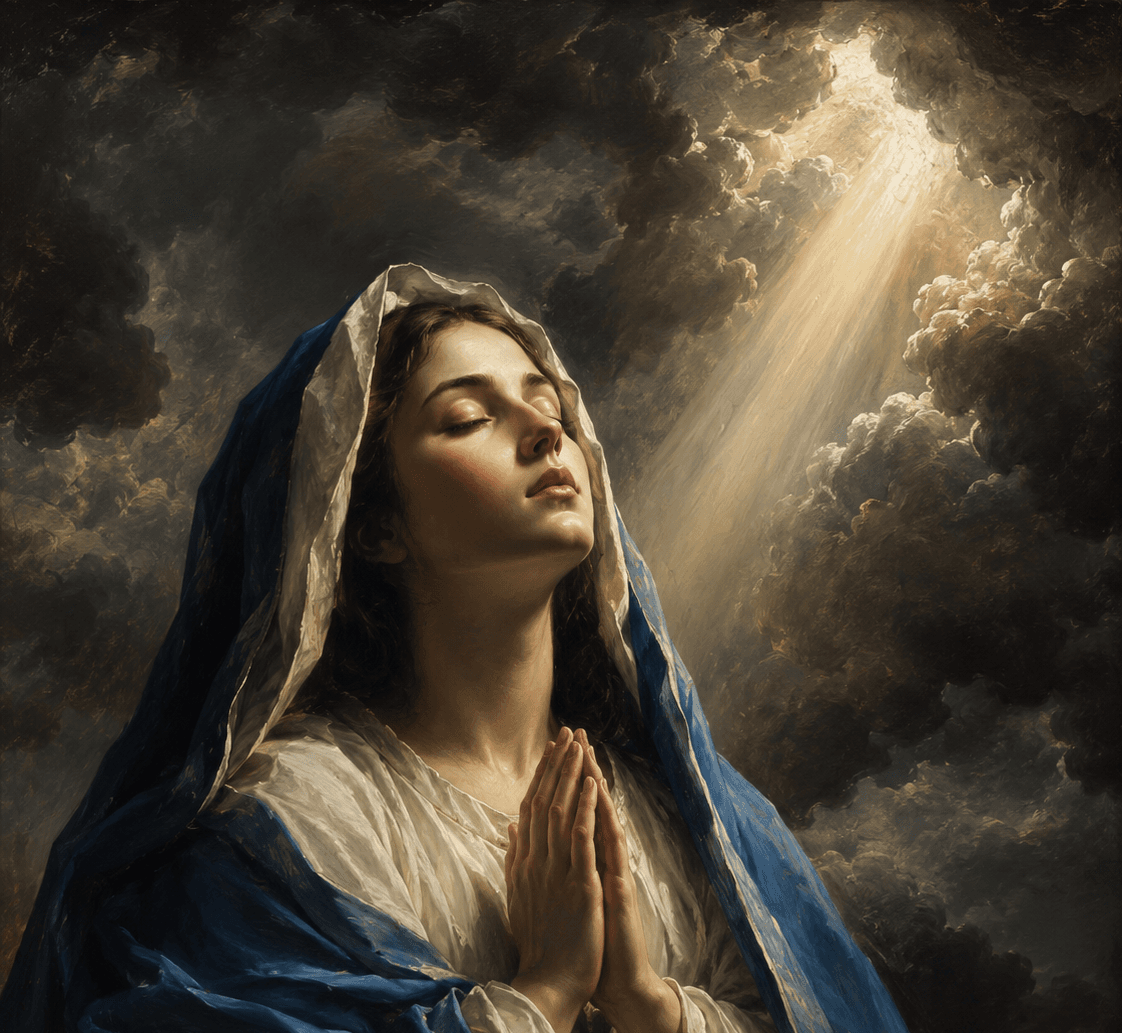
This is a title [Mary Mother of the Church], Venerable Brothers, certainly not unknown to the piety of Christians. On the contrary, the faithful and the whole Church like to invoke Mary above all by this name of Mother. This name certainly belongs to true devotion to Mary, because it is firmly grounded in the dignity with which Mary was endowed as Mother of the Incarnate Word of God.
In fact, just as the divine Motherhood is the reason why Mary has an absolutely unique relationship with Christ and is present in the work of human salvation accomplished by Christ, so too, above all in the divine Motherhood, subsist the relationships that exist between Mary and the Church. For Mary is the Mother of Christ, who, as soon as he assumed human nature in her virginal womb, united it as Head to his mystical Body, which is the Church. Therefore Mary, as Mother of Christ, must also be considered the Mother of all the faithful and Pastors, that is, of the Church.
This is the reason why we, though unworthy, though weak, raise our eyes to her with a soul that is confident and inflamed by filial love. She who one day gave us Jesus, the source of supernatural grace, cannot fail to direct her maternal office toward the Church, above all in this time in which the Bride of Christ sets herself to fulfill her salutary mission with greater zeal.
We are led to nourish and confirm this confidence still further by the very close bonds that exist between this our heavenly Mother and humanity. Although she was enriched by God with most generous and wonderful gifts to make her a Mother worthy of the Incarnate Word, Mary is close to us. Like us, she too is a daughter of Adam and therefore our sister by common human nature. By the future merits of Christ she was immune to original sin, but to the gifts divinely received she personally added the example of her perfect faith, to the point of meriting the evangelical praise: “Blessed are you who believed”.
In this mortal life she embodied the perfect form of the disciple of Christ, she was a mirror of all the virtues, and in her attitude she fully reflected those beatitudes proclaimed by Christ Jesus, so that the whole Church can receive from the Virgin Mother of God the example according to which Christ is to be perfectly imitated.
After these words of Paul VI, we may add that the Immaculate Conception presents Mary as the beginning of the Church. The Motherhood, as Mother of Christ and Mother of the Church, is already incorporated into Christ with the fullness of grace from her conception. At the moment of her motherhood, Mary enters into a more living contact with the source from which she was already secretly nourished. The Church, already constituted in a limited and invisible way with the Immaculate Conception, finds at this point a more living foundation. Jesus and Mary are not merely a society of mother and son, but a society of God the Savior and redeemed humanity. Now, it is the divine will that all men be called to this incorporation. As Mother of Christ, head of the Mystical Body, Mary acquires a special relationship with all the members of this Body. She becomes radically their Mother.
Mary ever Virgin, whom we venerate as Mother of Christ and Mother of the Church, is a new title in relation to the documents of the Magisterium. Chapter VIII of Lumen Gentium deliberately avoided this title. Evidently, it was a matter of specifying the exact point of view according to which this title is to be attributed to Mary, since it is also a figurative usage. In fact, if it is a question of the Church as a whole, the image is correct. If, on the other hand, it is a question of the Church as a community that pre-exists individuals, then the Church is Mother. Mary is only a figure of this.
A title solemnly proclaimed by Paul VI on November 21, 1964, in the closing address of the third session of the Second Vatican Council: Mary, as the Mother of Christ, is also the Mother of the faithful and of all pastors, that is, of the Church. On December 8, 1975, the tenth anniversary of the closing of the Council, he reaffirmed: If Mary is indeed the Mother of Christ according to the flesh, and Christ is the Head of the Church, his Mystical Body, Mary is spiritually the Mother of this Body, to which She herself belongs, at an eminent level, as daughter and sister.
Paul VI started from the consideration of the organic unity of the Mystical Body of Christ: Mary, by begetting the Head, in a certain way also begets all the members, a doctrine already present in the preaching of the Fathers as well.
Saint Augustine sets it forth in these terms: She is truly Mother of the members (of Christ), because she cooperated with charity in the birth of the faithful of the Church, who are the members of that Body (De Sancta Virginitate, PL 40, 339).
Saint Leo sets forth the same doctrine: The birth of Christ is the origin of the Christian people; the birth of the head is also the birth of the body.
Lumen Gentium, without giving Mary this title, confirms it indirectly when it speaks of her motherhood in relation to grace: Conceiving Christ, begetting him, nourishing him, she collaborated in such a way as to restore the supernatural life of souls. For this reason she was a Mother to us in the order of grace.
This vision of the Marian mystery is present in the “Daughter of Zion“, in whose midst the Lord is. Mary is the image and the beginning of the Church symbolized by that Jerusalem in whose midst the Lord is. In this perspective, the Mother of Jesus is prefigured by the city of Jerusalem, the spiritual capital of all who believe. All can say, turning toward Jerusalem: All my springs are in you. And of each one it can be said: This man was born there. As in Jerusalem, the historical center of the works of God, so too every one of the faithful can affirm it of Mary.
A final aspect of the Mary-Church relationship. We experience her intercession, for through her we received the author of life. The Second Vatican Council also affirms: “This motherhood of Mary in the economy of grace endures without interruption, from the consent which she faithfully gave at the Annunciation and which she maintained unwavering beneath the cross, until the eternal consummation of all the elect. In fact, after being taken up into heaven, she did not lay aside this saving mission, but by her manifold intercession continues to obtain for us the gifts of eternal salvation. Indeed, no creature can ever be ranked with the incarnate Word and Redeemer. But, just as the priesthood of Christ is shared in various ways by the ministers and by the faithful people, and just as the goodness of God, being one, is diffused in various ways among created beings, so too the one mediation of the Redeemer does not exclude but rather gives rise in creatures to various forms of cooperation, which participate in that one source. (Lumen Gentium 62).
Every prayer of the Church, invoking Mary, appeals to her motherhood, acquired in giving birth to the Author of life. Every prayer asks for her continual maternal help. There exists in the tradition of the Church a hymn that has a very particular phrase which may perhaps illuminate this path of discovering Mary as Mother of the Church: the Ave maris stella, which affirms: Show yourself a Mother, recalling to everyone the ways by which each one can come to be sister and mother of her Son.
Let us read:
| Ave maris stella,Dei Mater alma,Atque semper Virgo,Félix cæli porta. | Hail, star of the sea,Fruitful Mother of God,You who remained a Virgin,O sweet gate of Heaven |
| Sumens illud AveGabrielis ore,Funda nos in pace,Mutans Hevæ nomen. | You who heard that AveFrom the mouth of Gabriel,Establish us in peace,change the name of Eve. |
| Solve vincla reis,Profer lumen cæcis,Mala mostra pelle,Bona cuncta posce. | Free sinners from their chains,Send light to the blind,Drive away from us all evilsAnd obtain for us all good things. |
| Monstra te esse matrem,Sumat per te preces,Qui pro nobis natusTulit esse tuus. | Show that you are our mother:Through you may He hear our prayersHe who, to save us,Willed to be your Son |
| Virgo singularis,Inter omnes mitis,Nos, culpis solutos,Mites fac et castos. | O Virgin without equal,The gentlest of all,Freeing us from our faults,Make us meek and pure. |
| Vitam præsta puramIter para tutum,Ut, videntes Jesum,Semper collætemur. | Grant us a pure life,Make our ways safe:So that, in possession of Jesus,We may rejoice forever. |
| Sit laus Deo Patri,Summo Christo decus,Spiritui Sancto,Tribus honor unus. | Praised and glorified beGod the Father, the Son, and the Holy Spirit. To the three divine PersonsMay equal honor be given. |
Postgraduate Program in Mariology
Would you like to deepen your formation in Mariology? Discover the Postgraduate Program in Mariology of Locus Mariologicus, an academic formation that unites theological rigor, spiritual life, and the living tradition of the Church.


Responses