Mary among the Queens of the Bible

The Bible names several queens: Bathsheba, the mother of Solomon, the Queen of Sheba, Esther. Mary is not designated queen in the Gospels, but theological tradition recognizes in her the fulfillment of all biblical female royalty. This article examines the queens of the Old Testament and what each one prefigures in the person of Mary.
The queens of the Old Testament: meleket, the “Queen of Heaven” in Jer 7:18 and the Marian typology of Bathsheba and Esther
In the Hebrew Old Testament, one of the titles for queen is meleket, attributed only to the Queen of Heaven, associated with Ishtar or Astarte, worshipped in Jerusalem and Judah as the goddess of fertility, as mentioned in Jer 7:18: “The children gather the wood, the fathers kindle the fire, and the women knead the dough to make cakes for the Queen of Heaven and to pour out libations to other gods, in order to provoke my anger”. And Jer 44:17-19: “But we will fulfill every word that has gone out of our mouth, burning incense to the Queen of Heaven and pouring out libations to her, as we, our fathers, our kings, and our princes did in the cities of Judah and in the streets of Jerusalem. And we had plenty of bread, we prospered, and we saw no evil. But since we ceased to burn incense to the Queen of Heaven and to offer her libations, we have lacked everything and have been consumed by the sword and by famine. And when we burned incense to the Queen of Heaven and offered her libations, did we make her cakes to worship her and pour out libations to her without our husbands?”.
Another title, malkät, is used only for the Queen of Sheba, as described in 1 Kgs 10:1-4, 13: “The Queen of Sheba, having heard of the fame of Solomon, came to test him with hard questions. When the Queen of Sheba saw all the wisdom of Solomon and the house he had built […] Then she gave the king one hundred and twenty talents of gold, a great quantity of spices, and precious stones. Never again did such an abundance of spices come as that which the Queen of Sheba gave to King Solomon. King Solomon gave the Queen of Sheba everything she desired and asked for, besides what he had already given her out of his royal bounty. Then she returned and went to her own land with her servants”.
The royal consorts of Artaxerxes, Vashti and Esther, are mentioned in Esth 1: “In the time of Xerxes, the Xerxes who reigned over one hundred and twenty-seven provinces, from India to Ethiopia. He displayed the wealth of his glorious kingdom and the splendor of his majestic greatness for many days, one hundred and eighty days. On the seventh day, when the king’s heart was merry with wine, he commanded Mehuman, Biztha, Harbona, Bigtha, Abagtha, Zethar, and Carcas, the seven eunuchs who served in the presence of King Xerxes. And the king said to the wise men who knew the times (for so the king’s affairs were handled, in the presence of all who knew the law and judgment)”. Esth 4:4: “And Esther’s maids and her eunuchs came and made it known to her. Then the queen was exceedingly distressed, and she sent garments to clothe Mordecai and to take away his sackcloth. But he would not accept them”. Esth 7:1-8: “So the king came with Haman to drink with Queen Esther. And on the second day the king said to Esther, at the banquet of wine: What is your petition, Queen Esther? And it shall be granted you. And what is your request? Even to half the kingdom, it shall be done. Then Queen Esther answered and said: If I have found favor in your eyes, O king, and if it please the king, let my life be given me at my petition, and my people at my request. For we are sold, I and my people, to be destroyed, to be slain, and to perish. If we had been sold merely as menservants and maidservants, I would have held my peace, although the oppressor would not have compensated for the king’s loss. Then King Ahasuerus spoke and said to Queen Esther: Who is this man, and where is he? As this word went out of the king’s mouth, Haman stood up to plead with Queen Esther for his life, for he saw that evil was already determined against him by the king. Then, as the king returned from the palace garden to the house of the banquet of wine, Haman had fallen upon the couch where Esther was. Then the king said: Would he even force the queen before me in this house? As this word went out of the king’s mouth, they covered Haman’s face”. Esth 8:17: “And in every province and in every city, wherever the king’s word and his decree came, the Jews had joy and gladness, feasts and days of celebration. And many of the peoples of the land became Jews, for the fear of the Jews had fallen upon them”. Esth 9:12, 29, 31: “And the king said to Queen Esther: In the fortress of Susa the Jews have killed and destroyed five hundred men and the ten sons of Haman. What have they done in the rest of the king’s provinces? What, then, is your petition, and it shall be granted you? Or what more is your request, and it shall be done? Then Queen Esther, the daughter of Abihail, and Mordecai the Jew wrote with all authority to confirm this second letter of Purim. To confirm these days of Purim at their appointed times, as Mordecai the Jew and Queen Esther had enjoined upon them, and as they themselves had already established for themselves and for their descendants, concerning the fasts and their lamentation”.
The only reigning queen mentioned by name, without receiving the title of queen, was Athaliah, who seized power in Judah after the death of her son Ahaziah (840-835 B.C.). She was overthrown and killed when the high priest Jehoiada proclaimed the king’s son, Joash, as king, as described in 2 Kgs 11: “When Athaliah, the mother of Ahaziah, saw that her son was dead, she arose and destroyed all the royal offspring. But Jehosheba, the daughter of King Joram and sister of Ahaziah, took Joash, the son of Ahaziah, and stole him from among the king’s sons who were being killed, and put him and his nurse in the bedchamber. So they hid him from Athaliah, and he was not killed. Joash was seven years old when he began to reign” and 2 Chr 22:10-23:21: “When Athaliah, the mother of Ahaziah, saw that her son was dead, she arose and destroyed all the royal offspring of the house of Judah. But Jehosheba, the daughter of the king, took Joash, the son of Ahaziah, and stole him from among the king’s sons who were being killed, and put him with his nurse in the bedchamber. So Jehosheba, the daughter of King Joram, the wife of the priest Jehoiada (for she was the sister of Ahaziah), hid him from Athaliah, and she did not kill him. And all the people of the land rejoiced, and the city was at peace, because they had put Athaliah to the sword”.
Only in the Hasmonean period did Salome Alexandra (76-67 B.C.), after the death of her husband Alexander Jannaeus, seize power and hold it until her death. Royal consorts occasionally played significant roles in the politics of Israel and Judah, such as Bathsheba, the wife of David and mother of Solomon, and Jezebel, the wife of King Ahab, in the religious policy of the Kingdom of Israel.
The king’s mother (gebirät = great lady) held a special position at the court and in the kingdom, being mentioned by name at the beginning of her son’s reign, as in 1 Kgs 14:21: “Rehoboam, the son of Solomon, reigned in Judah. Rehoboam was forty-one years old when he began to reign, and he reigned seventeen years in Jerusalem, the city that the Lord had chosen out of all the tribes of Israel, to put His name there. And his mother’s name was Naamah, the Ammonite”. In 1 Kgs 15:2: “He reigned three years in Jerusalem. His mother’s name was Maacah, the daughter of Absalom”. And in 1 Kgs 15:10: “And he reigned forty-one years in Jerusalem. His mother’s name was Maacah, the daughter of Absalom”. Also in 1 Kgs 22:42: “Jehoshaphat was thirty-five years old when he began to reign, and he reigned twenty-five years in Jerusalem. His mother’s name was Azubah, the daughter of Shilhi”. And 2 Kgs 8:26: “Ahaziah was twenty-two years old when he began to reign, and he reigned one year in Jerusalem. His mother’s name was Athaliah, the granddaughter of Omri, king of Israel”. 2 Kgs 14:2: “He was twenty-five years old when he began to reign, and he reigned twenty-nine years in Jerusalem. His mother’s name was Jehoaddan, of Jerusalem”. 2 Kgs 15:2: “He was sixteen years old when he began to reign, and he reigned fifty-two years in Jerusalem. His mother’s name was Jecoliah, of Jerusalem”. 2 Kgs 15:33: “He was twenty-five years old when he began to reign, and he reigned sixteen years in Jerusalem. His mother’s name was Jerusha, the daughter of Zadok”. 2 Kgs 18:2: “He was twenty-five years old when he began to reign, and he reigned twenty-nine years in Jerusalem. His mother’s name was Abi, the daughter of Zechariah”. 2 Kgs 21:1: “Manasseh was twelve years old when he began to reign, and he reigned fifty-five years in Jerusalem. His mother’s name was Hephzibah”. 2 Kgs 22:1: “Josiah was eight years old when he began to reign, and he reigned thirty-one years in Jerusalem. His mother’s name was Jedidah, the daughter of Adaiah, of Bozkath”. 2 Kgs 23:33: “Pharaoh Neco imprisoned him at Riblah, in the land of Hamath, preventing him from reigning in Jerusalem, and imposed on the land a tribute of one hundred talents of silver and one talent of gold”. 2 Kgs 23:36: “Jehoiakim was twenty-five years old when he began to reign, and he reigned eleven years in Jerusalem. His mother’s name was Zebidah, the daughter of Pedaiah, of Rumah”. 2 Kgs 24:8: “Jehoiachin was eighteen years old when he began to reign, and he reigned three months in Jerusalem. His mother’s name was Nehushta, the daughter of Elnathan, of Jerusalem”. 2 Kgs 24:18: “Zedekiah was twenty-one years old when he began to reign, and he reigned eleven years in Jerusalem. His mother’s name was Hamutal, the daughter of Jeremiah, of Libnah”.
Her position, however, did not protect her from being deposed by a son or grandson devoted to YHWH if she fell into idolatry, as in 1 Kgs 15:13: “He even deposed Maacah, his grandmother, so that she would no longer be queen mother, because she had made a repulsive image to serve as a sacred pole. Asa cut down the repulsive image and burned it in the Kidron Valley”. And in 2 Chr 15:16: “King Asa even deposed Maacah, his grandmother, from her office as queen mother, because she had made a repulsive image to serve as a sacred pole. Asa cut down the repulsive image, broke it in pieces, and burned it in the Kidron Valley”. Or from being deported by an enemy conqueror, as in Jer 13:18: “Say to the king and to the queen mother: Come down from your thrones, for your glorious crown has fallen from your heads”. And Jer 29:2: “This was after King Jeconiah and the queen mother, the officials, the leaders of Judah and Jerusalem, the craftsmen and the artisans had been deported from Jerusalem”.
Mary as βασίλισσα in the New Testament: the Queen of the South (Mt 12:42, Lk 11:31), Rev 12 and Marian royalty
In the New Testament, the title “βασίλισσα” appears in Mt 12:42 and Lk 11:31 (here, “Queen of the South”) for the Queen of Sheba: “The Queen of the South will rise up at the judgment with this generation and will condemn it, for she came from the ends of the earth to hear the wisdom of Solomon. And behold, one greater than Solomon is here” (Mt 12:42). “The Queen of the South will rise up at the judgment with the men of this generation, and will condemn them. For she came from the ends of the earth to hear the wisdom of Solomon, and behold, one greater than Solomon is here” (Lk 11:31). And in Acts 8:27 for Candace, the queen of the Ethiopians: “He rose and went. And behold, an Ethiopian, a eunuch, a high official of Candace, queen of the Ethiopians, who was in charge of all her treasures, had come to Jerusalem to worship”. In Rev 18:7, the ungodly city of Babylon calls herself queen: “As much as she has glorified herself and lived in luxury, so much torment and mourning give her. For she says in her heart: I sit as a queen, I am not a widow, and I shall not see mourning”.
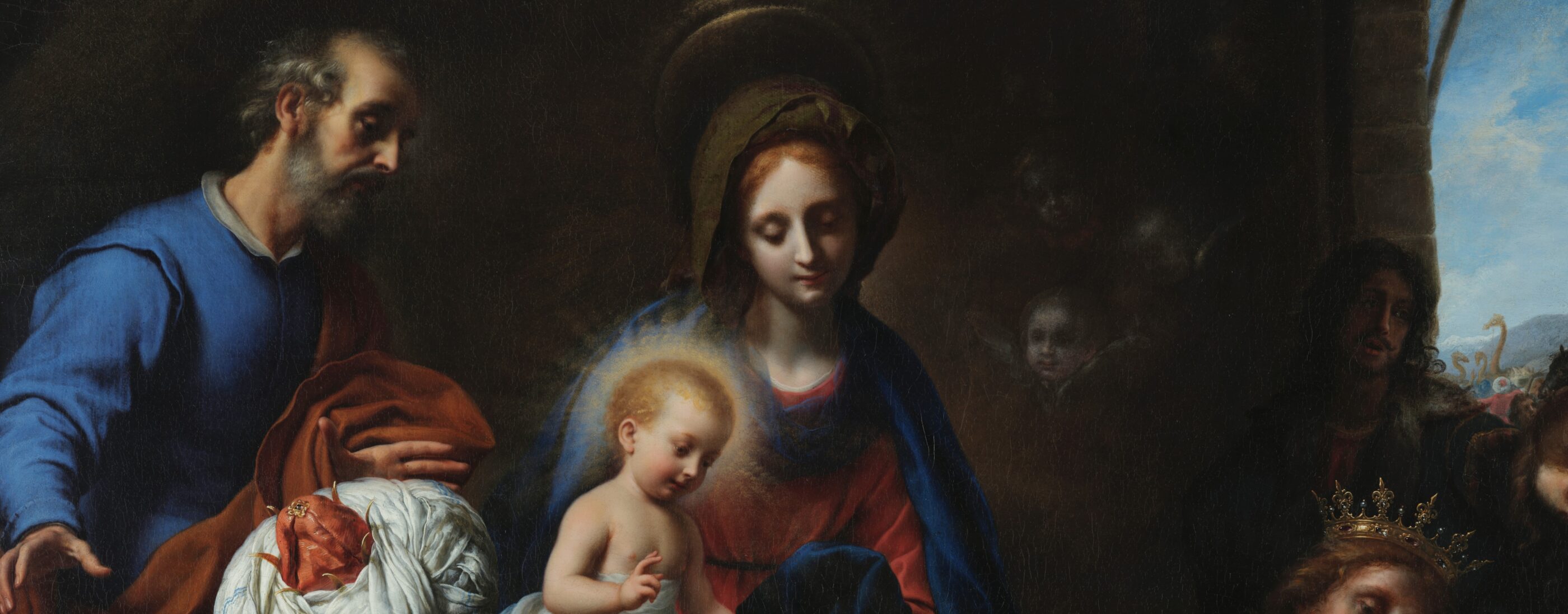
In Christian devotion, Mary is often seen as an intercessor, fulfilling the role of queen mother beside her Son, with Esther, who intercedes for her people, as a type of this intercession.
Deepen your studies: explore Mariology, Marian Theology, Marian apparitions and the Postgraduate Program in Mariology.
To deepen the biblical theology of Mary the Queen, consult the Encyclical Redemptoris Mater of Pope John Paul II.
Postgraduate Program in Mariology
Would you like to deepen your formation in Mariology? Discover the Postgraduate Program in Mariology of Locus Mariologicus, an academic formation that unites theological rigor, spiritual life, and the living tradition of the Church.
Would you like to study Mariology seriously?
This article is born of the works in the library of Locus Mariologicus. The Postgraduate Program in Mariology takes you to the same source, with academic guidance: Scripture, the Fathers of the Church, and the Magisterium, from the first dogma to contemporary questions.



Responses