Mary, cooperator in the Redemption: the delicate question of the Co-Redemptrix
“Stabat autem iuxta crucem Iesu mater eius” (Jn 19:25), “And standing by the cross of Jesus was His mother”
I. The Suffering Servant: the redemptive passion anticipated by Isaiah
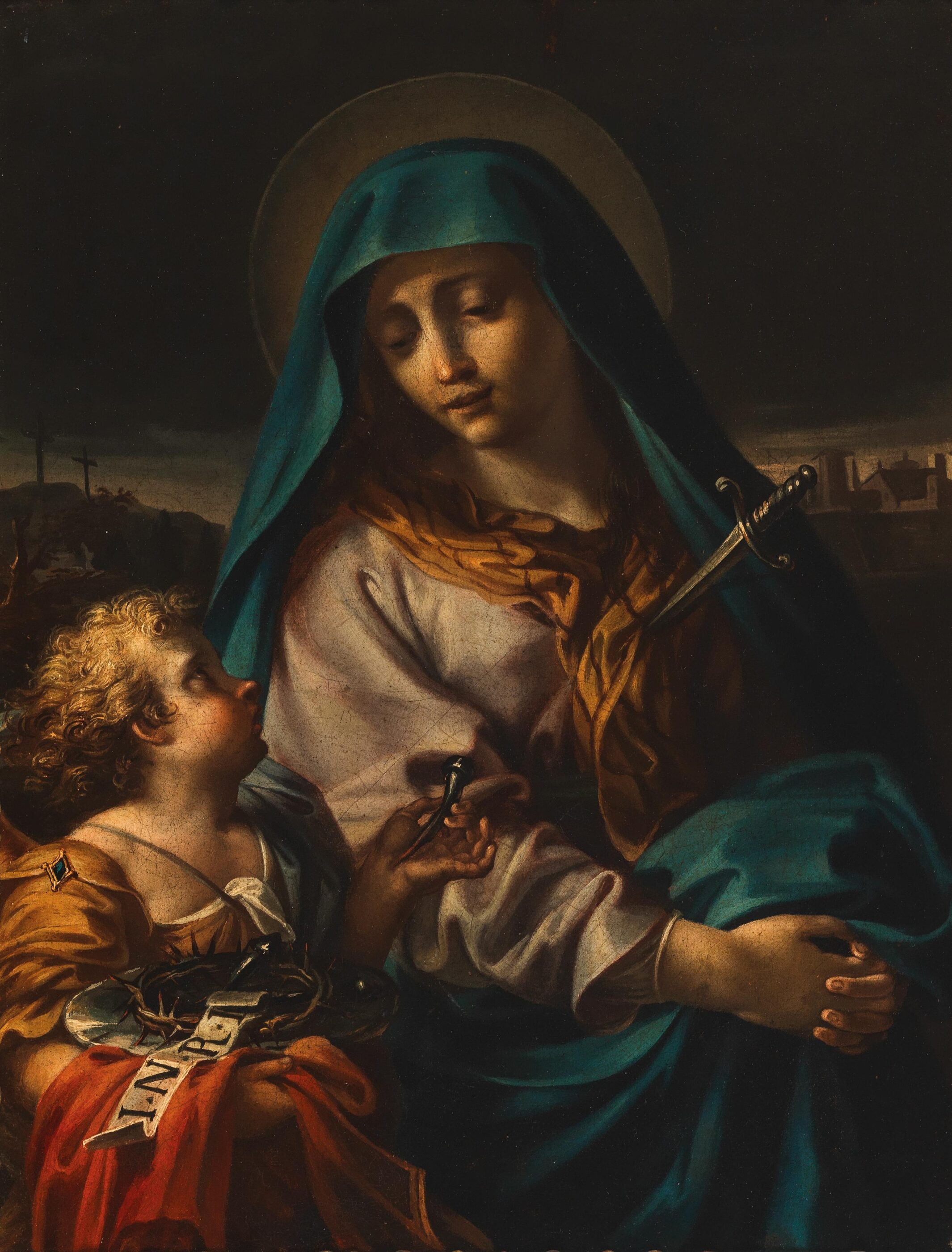
The fourth Song of the Servant of the Lord in the prophet Isaiah is one of the densest texts in all Old Testament theology of redemption. “Truly, He took upon Himself our infirmities and carried our sorrows… He was wounded for our iniquities and crushed for our sins. The chastisement that brings us peace fell upon Him, and by His wounds we were healed” (Is 53:4-5). Christian theology has recognized in this passage the prophetic anticipation of the redemptive passion of Christ. But the Marian tradition, particularly from the Middle Ages onward, noted a detail that enriches this reading: the Suffering Servant is not alone. Iconography and the classic liturgical hymns describe around the Servant the presence of Mary as witness and participant. The Stabat Mater, a sequence attributed to Jacopone da Todi in the thirteenth century, expresses this intuition with particular force: “Stabat Mater dolorosa, iuxta Crucem lacrimosa, dum pendebat Filius.” The Mother stands. The Mother weeps. The Mother suffers. And it is precisely this shared suffering, this association with the redemptive mystery, that lies at the foundation of the delicate and at times controversial Marian title of Co-Redemptrix.
II. The history of the term: from the Fathers to contemporary discussions
The Latin term Corredemptrix appeared in Western theology relatively late, being attested for the first time in the fifteenth century in German theological writings. But the theological substance that the term seeks to formulate has far older roots. Irenaeus of Lyons, in the second century, already presented the Eve-Mary typology, affirming that “what Eve bound by unbelief, Mary loosed by faith” (Adversus Haereses III, 22, 4), inscribing Mary within the act of redemption as the positive counterpart of the fall. The popes of the nineteenth and twentieth centuries used the term Co-Redemptrix in various documents: Pius IX, Leo XIII, Pius X, Benedict XV, Pius XI, and Pius XII. But it was never defined as a dogma. The campaigns of theologians and bishops calling for the dogmatic definition of this title, particularly intense in the 1990s and 2000s, with more than six million signatures gathered throughout the world, did not receive a favorable response. The Second Vatican Council used the term “cooperatrix” instead of “corredemptrix,” precisely in order to avoid ambiguities. Pope Francis, on various occasions, expressed explicit reservations about a possible dogmatic definition of the title Co-Redemptrix, holding that it could generate confusion about the uniqueness of the redemption wrought by Christ. This papal sobriety is not a denial of the theological content that the title seeks to express: it is care that the content be formulated without ambiguity.
III. Stabat Mater: the redemptive presence of Mary on Calvary
The Gospel of John presents with extreme sobriety the presence of Mary beside the cross: “Standing by the cross of Jesus were His mother and His mother’s sister, Mary the wife of Clopas, and Mary Magdalene” (Jn 19:25). The theology of this presence is incalculably dense. Mary did not flee, as the other disciples did. Mary did not deny, as Peter did. Mary stood in the most painful place possible for a mother, contemplating the torture and the death of her own son. This presence was not passive: it was active association with the redemptive mystery. Simeon’s prophecy about the sword that would pierce Mary’s soul (cf. Lk 2:35) was definitively fulfilled on Calvary. And it is precisely at that moment that Jesus institutes Mary’s spiritual motherhood over the beloved disciple and, through him, over the whole Church: “Woman, behold your son… Behold your mother” (Jn 19:26-27). Mary’s universal motherhood over the faithful is born in the redemptive act of the Cross. It is not a gift added later: it is the fruit of the Mother’s profound association with the sacrifice of the Son. This association, without being properly a co-redemptive act in the Christological sense of the term (the Redemption was the exclusive work of Christ’s divinity united to His humanity), was a free, conscious, and loving cooperation that the Second Vatican Council recognized as a “singular” and “incomparable” cooperation (cf. LG 56-58).
IV. The conciliar precision and the reasons for the papal reserve
The Constitution Lumen Gentium articulated this delicate question with a precision that deserves attention. Mary, according to the Council, “offered herself intimately with Him to the sacrifice, lovingly consenting to the immolation of the victim born of her” (LG 58). And further: “Conceiving Christ, bringing Him forth, nourishing Him, presenting Him in the Temple, suffering with her Son as He died on the Cross, she cooperated in a singular way in the work of the Savior, by obedience, faith, hope, and burning charity, so as to restore the supernatural life of souls. For this reason she is our Mother in the order of grace” (LG 61). The Council is clear in two complementary directions: it affirms Mary’s singular cooperation, and it affirms at the same time the uniqueness of Christ’s redemptive mediation. The papal reservations against the dogmatic definition of the title Co-Redemptrix, particularly articulated by Benedict XVI and Francis, must be understood in this context: they do not deny the theological content of a subordinate and true Marian cooperation, but they avoid a formula that could be interpreted as placing Mary on a par with Christ in the redemptive act. Linguistic precision is, in dogmatic theology, frequently a matter of pastoral prudence. Mary cooperated in a singular way in the Redemption, but she is not Redeemer in the absolute and unique sense in which Christ is. This dialectic between affirmation and precision is the heart of contemporary Mariological reflection, and it is in it that the title Co-Redemptrix finds its legitimate use, always directed to the glory of the one Mediator between God and men.
Postgraduate Program in Mariology
Would you like to deepen your formation in Mariology? Discover the Postgraduate Program in Mariology of Locus Mariologicus – an academic formation that unites theological rigor, spiritual life, and the living tradition of the Church.
Would you like to study Mariology seriously?
This article is born of the works in the library of Locus Mariologicus. The Postgraduate Program in Mariology takes you to the same source, with academic guidance: Scripture, the Fathers of the Church, and the Magisterium, from the first dogma to contemporary questions.




Responses