The disciple’s path passes through Calvary
A feast at the cross, but with a paschal tone
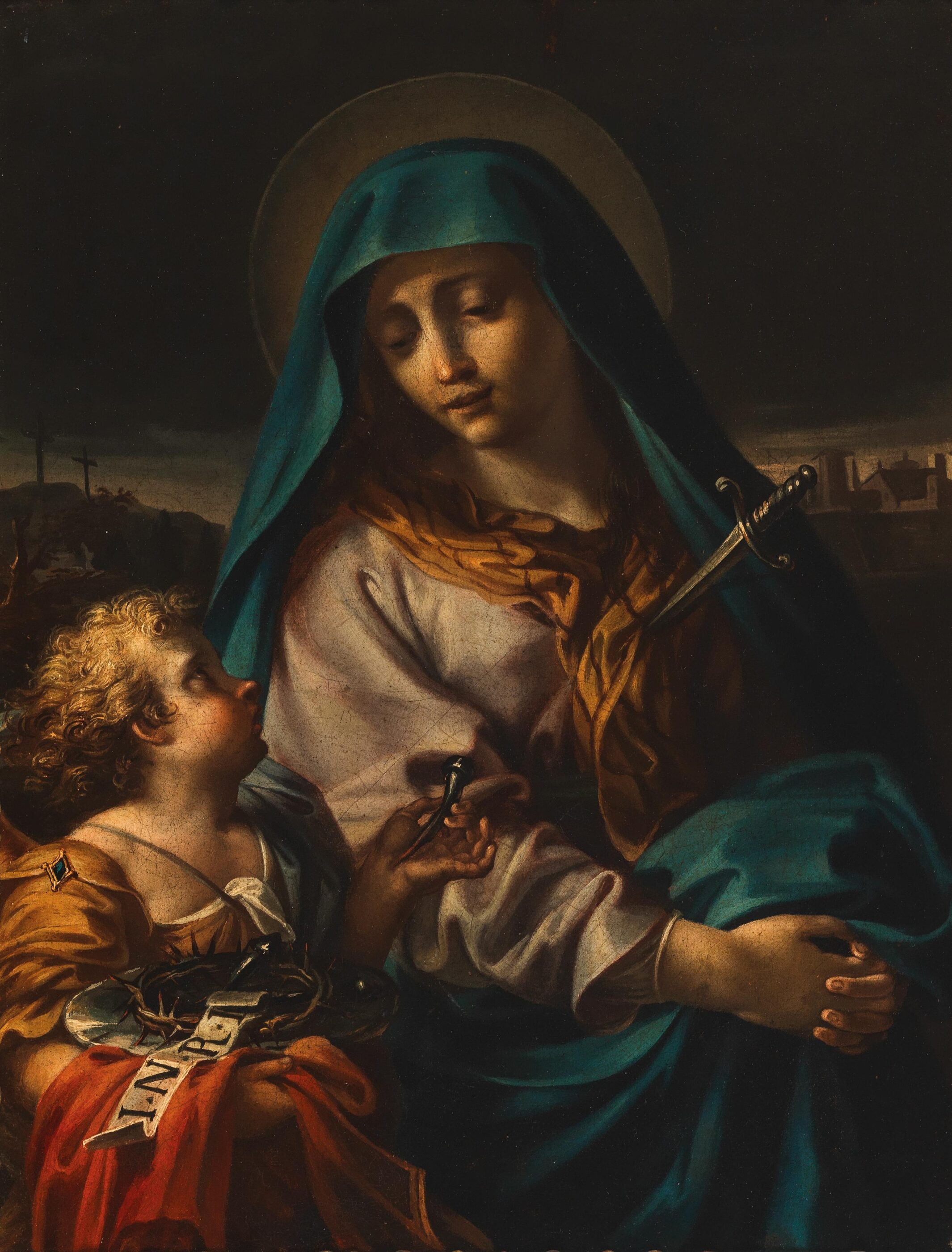
The first certain document concerning the rise of a liturgical feast relating to Mary’s sorrow comes from a local Church. Indeed, on April 22, 1423, a decree of the provincial council of Cologne introduced in that region the feast of Our Lady of Sorrows as reparation for the sacrileges and outrages committed by the Hussites against the images of the Crucified and of the Virgin at the foot of the cross. The feast was entitled Commemoratio angustiae et dolorum beatae Mariae virginis, according to the tenor of the conciliar decree, which said: “… We order and establish that the commemoration of the anguish and of the sorrows of the blessed Virgin Mary shall henceforth be celebrated every year on the Friday after Jubilate Sunday (the third Sunday after Easter), unless another feast occurs on that day, in which case it will be transferred to the Friday immediately following”. Further above, the decree also fixed the precise moment to which the celebration referred: “… Concerning the anguish and the sorrow she suffered when Jesus, with His hands stretched out on the cross and immolated for our salvation, entrusted His blessed Mother to the beloved disciple”. Moreover, the document specified that this feast “shall be celebrated only in choir, with first vespers, matins and terce, and with second vespers, according to the notes, the history and the homily composed for this same feast”, words that seem to allude to the existence of liturgical texts earlier than the council itself.
What deserves to be underlined is that this is a feast centered on the scene of Calvary and on the “commendation” (commendatio) of the Mother made by Jesus, on the cross, to John, and that, moreover, this remembrance or commemoration was assigned to the Easter season. In 1482, Pope Sixtus IV composed and had inserted into the Roman Missal, under the title “Our Lady of Pity”, a Mass centered on the saving event of Mary at the foot of the cross. Thereafter, this celebration spread throughout the West under various names and on various dates. Besides the name established by the Council of Cologne and the one fixed in the Mass of Sixtus IV, it was also called: “De transfixione seu martyrio cordis beatae Mariae”, “De compassione beatae Mariae virginis”, “De lamentatione Mariae”, “De planctu beatae Mariae”, “De spasmo atque doloribus Virginis”, “De septem doloribus beatae Mariae virginis”, etc.
As for the date, it varied from the Friday after the Sunday in albis, or the first Saturday after the octave of Easter, or the Friday after the second Sunday of Easter (not forgetting the date fixed by the Council of Cologne, that is, the Friday after the third Sunday of Easter), to the Monday, or Friday, or Saturday after Passion Sunday. In short, in the name there was a shift from the commendatio to the septem dolores (that is, from the scene at the foot of the cross to the various sorrows of Mary’s life) and, in the date, from the Easter season to the Lenten season. Naturally, these shifts happened slowly, although it is impossible for us to follow their development.
On August 18, 1714, the Sacred Congregation of Rites, at the request of the prior general of the Servants of Mary, granted that the “Solemn commemoration of the seven sorrows of the blessed Virgin Mary”, already celebrated in some provinces by special indult, be extended to the whole Order on Passion Friday, with the rank of greater double. On April 22, 1727, Benedict XIII, likewise at the request of the Servite Order, extended the feast of the seven sorrows of Mary to the whole Latin Church and fixed it according to the Order’s date, on the Friday after Passion Sunday. Thus unification of both the title and the date was achieved.
The reference to the seven sorrows, occasioned by the much older reference to the seven joys of Mary, goes back to the fourteenth century, although for a long time there was no uniformity in determining the individual sorrows. There were, in fact, various groupings, and the number seven, with the content that has remained to this day, became established only around the end of the fifteenth century. The passage from the Pity to the Seven sorrows did not occur without the influence of the Order of the Servants of Mary, which meanwhile outlined another feast on the sorrows of Mary in September, in order to favor lay groups.
Indeed, around 1500, it was customary to hold at the churches of the Servants of Mary a gathering of those enrolled in the Company of the habit of the seven sorrows, on the third Sunday of each month. A century later, one of these gatherings began to be made more solemn with a procession, the third Sunday of September being chosen. The Holy See, on July 9, 1668, authorized the Order to celebrate this feast of the seven sorrows solemnly on the third Sunday of September. Furthermore, at the request of the procurator general, Clement XI, with the bull Iniunctae nobis, granted a plenary indulgence to all who had visited, on the third Sunday of September, a church of the Servites.
At the request of Philip V, the September feast of the seven sorrows was extended, on September 17, 1735, to all the dominions of Spain. On September 18, 1814, Pius VII, greatly devoted to Our Lady of Sorrows, in memory of the sufferings inflicted by Napoleon on the Church in the person of her head, extended it to the whole Latin Church, with the texts of the office and of the Mass already in use among the Servants of Mary. With the liturgical reform of Pius X, who wished to give prominence to Sunday, this September feast, in 1913, ceased to be movable and was fixed on September 15, the day on which it was celebrated in the Ambrosian rite, which already kept the seven sorrows on the day of the octave of Mary’s Nativity.
As for the feast of Passion Friday, it was reduced to a simple commemoration by the rubrical reform of 1960. Besides, these were two feasts identical in title and with the same Mass texts, except for the Collect. The new Calendar of 1969, besides completely suppressing the commemoration in Passiontide and reducing the rank of the September 15 celebration to a simple “memorial”, also changed the title of the feast (Blessed Virgin Mary of Sorrows). The specific memorial of the “Seven sorrows” is not made; rather, the intention is to contemplate “the sorrow” of Mary as a whole.
One can agree with this last change, although it seems to us that it would have been more effective to move from “Our Lady of Sorrows” (almost the fruit of a devotional piety) to “Mary at the cross” (an evident “saving event” and therefore open to a memorial celebration). Considering that all the oldest manifestations of the liturgical cult of Our Lady of Sorrows, besides referring to Jn 19:25-27, also belong to the Lenten and paschal season, we ask ourselves whether it would not have been better to privilege not the September feast but the Passion one (which entered the Roman Calendar a century earlier), thus filling a gap as regards the explicit presence of Mary during the season of the celebration of the paschal mystery.
Thus, just as the study of the ancient sources led to the recovery of the solemnity of the Mother of God inserted into the Christmas cycle, the same study would have led to the recovery of a feast of the compassio of the Virgin to be inserted into the paschal cycle. Moreover, it seems to us that not only the historical events recalled, but also the Marialis cultus is more on our side. In fact, the papal document, first of all, lists this feast among “the celebrations that commemorate saving events in which the Virgin was closely associated with her Son” and which carry the liturgical rank of “feast”. Next, it indicates its content, saying that “the memorial of the Virgin of Sorrows is a fitting occasion for reliving a decisive moment in the history of salvation and for venerating the Mother associated with the passion of her Son and close to Him, raised up on the cross” (Marialis cultus 7).
This is the true content of the feast, that is, the effective presence of Mary at the culminating moment of the redemption, and this is precisely what the liturgical texts of the day bring out. Now, the historical saving fact must be matched by its celebration in mystery throughout the liturgical year: why separate in the celebration what happened together in the history of salvation? If it could be written: “Despite all the adaptations, it is not easy to find a justification for Mary’s sorrow in the liturgy: the theme in itself, as it was conceived in piety or in devotion, takes on an eminently personal aspect, of private devotion, and not of liturgy”, this happened because attention stopped at the title “Our Lady of Sorrows”, almost the fruit of a pious sentimentalism, and because the content of the feast was not duly considered, centered as it is on Jn 19:25-27 and so well brought out in chapter VIII of the Lumen gentium of Vatican II (cf. Lumen gentium 58 and 61). If the celebration had been placed in the paschal cycle, it would have been more immediate to perceive all its density of mystery. Unfortunately, as it stands, it bears the scars of the historical lacerations between devotions and liturgy, awaiting better, more paschal solutions.
From the mystery celebrated to the mystery lived
The liturgical texts of the September 15 celebration fared better, because for the most part they are new formularies, even if drawn from various sources and suitably adapted. Indeed, this extensive replacement becomes a clear sign that a real correction was intended in the memorial of Our Lady of Sorrows: from a predominantly devotional and sentimental reading, an attempt is made to arrive at a vital, mystery-centered reading of Mary’s participation in the passion of her Son. Let us try, briefly, to grasp it.
A) The Marian core of the feast, in dependence on the mystery of Christ
First of all, the Marian content of the feast is brought out, with clear dependence on the mystery of Christ. It seems to us that it is the Collect of the Mass (whose precise purpose is to “express the character of the celebration”) that focuses the central theme: “O God, You willed that beside Your Son, raised up on the cross, His suffering Mother should stand”. It refers, that is, to the culminating fact of our redemption, to the saving event of Calvary, in order to affirm that it has two subjects: beside Christ, His Mother. Unfortunately, the Italian text weakly renders the Latin expression compatientem Matrem astare voluisti, where it is more explicit that Mary not only “was present”, but was also “com-passionate” (from pati cum, to suffer together with) with Christ, effectively collaborating in His redemptive work.
The expression compassionem b. v. M. recolentes of the prayer after communion is likewise rendered as “in the memorial of the blessed Virgin of Sorrows”. It seems to us, in fact, that the term “of Sorrows” does not express well the whole breadth of the “com-passion” and weakens it into a generic and vague sentiment. All this is grounded in the constitution on the Church of the Second Vatican Council (to which our text seems to refer), which affirms: “Mary, suffering with her Son as He died on the cross, cooperated in an altogether singular way in the work of the Savior” (Lumen gentium 61).
Moreover, this happens by the will of the Father (“O God, You willed”): the Son who dies on the cross and the Mother who shares in that suffering constitute an act of obedience to the will of the Father, in direct line with His whole plan of salvation. What we celebrate is not a secondary circumstance in the life of Jesus and of Mary, but something that stands at the center of the designs of God the Father, because, as the same council says: “Mary, not without a divine plan, stood by the cross, suffering deeply with her only-begotten Son and joining herself with a maternal heart to His sacrifice, lovingly consenting to the immolation of the victim she had brought forth” (Lumen gentium 58).
The “passion” of Christ corresponds to the “com-passion” of Mary: if the Son is “the man of sorrows” (cf. Is 53:3), His Mother becomes “the woman of sorrows”. If He is the suffering “Servant of JHWH”, she becomes the suffering “Handmaid of the Lord” (cf. Lk 1:38). This is the central core of the mystery celebrated.
Now, the two Gospel passages of the day (Lk 2:33-35 and Jn 19:25-27) recall the historical fact that the Collect grasped as an event of salvation: the first, in the form of prophecy. The second, in the form of full realization. In fact, “the sword” that Simeon foretells to Mary will accompany her whole life, but will find its fulfillment above all in the “hour” of Calvary. And it is precisely the Gospel of John that brings out what the prayer over the offerings will affirm: Mary “was given to us as a most sweet Mother beside the cross of Christ”.
Her “com-passion”, defined by the Gospel acclamation as a true martyrdom (“Blessed is the Virgin Mary, because, without dying, she merited beneath the cross the palm of martyrdom”), makes her a collaborator of the Son who, according to the first reading (Heb 5:7-9), by His death “became the source of eternal salvation for all who obey Him”. By her sorrow, Mary too, until then only the Mother of Jesus, becomes our Mother, the Mother of all the faithful and of all who are called to salvation.
Exegetes observe that, structurally, the scene described by Jn 19:25-27 underlines a transfer of belonging: the woman who until then was “the mother of Jesus” will henceforth be, by the will of Jesus Himself, “the mother of the disciple”. With the title “woman” that Jesus uses on the cross, He constitutes His mother in the role of the New Eve, of the new “mother of the living”. The Second Vatican Council says: “With good reason the holy Fathers hold that Mary, by obeying, became a cause of salvation for herself and for the whole human race. Hence not a few of the ancient Fathers, in their preaching, affirm with Irenaeus that the knot of Eve’s disobedience was untied by Mary’s obedience: what the virgin Eve bound by her unbelief, the Virgin Mary loosed by her faith. And, comparing her with Eve, they call Mary ‘the mother of the living’, often affirming: ‘death through Eve, life through Mary’” (Lumen gentium 56).
Further on, the same council affirms peremptorily that Mary “suffering with her Son as He died on the cross, cooperated in an altogether singular way in the work of the Savior, by obedience, faith, hope, and burning charity, to restore supernatural life to souls. For this reason she became for us a mother in the order of grace” (Lumen gentium 61). This spiritual yet real motherhood, won by Mary, as every motherhood is, in sorrow, is the consequence of the central mystery celebrated and opens the way to another set of considerations.
B) From the event to the Church, from the mystery celebrated to the mystery lived
Passing, therefore, to our own involvement in the celebration, let us recall that the scene of Jn 19:25-27 also has a very high ecclesiological value. In fact, the two persons present at the cross both have, though in different ways, a relationship with the Church: the mother of Jesus becomes the mother of the disciple and of all the disciples (and in this sense it can be said that here she becomes the Mother of the Church). The beloved disciple, for his part, represents all the disciples of Christ, the faithful of the Church.
The last act of Jesus, before dying, was to form the messianic people, to found the Church, in the persons of His Mother and of His beloved disciple. Now, the liturgical texts refer precisely also to the Church, to us who celebrate this mystery, asking the Father that we may gather its fruits: “Grant that Your holy Church, associated with Mary in the passion of Christ, may share in the glory of the resurrection” (Collect). This is an essential and vital petition: to share in the passion of Christ like her who is mother and image of the Church, ardently desiring to attain, as she attained, final glorification.
In short, we ask to be associated, like Mary, with the whole paschal mystery of Christ, according to the exhortation of the communion antiphon: “Insofar as you share in the sufferings of Christ, rejoice, so that in the revelation of His glory you may also rejoice and exult”. For all who have been baptized into the death and resurrection of the Lord, this is the way to relive their own baptism, and the celebration of the Eucharist, the memorial presence of the paschal mystery, is what brings it to fulfillment.
The petitions of the Liturgy of the Hours also tend toward this: “Our Savior, who willed Your Mother to stand at the foot of the cross, united to the offering of the sacrifice, grant that through her intercession we may share in the mystery of Your passion and of Your glory”. “Good Jesus, who, while You hung upon the cross, gave the suffering Virgin to John as his mother, grant us the grace to live as her true children” (intercessions at Lauds). “You made Mary strong at the foot of the cross and filled her with joy at the resurrection of Your Son: sustain us in the trials of life and strengthen us in hope” (intercessions at Vespers).
Conclusion
The historical course of the feast of Our Lady of Sorrows, with its variations of title and of date, reveals a real tension: on the one hand, the tendency to shift the gaze away from the paschal event, concentrated in the commemoratio of the Mother to the disciple, toward a more fragmented and devotional reading of the septem dolores. On the other hand, the ever-recurring need to lead Mary’s sorrow back to its proper theological locus, that is, to Calvary as a saving event. When the celebration is fixed in September, there is a risk of separating, in the rhythm of the liturgical year, what in the history of salvation took place as a unity: the passion of the Son and the com-passion of the Mother. The memorial can then lose its density of mystery and more easily become an object of private piety, without standing forth, by its very structure, as ecclesial participation in the paschal mystery.
The liturgical reform, in choosing to contemplate “the sorrow” of Mary as a whole, opens an important possibility: to free the celebration from a narrow sentimentalism and to recover the essential core, which is the effective presence of Mary beside the Son raised up on the cross, in obedience to the design of the Father. Nevertheless, this recovery will be all the more fruitful the more explicitly it allows itself to be guided by the Gospel datum that sustains the feast: (Jn 19:25-27). There the Church sees, at one and the same time, the consummation of the redemptive work and the establishment of a new bond, real and permanent, between Mary and the disciples. Mary’s sorrow is not only a sorrow “over” Christ, but a sorrow “with” Christ, a participation that, without being confused with the unique action of the Redeemer, is taken up as maternal cooperation in the plan of salvation, according to the ecclesial reading proposed by Lumen gentium (Lumen gentium 58 and 61).
From this follows the decisive point: the liturgical celebration is not limited to recalling a past event, but makes it possible to pass from the mystery celebrated to the mystery lived. The Church, associated with Mary, is called to enter into the same paschal dynamism: to suffer with Christ in order to rise with Christ, to pass through trial in hope, and to receive, as a gift, the spiritual motherhood of Mary as a principle of belonging and of ecclesial communion. Therefore, when the liturgy asks that the Church, united to Mary, may share in the glory of the resurrection, it is not making a Marian ornament of worship, but pointing to an itinerary of discipleship: the disciple’s path passes through Calvary, and Calvary is fully understood only from Easter.
In sum, the feast of Our Lady of Sorrows attains its truth when it is read within its paschal horizon and its ecclesiological scope. Calvary is not only the place of suffering, but the place of foundation: in it are manifested, in the most extreme way, the obedient love of the Son and the maternal consent of the Mother. In it the Church is symbolically born, in the relationship between “the Mother” and “the beloved disciple”. In it the faithful learn that sorrow, when passed through in faith, does not lead to closing in on oneself, but to fruitfulness. Thus, to find again a more paschal, explicit and mystery-centered placement for the memorial of Mary at the cross is not a rubrical detail, but a pastoral and spiritual key: to restore to the celebration its power to form disciples who, with Mary, remain beside the cross and, with her, learn to await the joy of the resurrection.
Why does the disciple’s path pass through Calvary?
Calvary is the disciple’s unavoidable path because Jesus declared: “If anyone wishes to come after Me, let him deny himself, take up his cross, and follow Me” (Mt 16:24). Mariology sees in Mary the first disciple who walked this path to the end: standing beside the Cross (Jn 19:25), she did not flee from suffering, but united herself to the sacrifice of the Son. This fidelity at Calvary is the condition of paschal joy: without the Cross there is no Resurrection, without Calvary there is no Easter Sunday. Mary teaches the disciple that the way of the Cross is the way of life.
What is the mariological meaning of Mary’s presence beside the Cross in Jn 19:25?
Mary’s presence “beside the Cross” (Jn 19:25) has a profound theological meaning: she is not merely a passive witness, but an active co-participant in the sacrifice of the Son. The theological tradition (Saint Bernard, Saint Bonaventure, Saint Louis Marie Grignion de Montfort) sees in this scene the consummation of the “fiat” of the Annunciation: the same “yes” that welcomed the Incarnation now welcomes Calvary. The Second Vatican Council (Lumen Gentium, no. 58) affirms that Mary, “suffering with her only Son”, cooperated in an altogether singular way in the work of the Savior.
How does Mary accompany the disciple on his way of the Cross today?
Mary accompanies the disciple on the way of the Cross through a threefold presence: as the mother who intercedes (Jn 2:3, the model of Cana), as the teacher who shows how to unite one’s suffering to that of Christ (Col 1:24), and as a sister on the road who knows sorrow from her own experience. Devotion to the Rosary, particularly the Sorrowful Mysteries, proposes a meditative contemplation of Calvary with the eyes of Mary: not in order to linger in sorrow, but to discover in it the love of God that transforms every Cross into hope of Resurrection.
Deepen your knowledge of Mariology: If you wish to study Mariology with academic rigor, get to know our Postgraduate Program in Mariology. Learn more about Marian Theology and the Marian apparitions approved by the Church.
To deepen the theological reflection on Mary at the foot of the Cross and the role of Calvary in the Christian faith, consult the Encyclical Redemptoris Mater of Pope John Paul II.
Postgraduate Program in Mariology
Would you like to deepen your formation in Mariology? Get to know the Postgraduate Program in Mariology of Locus Mariologicus, an academic program that unites theological rigor, spiritual life and the living tradition of the Church.



Responses