Ut sint unum: Mary and the Prayer for Unity
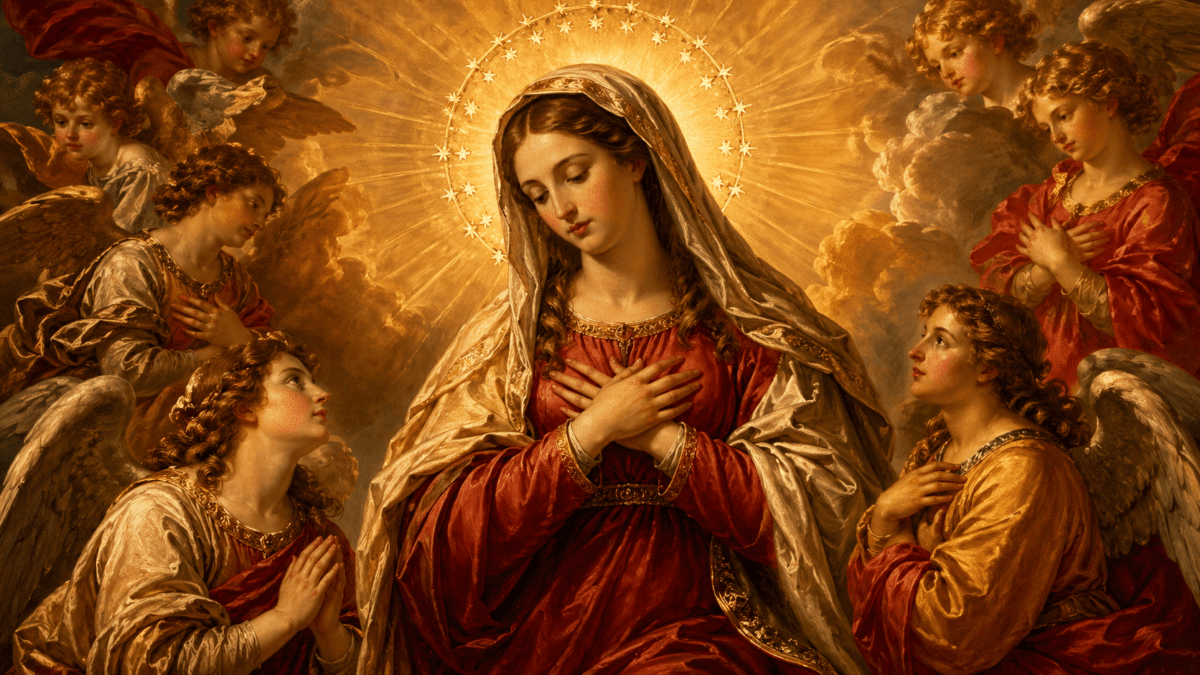
Ut omnes unum sint, sicut tu, Pater, in me et ego in te, ut et ipsi in nobis unum sint.
Jn 17:21
“That all may be one, as you, Father, are in me and I in you, that they also may be in us.” Jesus’ priestly prayer (Jn 17) culminates in this petition for unity: not an organizational or juridical unity, but an ontological unity modeled on the unity within the Trinity. The division of Christendom, the fractures between East and West (1054) and between Rome and the Reformation (16th century), are the scandal that this prayer denounces and that the ecumenical vocation seeks to overcome. Mariology finds in this prayer its deepest ecumenical foundation: Mary, whose faith was the origin of the unity of the nascent Church, is called to be a figure of the unity that Christ asked for.
I. “As you in me and I in you”: the Trinitarian model of unity
John 17:21 establishes the model of ecclesial unity in the unity within the Trinity. “As” (kathos), the same word that structures the commandment of love (Jn 13:34), points to a real analogy, not a merely metaphorical one: the unity that Jesus asks for His own is a participation in the unity of the Father and the Son. Not an outward imitation, but an inner indwelling: “that they also may be in us” (hina kai autoi en hêmin ôsin).
This “dwelling in us,” the life of the disciples within the Trinitarian life, is what the theology of grace describes as the “indwelling of the Trinity.” Baptism brings the believer into this indwelling. The Eucharist deepens it. The life of grace sustains it. The unity of the Church is not, in the final analysis, a human achievement; it is the fruit of this common indwelling in the Trinitarian life. Christians are “one” to the extent that they are “in” the Father and “in” the Son through the Spirit.
The divisions of Christendom are, from this perspective, fractures in this common indwelling. It is not that the separated Churches are “outside” the Trinitarian life, but that their indwelling in that life is partial, fragmented, wounded by historical divisions. The ecumenical vocation is the vocation to recover the fullness of this common indwelling, not through institutional fusion (which would be a counterfeit of unity), but through conversion to the love that the Spirit pours into our hearts (Rom 5:5).
The ecumenical theology of the twentieth century, of which the bilateral dialogues between Rome, the Orthodox Churches, and the communities of the Reformation are the most concrete expression, has sought to articulate this Trinitarian unity as both foundation and horizon. The document of the Faith and Order Commission of the World Council of Churches (BEM, Baptism, Eucharist and Ministry, 1982) and the Catholic-Lutheran Joint Declaration on the Doctrine of Justification (1999) are concrete steps along this path, inspired by the prayer of Jn 17.
II. Mary as a figure of ecclesial unity
Mary occupies a unique place in the ecumenical vocation of the Church. On the one hand, she is venerated, in differing degrees and forms, by the principal Christian traditions: by Catholicism (with its Marian dogmas and rich devotional tradition), by Orthodoxy (with its icons of the Theotokos and its Marian hymnography), and, albeit with greater reserve, by the traditions of the Reformation, which never entirely abandoned the figure of Mary (the Augsburg Confession and the Smalcald Articles preserve her dignity) and which in the twentieth century experienced a significant rediscovery in authors such as H. Asmussen, W. Stählin, and W. Pannenberg on the Lutheran side, and in the work of the Anglican–Roman Catholic International Commission (ARCIC, Mary: Grace and Hope in Christ, Seattle, 2004) on the Anglican side. This shared veneration, though marked by real differences, points to a common foundation.
The document of the Groupe des Dombes (Marie dans le dessein de Dieu et la communion des saints, 1998), the result of decades of dialogue between French-speaking Catholic and Protestant theologians, identified Mary as a possible ecumenical “point of convergence.” The key is the distinction between a Christocentric Mariology (which presents Mary as a figure of Christ and of the Church) and a Mariology that exalts Mary in herself. A Christocentric Mariology can be shared by all traditions. A Mariology disconnected from Christology is a source of division.
The prayer of the Rosary, which seems eminently “Catholic” in its form, has recently been recognized by theologians of other traditions as a form of meditation on the mysteries of Christ that has its own ecumenical value: to meditate on the Annunciation, the Visitation, the Nativity, the Passion, and the Resurrection with Mary is not “Mariocentric”; it is Christocentric, carried out from the perspective of the Mother. The Rosary, rightly understood, can be an ecumenical prayer because it is fundamentally a prayer about the mysteries of Christ.
John Paul II, whose pontificate was one of the most marked by Marian devotion in the twentieth century, was also the pope of the greatest ecumenical advance in history: the visit to the Ecumenical Patriarchate of Constantinople (1979), the Common Declaration with Patriarch Bartholomew I (Rome, June 29, 1995), the historic visit to Romania and the joint declaration with Patriarch Teoctist (1999), as well as far-reaching ecumenical documents such as the encyclical Ut Unum Sint (1995). His Marian spirituality was not an obstacle to ecumenism; it was one of its driving forces, because he understood Mary as a figure of the unity that Christ asked for in Jn 17.
III. “That the world may believe”: unity and mission
John 17:21 continues: “that the world may believe that you have sent me.” The unity of the Church is not an end in itself; it is ordered to mission: the world “believes” when it sees the unity of Christians. The division of Christendom is thus not only an internal tragedy; it is an obstacle to mission. The world that watches Christians dividing among themselves does not see the sign of John 13:35 (“By this all will know that you are my disciples, if you have love for one another”).
This connection between unity and mission has a direct Marian dimension. Mary, as Mater Ecclesiae, stands at the heart of both unity and mission: she who prays with the Apostles in the Upper Room, before Pentecost and before the universal mission, is the figure of the Church united in prayer that prepares for mission. The Pentecost awaited in the Upper Room is at once the gift of unity (the same Spirit dwells in all) and the gift of mission (the same Spirit sends all).
The World Youth Days, which John Paul II inaugurated in 1986, are one of the most visible contemporary signs of this unity in the service of mission. Mary’s presence at this event (the Marian icon of the Salus Populi Romani, entrusted by John Paul II to young people in 2003, which goes on pilgrimage with the WYD Cross, and the tradition of entrusting young people to Mary at the end of each World Youth Day) expresses the intuition that the unity of the world’s young Christians has a Marian heart: Mary, who gathers Christ’s spiritual children around herself, is the figure of the unity that mission requires.
The missionary Mariology of Saint Louis-Marie de Montfort (Treatise on True Devotion, nos. 47-59) announced that the “latter times,” understood not in the strict apocalyptic sense but as a reference to the final period of the Church’s history on its way toward the parousia, would be marked by an intensification of Marian devotion as a privileged instrument of evangelization. This prophecy found historical confirmation in the great Marian movements of the twentieth century—Fatima; Medjugorje (the subject of the Note Gospa of the Dicastery for the Doctrine of the Faith, 2024, which recognizes positive spiritual fruits without pronouncing on the supernatural character of the apparitions); and the approved apparitions in various parts of the world—which coincided with a renewal of mission and unity in many local Churches. The connection between Mary and missionary ecclesial unity is a fact of historical experience that theology seeks to understand.
IV. “I in them and you in me”: the perfection of unity
John 17:23: “I in them and you in me, that they may become perfectly one.” The perfection of unity (teteleitai eis hen) is the eschatological horizon: it will not be fully attained within history, but it gives direction to the whole historical process. Every concrete ecumenical step is an anticipation of this perfection. Every division that is maintained is a refusal of the vocation that Christ formulated in His most solemn prayer.
Mary, glorified in the Assumption, is already in this “perfect unity” with the Father, the Son, and the Spirit. She who is “one” with the Trinity in the fullest way possible for a creature is the figure and the guarantee of the “perfect unity” for which Christ prays. To contemplate Mary in glory is to contemplate the horizon of the unity we await. To invoke her is to ask her to intercede for the fulfillment of the prayer that the Son raised to the Father on the night He was handed over.
The ecumenical tradition has increasingly recognized that unity cannot be purely institutional or juridical; it will have to be spiritual, a unity of conversion and of prayer. The “Week of Prayer for Christian Unity” (January 18-25) and the “ecumenical walk” that many dioceses promote are expressions of this conviction: unity begins with prayer, which is precisely what Jesus did in Jn 17. And Mary, who “persevered with one accord in prayer” in the Upper Room, is the model of this prayerful perseverance while awaiting the Spirit who “guides into all the truth,” including the truth of the unity that Christ asked for.
Mary, figure of the Church united in prayer in the Upper Room, is the heart of the ecumenical vocation grounded in Jn 17:21: the unity that reflects the Trinitarian life and makes the world able to believe.
References
- John Paul II, Ut Unum Sint, nos. 21-27 and 79 (1995).
- Groupe des Dombes, Marie dans le dessein de Dieu (1998).
- Second Vatican Council, Unitatis Redintegratio (1964).
- Saint Louis-Marie de Montfort, Treatise on True Devotion, nos. 49-54.
- H. U. von Balthasar, The Office of Peter and the Structure of the Church (1986).
Postgraduate Program in Mariology
Would you like to deepen your formation in Mariology? Discover the Postgraduate Program in Mariology of Locus Mariologicus – an academic formation that unites theological rigor, spiritual life, and the living tradition of the Church.
Would you like to study Mariology seriously?
This article grows out of the works in the Locus Mariologicus library. The Postgraduate Program in Mariology takes you to the same source, with academic guidance: Scripture, the Fathers of the Church, and the Magisterium, from the first dogma to contemporary questions.




Responses