Pater, venit hora: Mary and the Approaching Glorification
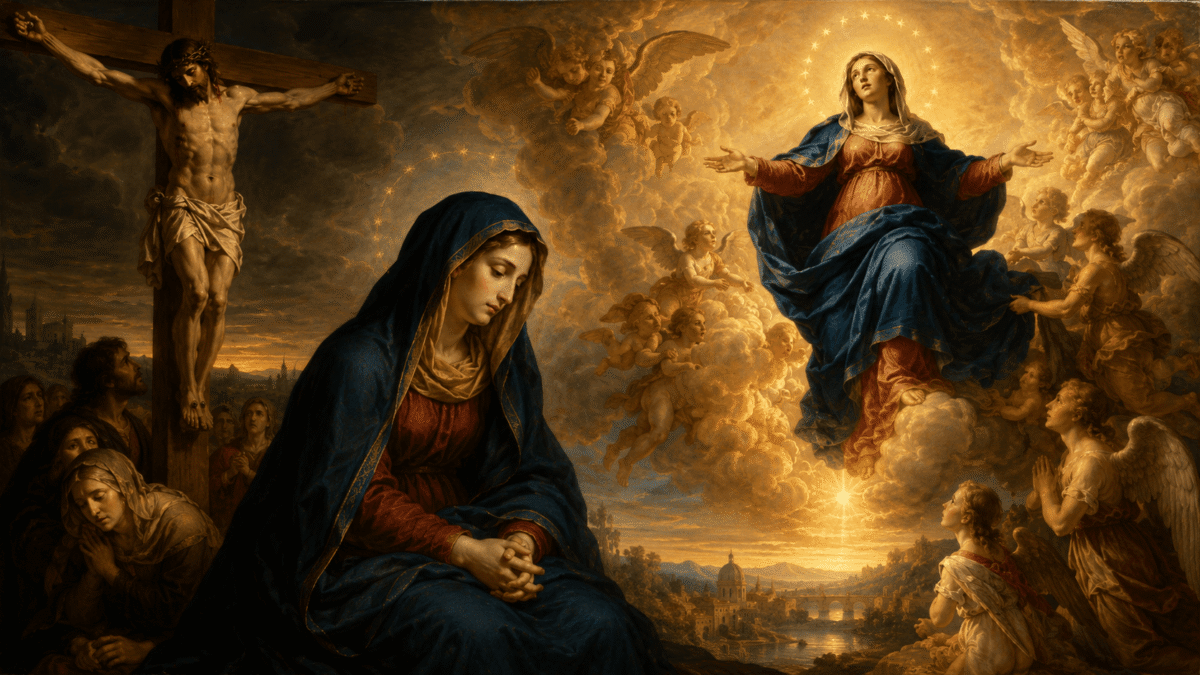
Pater, venit hora: glorifica Filium tuum, ut Filius tuus glorificet te.
Jn 17:1
“Father, the hour has come: glorify your Son, so that your Son may glorify you.” Jesus’ priestly prayer (Jn 17) opens with the announcement of the “hour,” the central moment of all Johannine theology: the hour of the Cross, of the Resurrection, and of the mutual glorification of the Son and the Father. Mariology finds in this “hour” the point of convergence of all its reflection: Mary, who was the human “hour” of the Incarnation of the Son (the one who made it possible for the eternal Son to enter time), is also the one who most fully participated in the “hour” of glorification.
I. The “Hour” in John: Structure and Meaning
The theme of the “hour” (hôra) runs through the entire Fourth Gospel like a guiding thread. At Cana: “my hour has not yet come” (Jn 2:4). In the disputes with the Pharisees: “no one arrested him, because his hour had not yet come” (Jn 7:30; 8:20). At the entry into Jerusalem: “the hour has come for the Son of Man to be glorified” (Jn 12:23). In the farewell discourses: “the hour has come” (Jn 16:32). And now, in the priestly prayer: “Father, the hour has come” (Jn 17:1).
The “hour” of Jesus in John is not an event confined to a single moment; it is the whole complexity of the Paschal Mystery: the passage from death to life, from humiliation to glorification, from abandonment to perfect communion with the Father. The “hour” is at once the darkest moment (the Cross) and the most luminous (the Resurrection-Glorification): in John, these two aspects are inseparable, because the Cross is already the beginning of the glorification (“when I am lifted up from the earth,” Jn 12:32).
The mutual “glorification” of the Father and the Son for which Jn 17:1 asks is the economic expression of the intra-Trinitarian perichoresis. The Son “glorifies” the Father through His obedience unto death, revealing the Father’s love to the world. The Father “glorifies” the Son by raising Him and exalting Him at His right hand, confirming the truth of His mission. This mutual glorification, which the theological tradition describes as the temporal expression of the eternal life of the Father and the Son, is the horizon within which all Christology, all soteriology, and all Mariology find their definitive meaning.
The connection between the “hour” of Jesus and Mary is rooted in the Johannine text. In Jn 2:4, when Jesus says “my hour has not yet come,” He is responding to Mary’s initiative at Cana. This mysterious reply suggests that Jesus’ “hour,” His Paschal Mystery, is somehow linked to Mary’s presence and intercession. In a certain sense, the “hour” began with the Annunciation: when Mary said “fiat,” the hour of the eternal Word entering time began.
II. Mary and the “Hour”: Participation in the Paschal Mystery
Jn 19:25 places Mary at the foot of the Cross precisely when Jesus’ “hour” reaches its highest and darkest point: “Standing by the Cross of Jesus was his Mother.” Mary’s presence in Jesus’ “hour” is not accidental; it is the fulfillment of a logic that goes back to the Annunciation: she who said “yes” to the Son in the “hour” of the Incarnation is present in the “hour” of the glorification, even when it passes through death.
The theological tradition has identified Mary as the “handmaid of the hour” of Jesus: just as she made the Incarnation possible by saying “fiat,” she made possible, in a manner wholly subordinate to and dependent on the one mediation of Christ, her participation in the redemptive work by remaining present in the “hour” of the Cross. Not that her physical presence was necessary for the validity of the redemptive sacrifice, but that she was called to participate in it in a real way, with her whole being, with all her suffering.
Saint John Paul II, in Redemptoris Mater (no. 18), developed the idea that Mary’s faith in the “hour” of the Cross is the purest form of her pilgrimage of faith: she who believed at the Annunciation without seeing all the implications of her “fiat” now believes on Calvary without seeing the Resurrection. This faith in darkness, adherence to Christ’s word without the tangible confirmation of His victory, is the model of all Christian faith that passes through “hours” of darkness and apparent abandonment.
The eschatological dimension of the “hour” finds its fullest expression in Mary. Jn 17:5: “Father, glorify me now in your own presence with the glory which I had with you before the world existed.” The glorification that Jesus asks for is the restoration of the glory He had “before the world,” the eternal glory of the Son with the Father. Mary participates in this glorification through the Assumption: she who took part in the “hour” of the Cross shares in the glory that the Son asked of the Father and that the Father granted to Him.
III. “To Know You, the Only True God”: Eternal Life as Knowledge
Jn 17:3: “This is eternal life: to know you, the only true God, and Jesus Christ whom you have sent.” In John, “eternal life” is not a matter of time; it is a matter of knowledge: gnosis in the Johannine sense, which is the knowledge of love, the personal relationship with the Father and the Son that the Spirit mediates. To “know” God is to be in relationship with Him. And this relationship of knowledge and love is the “eternal life” that already begins in the present for those who believe.
Mary is the creature who most deeply “knew” the Son, in the Semitic and Johannine sense of ginoskein: not abstract knowledge, but the knowledge of relationship. She who “knew” Him in her womb, who “knew” Him in Nazareth for thirty years, who “knew” Him at the Cross and in the glory of the Resurrection, possesses this “knowledge of eternal life” in a way that surpasses that of any other human being. Her “eternal life,” which the Assumption confirmed, is the definitive fulfillment of this knowledge that began at the Annunciation.
The Christian mystical tradition, from Evagrius Ponticus to Saint John of the Cross, identified the “knowledge of God” (theognosia) as the ultimate end of the contemplative life: not the conceptual knowledge that Scholastic theology works out, but the knowledge of love that infused contemplation mediates. For this tradition, Mary is the model and the icon of this theognosia: she who “kept and pondered” in her heart is the contemplative above all others, whose “knowledge” of God reached its definitive and complete form in the Assumption.
The connection between “knowledge” and “glory” in Jn 17, “glorify your Son” (v. 1) and “this is eternal life: to know you” (v. 3), points to a profound unity: the glorification that Jesus asks of the Father is the revelation of the knowledge of God that Jesus came to communicate. “Glory” is not a spectacle; it is the revelation of intra-Trinitarian life to the world: “I have manifested your name to men” (Jn 17:6). And this revelation has its most eloquent icon in Mary, the one who knew the Son most deeply and who, through the Assumption, is now the fullest witness to the glory that He asked for.
IV. “Glorify Me Now in Your Own Presence”: Ascension, Assumption, and Shared Glory
Jn 17:5: “glorify me in your own presence.” Jesus asks the Father to restore Him to the glory He had “before the world.” This “pre-cosmic glory” of the Son, which the Incarnation “veiled” without eliminating it, is restored by the Resurrection-Ascension. And the disciples share in this glory: “the glory which you gave me, I have given to them” (Jn 17:22). Jesus’ glorification has an ecclesial dimension: He is not glorified “alone,” but takes His own with Him.
In the order of creatures, Mary is the first to participate in this shared glory of the Son: the Assumption is one of the fullest expressions, in the order of creatures, of the promise of Jn 17:22. The “glory that the Father gave the Son” reached Mary in all its fullness: not only spiritually (as happens to all the saints), but bodily, in body and soul, just as the Son Himself was glorified in body and soul in the Resurrection.
Christian eschatology, the hope of the universal resurrection and of eternal life, has in Mary its most concrete “sign.” Not merely an abstract promise, but a fulfillment already verified: in Mary, Jesus’ “hour” has produced its most complete fruit. The glory that Christ asked of the Father was granted to Him. And that glory has already reached, in Mary, its full extension to humanity. What we hope for ourselves and for all redeemed humanity has already been given to Mary, and this “already” of Mary is the surest guarantee of our “not yet.”
The Church’s liturgy celebrates this shared glory of Mary in the great Marian feasts: the Assumption (August 15), the Immaculate Conception (December 8), and the Nativity of Mary (September 8). Each of these celebrations is an anticipation of eschatological glory: the Church that celebrates Mary’s glory celebrates the destiny that the Son won for all humanity. “Pater, venit hora”: the hour of Jesus has come. His glory has been fulfilled. And Mary, who participated in that hour with her whole being, is the first sign of the glory that this hour produced for humanity.
Mary, who participated in the “hour” of Jesus from the Fiat to Calvary, was the first to share in the glorification that the Son asked of the Father, and her Assumption is the most eloquent sign that this glory has reached humanity.
References
- John Paul II, Redemptoris Mater, nos. 18-19 (1987).
- Pius XII, Munificentissimus Deus, nos. 38-44 (1950).
- R. Brown, The Gospel According to John, vol. II (1970).
- H. U. von Balthasar, Theodramatik, IV: “Das Endspiel” (1983).
- A. Feuillet, Le Sacerdoce du Christ et de ses Ministres (1972).
Postgraduate Program in Mariology
Would you like to deepen your formation in Mariology? Discover the Postgraduate Program in Mariology of Locus Mariologicus, an academic formation that unites theological rigor, spiritual life, and the living tradition of the Church.
Would you like to study Mariology seriously?
This article grows out of the works in the Locus Mariologicus library. The Postgraduate Program in Mariology takes you to the same source, with academic guidance: Scripture, the Fathers of the Church, and the Magisterium, from the first dogma to contemporary questions.





Responses