Fallen Angels: Who They Are, What the Bible Says and What the Church Teaches
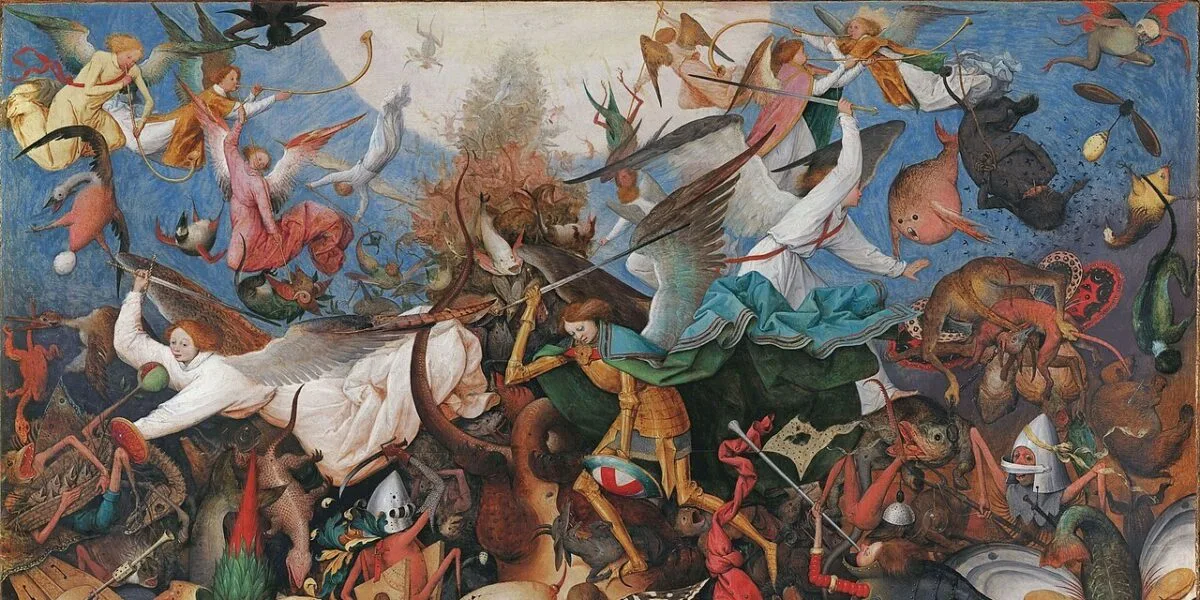
By Prof. Dr. Daniel C. Afonso · Updated
The fallen angels are angels whom God created good and who, by a free, radical and irrevocable choice, rejected God and his Kingdom (CCC 392). Scripture calls their chief Satan or the Devil, and the Church teaches, with the Fourth Lateran Council (1215), that they were not created evil: they made themselves evil.
The Bible speaks of this fall in sober and dense texts (2 Pet 2:4, Jude 6, Rev 12:7-9), and the Magisterium fixed the doctrine in a sentence that definitively excludes any dualism: evil was not created, it was chosen. This article goes through the texts in the original Greek and Hebrew, the teaching of the Catechism (nos. 391-395), the Lateran definition, the passages of Isaiah 14, Ezekiel 28 and Genesis 6 that are often read without care, and answers honestly the most searched question: what, after all, are the names of the fallen angels?
Who the fallen angels are
For the Catholic faith, the fallen angels are what ordinary language calls demons. They are not gods of evil, nor souls of the dead, nor impersonal forces: they are spiritual, personal creatures, endowed with intelligence and will, like all the angels (CCC 330). The difference between them and the faithful angels lies not in nature, which is the same, but in the answer they gave to God. The summary of the Catechism says it all in three sentences:
“Satan or the Devil and the other demons are fallen angels, because they freely refused to serve God and his plan. Their choice against God is definitive. And they try to associate man with their revolt against God.” (CCC 414)
Hence the three data that organize the whole subject: the origin (created good), the fall (a free and definitive choice) and the present activity (the temptation of man, always within the limits that God permits). For the full picture of the doctrine on the spirits, see our page on angelology.
What the Catechism teaches about the fall of the angels (CCC 391-395)
The Catechism of the Catholic Church treats the fall of the angels in five paragraphs, within the chapter on original sin. They are worth reading to the letter, because every sentence has been weighed. The quotations below are given in our translation. The full texts, together with paragraphs 328-336 on the angels, are gathered on our page of sources on the Catechism, angels and demons.
CCC 391: behind the first sin there is a seductive voice
“Behind the disobedient choice of our first parents there lies a seductive voice, opposed to God, which makes them fall into death out of envy. Scripture and the Church’s Tradition see in this being a fallen angel, called Satan or the Devil. According to the teaching of the Church, he was at first a good angel, created by God.” (CCC 391, with references to Gen 3:1-5, Wis 2:24, John 8:44 and Rev 12:9)
CCC 392: the fall was a free choice
“Scripture speaks of a sin of these angels. The fall consists in the free choice of these created spirits, who radically and irrevocably rejected God and his Kingdom. We find a reflection of this rebellion in the words of the tempter to our first parents: ‘You will be like God’ (Gen 3:5). The Devil is ‘a sinner from the beginning’ (1 John 3:8), ‘the father of lies’ (John 8:44).” (CCC 392, with a reference to 2 Pet 2:4)
CCC 393: why the sin of the angels is not forgiven
“It is the irrevocable character of their choice, and not a defect in the infinite divine mercy, that makes the sin of the angels unforgivable. ‘There is no repentance for them after the fall, just as there is no repentance for men after death.’” (CCC 393, quoting Saint John Damascene, De fide orthodoxa 2,4, PG 94,877)
CCC 394: the influence of the Devil and the victory of Christ
“Scripture attests the baneful influence of the one whom Jesus calls ‘a murderer from the beginning’ (John 8:44), and who even tried to turn Jesus away from the mission received from the Father. ‘The Son of God appeared for this purpose: to destroy the works of the Devil’ (1 John 3:8). Of these works, the gravest in its consequences was the deceitful seduction that led man to disobey God.” (CCC 394, with a reference to Matt 4:1-11)
CCC 395: the power of Satan is not infinite
“Nevertheless, the power of Satan is not infinite. Satan is a mere creature, powerful by the fact of being pure spirit, but nonetheless a creature: powerless to prevent the building up of God’s Kingdom. […] The divine permission of diabolical activity is a great mystery. But ‘we know that in everything God works for good with those who love him’ (Rom 8:28).” (CCC 395)
In the omitted passage, the Catechism explains that Satan’s action, moved by hatred of God, can cause grave harm, of a spiritual nature and, indirectly, also physical, but that this action is permitted by Providence, which guides history with strength and gentleness. This is the key to reading the subject without fear: the enemy is real, but he is a creature, and he does not have the last word.
Created good: the definition of the Fourth Lateran Council (1215)
Against the Cathars and every form of dualism, which imagined an eternal evil principle alongside God, the Fourth Lateran Council defined, in its first chapter, known by its opening words Firmiter credimus (“we firmly believe”):
“Diabolus enim et alii daemones a Deo quidem natura creati sunt boni, sed ipsi per se facti sunt mali.”
“For the Devil and the other demons were created by God naturally good, but they themselves, by their own doing, became evil.” (Fourth Lateran Council, ch. 1, DS 800, cited in CCC 391, translation of the Catechism text)
The sentence carries the whole Christian metaphysics of evil. Nothing that exists is evil by nature, because everything that exists was created by God, and God creates only the good. Evil is not a substance, it is a ruin: the twisted use of a good freedom. The demon is not God’s counterpart or his rival of equal strength; he is a creature, and a creature spoiled by himself. The full text of the chapter is on our page on the Fourth Lateran Council and the definition on angels and demons, and the question of the freedom that made the fall possible is treated in do angels have free will?
Fallen angels in the Bible: 2 Peter 2:4 and Jude 6
The New Testament refers to the fall of the angels in two parallel passages. The second letter of Peter writes:
Εἰ γὰρ ὁ θεὸς ἀγγέλων ἁμαρτησάντων οὐκ ἐφείσατο, ἀλλὰ σειραῖς ζόφου ταρταρώσας παρέδωκεν εἰς κρίσιν τηρουμένους,
“For if God did not spare the angels who sinned, but, casting them into Tartarus, handed them over to chains of darkness, kept for judgment…” (2 Pet 2:4, literal translation)
And the letter of Jude:
ἀγγέλους τε τοὺς μὴ τηρήσαντας τὴν ἑαυτῶν ἀρχὴν ἀλλὰ ἀπολιπόντας τὸ ἴδιον οἰκητήριον εἰς κρίσιν μεγάλης ἡμέρας δεσμοῖς ἀϊδίοις ὑπὸ ζόφον τετήρηκεν·
“And the angels who did not keep their own principality (archē), but abandoned their proper dwelling, he has kept in eternal chains, under darkness, for the judgment of the great day” (Jude 6, literal translation)
The two texts say the essential in a few words: there were angels who sinned (hamartēsantōn), the sin consisted in not keeping the dignity received, and their condition is definitive. Note the wordplay in Jude: the angels who did not “keep” (tērēsantas) their dignity are now “kept” (tetērēken) for judgment. Note also what the texts do not do: they do not narrate the scene, they give no names, they do not satisfy curiosity. Scripture is sparing with details about the fall because its interest is not mythological but salvific: what matters is to know that the tempter exists and has been conquered, not to write his biography.
Jesus himself speaks of the destiny of these angels when describing the final judgment: the eternal fire was “prepared for the devil and his angels” (τὸ ἡτοιμασμένον τῷ διαβόλῳ καὶ τοῖς ἀγγέλοις αὐτοῦ, Matt 25:41). Hell was not designed for man; it was prepared for those who definitively rejected God.
The war in heaven: Michael and the dragon (Revelation 12:7-9)
The Apocalypse describes the same reality in the language of vision:
Καὶ ἐγένετο πόλεμος ἐν τῷ οὐρανῷ, ὁ Μιχαὴλ καὶ οἱ ἄγγελοι αὐτοῦ τοῦ πολεμῆσαι μετὰ τοῦ δράκοντος. καὶ ὁ δράκων ἐπολέμησεν καὶ οἱ ἄγγελοι αὐτοῦ, καὶ οὐκ ἴσχυσεν, οὐδὲ τόπος εὑρέθη αὐτῶν ἔτι ἐν τῷ οὐρανῷ.
“And there was war in heaven: Michael and his angels fought against the dragon. And the dragon fought, and his angels, and he did not prevail, nor was any place found for them in heaven any longer” (Rev 12:7-8, literal translation)
καὶ ἐβλήθη ὁ δράκων ὁ μέγας, ὁ ὄφις ὁ ἀρχαῖος, ὁ καλούμενος Διάβολος καὶ ὁ Σατανᾶς, ὁ πλανῶν τὴν οἰκουμένην ὅλην, ἐβλήθη εἰς τὴν γῆν, καὶ οἱ ἄγγελοι αὐτοῦ μετʼ αὐτοῦ ἐβλήθησαν.
“And the great dragon was thrown down, the ancient serpent, the one called Devil and Satan, who deceives the whole inhabited world. He was thrown down to the earth, and his angels were thrown down with him” (Rev 12:9, literal translation)
The text piles up the names of the enemy (dragon, ancient serpent, Devil, Satan), as if to say that no single name exhausts him, and it places at the head of the faithful armies Saint Michael the Archangel, whose name is itself a battle cry: “who is like God?” The decisive detail is theological: the dragon “did not prevail.” The fall of the angels does not set up a cosmic stalemate. Shortly before, the dragon’s tail sweeps down “a third of the stars of heaven” (τὸ τρίτον τῶν ἀστέρων τοῦ οὐρανοῦ, Rev 12:4), an image that tradition read as the angels dragged along in the fall, without this being a revealed statistic.
Chapter 12 of the Apocalypse, moreover, opens with the sign of the Woman clothed with the sun: the angelic war is set within the history of salvation, between the Mother, the Son and the serpent, the arc that runs from Gen 3:15 to the end. And Jesus, hearing the disciples report that the demons were subject to them, sums up the same victory in one sentence: “I saw Satan fall from heaven like lightning” (Ἐθεώρουν τὸν Σατανᾶν ὡς ἀστραπὴν ἐκ τοῦ οὐρανοῦ πεσόντα, Luke 10:18).
Isaiah 14 and Ezekiel 28: what they say and what they do not say
Two prophetic texts appear on almost every page about fallen angels. Both deserve an honest clarification, because in their literal sense they speak not of angels but of human kings.
Isaiah 14:12 and the name “Lucifer”
אֵיךְ נָפַלְתָּ מִשָּׁמַיִם הֵילֵל בֶּן־שָׁחַר נִגְדַּעְתָּ לָאָרֶץ חוֹלֵשׁ עַל־גּוֹיִם׃
“How you have fallen from the heavens, Helel, son of the dawn! You have been cut down to the ground, you who subdued the nations” (Isa 14:12, literal translation)
The prophet intones a funeral satire against the king of Babylon (Isa 14:4). Helel means “the shining one,” the morning star, and the Vulgate rendered it lucifer, “light-bearer,” the common Latin name of that star: “Quomodo cecidisti de caelo, lucifer, fili aurorae?” (Isa 14:12, Nova Vulgata). In the literal sense, the oracle refers to the fall of a tyrant. It was the Fathers, reading in depth, who recognized in this pattern of pride and fall the signature of the first proud one. Origen, for example, applies the text to the adverse power that fell from heaven (De principiis I,5,5). The use is legitimate as a consecrated spiritual reading, but its status should be known: “Lucifer” is not a revealed proper name of the demon. Curiously, the same Latin word designates Christ in the paschal Exsultet and in the tradition, because Christ is the true morning star (cf. Rev 22:16).
Ezekiel 28 and the king of Tyre
אַתְּ־כְּרוּב מִמְשַׁח הַסּוֹכֵךְ וּנְתַתִּיךָ בְּהַר קֹדֶשׁ אֱלֹהִים הָיִיתָ בְּתוֹךְ אַבְנֵי־אֵשׁ הִתְהַלָּכְתָּ׃
“You were an anointed cherub, a guardian, and I placed you: you were on the holy mountain of God, you walked in the midst of the stones of fire” (Ezek 28:14, literal translation)
תָּמִים אַתָּה בִּדְרָכֶיךָ מִיּוֹם הִבָּרְאָךְ עַד־נִמְצָא עַוְלָתָה בָּךְ׃
“You were blameless in your ways from the day you were created, until iniquity was found in you” (Ezek 28:15, literal translation)
Here too the literal addressee is human: the text is a lament “over the king of Tyre” (Ezek 28:12), whose commercial wealth led him to pride (Ezek 28:16-17). The prophet, however, describes this king with images of Eden and of the cherub, and for this reason several Fathers read in the passage the portrait of the angel who fell. Tertullian cites it to show that the devil was good by creation and corrupted by choice (Against Marcion II,10), and Origen comments on it at length in the same sense (De principiis I,5,4). The reading is traditional and illuminates the mystery, but, from the exegetical point of view, it is a spiritual sense built upon a political oracle, and not a direct narration of the fall of the angels. The doctrine of the fall does not depend on these texts: it rests on 2 Pet 2:4, Jude 6, John 8:44 and the Magisterium.
Genesis 6: were the “sons of God” fallen angels?
וַיִּרְאוּ בְנֵי־הָאֱלֹהִים אֶת־בְּנוֹת הָאָדָם כִּי טֹבֹת הֵנָּה וַיִּקְחוּ לָהֶם נָשִׁים מִכֹּל אֲשֶׁר בָּחָרוּ׃
“And the sons of God (benê ha-Elohim) saw the daughters of man, that they were beautiful, and they took for themselves wives from among all whom they chose” (Gen 6:2, literal translation)
Verse 4 adds that “the Nephilim were on the earth in those days” (הַנְּפִלִים הָיוּ בָאָרֶץ בַּיָּמִים הָהֵם), when the sons of God came in to the daughters of men, and that from them were born “the heroes of old, the men of renown” (Gen 6:4). There are two ancient readings of this enigmatic text:
- The angelic reading. The apocryphal book of Enoch (1 Enoch 6-11, a Jewish text earlier than Christ) understands the “sons of God” as angels, the so-called Watchers, who came down to earth, united themselves with women and begot giants. This reading influenced part of ancient Judaism and some Christian writers of the first centuries.
- The human reading. Saint Augustine, in the City of God (XV,23), understands the “sons of God” as the pious descendants of Seth who mingled with the descendants of Cain. He recalls that angels are of spiritual substance and declares that the apocryphal books, Enoch included, have no canonical authority, even though they contain some truth.
The prevailing Catholic interpretation follows the line of Augustine and of later theology: angels are “purely spiritual creatures” (CCC 330), without a body, and therefore do not beget children. Gen 6:1-4 is not, then, the account of the fall of the angels. The Church has never taught that the angels fell out of desire for women. The fall, according to Scripture and theology, was a sin of the spirit, prior to human history, as the very account of Eden shows, in which the serpent is already a tempter (Gen 3:1-5, CCC 391).
Names of the fallen angels: what the Bible really says
Anyone who searches for “names of the fallen angels” finds lists with dozens of names on the internet. The Bible, however, knows few, and almost all are titles that describe a function, not personal names. These are the ones that actually appear in the Scriptures:
Satan
From the Hebrew satan, “adversary,” “accuser.” In the Old Testament it is a title (in the book of Job, “the satan,” with the article), and in the New Testament it becomes the name of the chief of the fallen angels (Rev 12:9). The evolution of this name is explained on our page what Satan is in the Bible.
Devil
From the Greek diabolos (Διάβολος), “slanderer,” “the one who divides.” It is the usual Greek translation of satan, and the Apocalypse joins the two titles: “the one called Devil and Satan” (Rev 12:9). Jesus calls him “father of lies” and “murderer from the beginning” (John 8:44, cited in CCC 392 and 394).
Beelzebul
In the Gospel, the Pharisees accuse Jesus of casting out demons “by Beelzebul, the prince of demons” (ἐν τῷ Βεελζεβοὺλ ἄρχοντι τῶν δαιμονίων, Matt 12:24), and Jesus answers by identifying him with Satan (Matt 12:26). The name comes from Baal-Zebub, a Philistine deity of Ekron consulted by King Ahaziah (בְּבַעַל זְבוּב אֱלֹהֵי עֶקְרוֹן, “to Baal-Zebub, god of Ekron,” 2 Kgs 1:2). The meaning is usually explained as “lord of the flies,” but the exact etymology of the Greek form Beelzeboul is disputed.
Abaddon and Apollyon
ἔχουσιν ἐπʼ αὐτῶν βασιλέα τὸν ἄγγελον τῆς ἀβύσσου· ὄνομα αὐτῷ Ἑβραϊστὶ Ἀβαδδών, καὶ ἐν τῇ Ἑλληνικῇ ὄνομα ἔχει Ἀπολλύων.
“They have over them as king the angel of the abyss. His name in Hebrew is Abaddon, and in Greek he has the name Apollyon” (Rev 9:11, literal translation)
Abaddon means “destruction” and Apollyon, “the destroyer.” It is again a title, not a baptismal name, and exegetes debate whether the “angel of the abyss” is Satan himself or an angel of destruction in his service. The text does not say.
Belial and Asmodeus
Saint Paul asks: “what agreement is there between Christ and Beliar?” (τίς δὲ συμφώνησις Χριστοῦ πρὸς Βελιάρ, 2 Cor 6:15), using a Hebrew term meaning “worthless,” “perversity,” as a name of the adversary. And the book of Tobit, which is part of the Catholic Bible, speaks of “Asmodeus, the evil demon” who killed Sarah’s husbands (Tob 3:8, Nova Vulgata: “Asmodeus daemonium nequissimum”), defeated by the action of the archangel Raphael (Tob 3:17).
And Lucifer? As we saw, it is a spiritual reading of Isa 14:12 consecrated by usage, not a revealed name. In sum, Scripture names the enemy by what he does (he accuses, slanders, destroys, deceives) and almost never grants him the dignity of a personal name.
Why the lists of demon names are not Catholic
The long lists that circulate on the internet come from two sources that the Church does not recognize as authority:
- The Jewish apocrypha, above all the book of Enoch, which names the leaders of the Watchers (Semyaza, Azazel and others). The name Azazel appears in the Bible only in the rite of the Day of Atonement, as the recipient of one of the goats (לַעֲזָאזֵל, “for Azazel,” Lev 16:8), without the text presenting him as a fallen angel. The identification comes from the apocryphon.
- Magic and the occult, especially the medieval and modern grimoires, which catalog demons with names, hierarchies and “seals” for invoking them. This is not theology but practices that the Church condemns: resorting to Satan or to demons and every form of magic is contrary to the virtue of religion (CCC 2116-2117).
Even in the case of the good angels, the Church asks for sobriety. The Directory on Popular Piety and the Liturgy (2001), of the Congregation for Divine Worship, states in no. 217: “È da riprovare anche l’uso di dare agli Angeli nomi particolari, eccetto Michele, Gabriele e Raffaele che sono contenuti nella Scrittura,” that is, the custom of giving particular names to the angels is to be disapproved, except Michael, Gabriel and Raphael, who are in Scripture (official Italian text, our translation). If the Church discourages inventing names for the holy angels, all the more reason not to use catalogs of demon names, which are born of curiosity or magic. The same number of the Directory warns against the tendency to attribute to the Evil One every adversity of daily life. On the names of the faithful angels, see the article on the names of the angels.
What was the sin of the fallen angels
Scripture does not describe the scene of the fall, but it offers a clue that the Catechism gathers up: “We find a reflection of this rebellion in the words of the tempter to our first parents: ‘You will be like God’” (CCC 392, citing Gen 3:5). The tempter proposes to man the same path that he himself traveled. For this reason the theological tradition, from Augustine to Saint Thomas Aquinas, identifies the first sin of the angel with pride: wanting to be like God not by grace, by receiving, but by oneself, without depending on him (Saint Thomas, Summa Theologiae I, q. 63, aa. 2-3). Envy of man came afterward, as a consequence: the Catechism, with Wis 2:24, says that it was “out of envy” that the tempter made our first parents fall into death (CCC 391).
Why the fall of the angels is irrevocable
The Catechism is explicit: it is not God’s mercy that fails, it is the angel’s choice that is irrevocable (CCC 393). Classical theology explains this from the angelic nature. The angel is pure spirit: he does not know by stages, does not decide blindly, is not swept along by passions nor deceived by weakness. His choice is made with the full weight of his being and all at once, and for that reason it does not admit repentance, which in us is born precisely from reviewing what was badly chosen. Put in the personal key that this site favors: the freedom of the angel is the total gift of self in a single act. The faithful angel gave himself wholly to God forever; the fallen angel closed himself wholly in on himself forever. The tragedy of the demon is not having been expelled, it is not wanting to return.
What the fallen angels do today and what their limit is
According to the Catechism, the demons “try to associate man with their revolt against God” (CCC 414). Their ordinary action is temptation, lying and division. But the same Catechism recalls that Satan is “a mere creature,” “powerless to prevent the building up of God’s Kingdom” (CCC 395), and that the Son of God appeared precisely to destroy the works of the Devil (CCC 394, citing 1 John 3:8). More specific questions, such as the real reach of this action, are treated in their own articles: can the demon read our thoughts? and the difference between demonic possession and obsession. The Christian answer is not fear, but what the Directory on Popular Piety sums up as moral commitment, choice of the Gospel, humility and prayer (no. 217), with trust in the guardian angel whom God gives to each one.
The fall of the angels read by the Fathers of the Church
Isaiah 14 and Ezekiel 28 in the Fathers: Origen and Theodoret
Several Fathers, among them Origen and Theodoret, knew that the oracles of Isaiah and Ezekiel are addressed to kings. It was precisely by reading them attentively that they concluded that some phrases suit no human king. Origen, in the fourth book of On First Principles, writes about the king of Babylon in Isa 14:
«Οὔτε γὰρ ἐξέπεσεν ἐκ τοῦ οὐρανοῦ, οὔτε ἑωσφόρος ἦν, οὐδὲ πρωῒ ἀνέτελλεν ἐπὶ τὴν γῆν ὁ Ναβουχοδονόσορ ὁ ἄνθρωπος». “For Nebuchadnezzar, the man, neither fell from heaven, nor was he the morning star, nor did he rise at dawn upon the earth” (Origen, De principiis IV, PG 11, 391-392).
The same reasoning appears, two centuries later, in an exegete of the school of Antioch, the one most attentive to the literal sense. Commenting on Ezek 28:18, “you profaned your holiness,” Theodoret of Cyrus asks:
«Εἰπάτωσαν οἱ ἀντιλέγοντες, ποῖον ἁγιασμὸν εἶχεν ὁ δυσσεβὴς τῆς Τύρου βασιλεύς· ἀλλ᾿ οὐκ ἂν ἔχοιεν δεῖξαι. Οὗτος δέ, περὶ οὗ νῦν ὁ λόγος, ἡνίκα εἷς τῶν ἁγίων ἀρχαγγέλων ὑπῆρχεν, ἐν μετουσίᾳ ἦν ἁγιωσύνης ἁπάσης· ἀλλ᾿ αὐτὸς τὸν ἁγιασμὸν ἐβεβήλωσε κακῇ χρησάμενος ἐμπορίᾳ, καὶ τοῦ πλείονος ἐπιθυμήσας καὶ τῶν δοθέντων ἐξέπεσε». “Let those who contradict us say what holiness the impious king of Tyre had. They will not be able to show it. But this one of whom we are now speaking, when he was one of the holy archangels, shared in all holiness. Yet he himself profaned holiness by engaging in an evil trade, and, desiring more, fell also from what had been given to him” (Theodoret of Cyrus, In Ezechielem 28,18, PG 81, 1093).
These Fathers do not deny that the oracle speaks of a king. They judge, however, that certain expressions do not fit him, and they apply them directly to the fallen angel. This is where the reading we spoke of above comes from, and for this reason the tradition saw in these texts the portrait of the first proud one: someone who had received much and wanted more than had been given to him.
Pride first, envy afterward: Irenaeus, Augustine and Leo the Great
What was the angel’s sin? Saint Irenaeus of Lyon, at the end of the second century, placed envy at the origin:
«Diabolus, cum sit unus ex angelis his qui super spiritum aeris praepositi sunt, quemadmodum Paulus Apostolus in ea quae ad Ephesios est manifestavit, invidens homini, apostata a divina factus est lege: invidia enim aliena est a Deo». “The Devil, being one of the angels placed over the spirit of the air, as the apostle Paul showed in the letter to the Ephesians, envying man, became an apostate from the divine law, for envy is foreign to God” (Irenaeus of Lyon, Adversus haereses V,24,4, SC 153, p. 306).
Saint Augustine knew this opinion and corrected the order. Envy cannot have been first, he explains, because it is born from another root:
«Nonnulli enim dicunt ipsum ei fuisse casum a supernis sedibus, quod inviderit homini facto ad imaginem Dei. Porro autem invidia sequitur superbiam, non praecedit: non enim causa superbiendi est invidia, sed causa invidendi superbia. Cum igitur superbia sit amor excellentiae propriae, invidia vero sit odium felicitatis alienae, quid unde nascatur satis in promptu est». “Some say that his fall from the heights was that he envied man, made in the image of God. But envy follows pride, it does not precede it: envy is not the cause of pride, pride is the cause of envy. Since pride is the love of one’s own excellence, and envy is the hatred of another’s happiness, it is quite evident what is born from what” (Augustine, De Genesi ad litteram XI,14,18, PL 34, 436).
A few decades later, Saint Leo the Great summed up the doctrine in a preacher’s sentence that joins Irenaeus and Augustine without contradicting either:
«Incentor namque ille auctorque peccati primum superbus ut caderet, deinde invidus ut noceret». “That instigator and author of sin was first proud, so that he fell, and then envious, so that he might do harm” (Leo the Great, Sermo 9, De collectis IV, SC 49, p. 15).
The order is consistent with the Catechism, which speaks first of the free refusal of the angels, reflected in the “you will be like God” (CCC 392), and of the seductive voice that “out of envy” leads man to death (CCC 391).
Genesis 6 in a second-century apologist: Athenagoras
The angelic reading of Gen 6, of which we spoke above, did not remain only in the Jewish apocrypha. Athenagoras of Athens, addressing the emperors Marcus Aurelius and Commodus around 177, distinguishes two modes of fall: that of the prince to whom matter had been entrusted, and that of the angels who united themselves with women.
«ἐκεῖνοι μὲν εἰς ἐπιθυμίαν πεσόντες παρθένων καὶ ἥττους σαρκὸς εὑρεθέντες, οὗτος δὲ ἀμελήσας καὶ πονηρὸς περὶ τὴν τῶν πεπιστευμένων γενόμενος διοίκησιν». “those, falling into desire for virgins and being found weaker than the flesh, and this one, becoming negligent and wicked in the administration of what had been entrusted to him” (Athenagoras, Legatio pro christianis 24, PG 6, 948).
The testimony is precious for the history of exegesis. The reading that sees in the “sons of God” the descendants of Seth, however, gained great authority in the Latin West above all from Augustine onward, and the teaching that angels are purely spiritual creatures (CCC 330) does not allow us to understand them as fathers of children according to the flesh.
“What death is for men”: Saint John Damascene
The sentence that the Catechism cites in no. 393 comes from the great summary of the Greek faith of the eighth century. In the original, Saint John Damascene writes:
«Χρὴ δὲ γινώσκειν, ὅτι ὅπερ ἐστὶ τοῖς ἀνθρώποις ὁ θάνατος, τοῦτο τοῖς ἀγγέλοις ἡ ἔκπτωσις. Μετὰ γὰρ τὴν ἔκπτωσιν οὐκ ἔστιν αὐτοῖς μετάνοια, ὥσπερ οὐδὲ τοῖς ἀνθρώποις μετὰ τὸν θάνατον». “One must know that what death is for men, this the fall is for the angels. For after the fall there is no repentance for them, just as there is none for men after death” (John Damascene, De fide orthodoxa II,4, PG 94, 877 C).
The comparison is sober: death does not close God’s mercy, it closes the time of choice. For man, that time is the whole of life. The Damascene does not explain here why the fall has for the angel the weight of death. Later theology, above all Saint Thomas, seeks the answer in the nature of pure spirit, which chooses without the succession and the hesitations proper to one who knows little by little.
The Woman of the Apocalypse and the Mother of God
Chapter 12 of the Apocalypse shows two signs in heaven, the Woman clothed with the sun (Rev 12:1) and the great dragon (Rev 12:3). Between them the Woman’s Son is born, and right after comes the war of Michael against the dragon. Andrew of Caesarea, author of one of the first Greek commentaries on the Apocalypse, records the two readings that were already in circulation:
«Γυναῖκα δὲ περιβεβλημένην τὸν ἥλιον, τινὲς μὲν δι᾿ ὅλου τὴν παναγίαν Θεοτόκον νενοήκασι, πρὶν ἢ γνωσθῆναι αὐτῆς τὸν θεῖον τόκον, παθοῦσαν τὰ λεγόμενα. Ὁ δὲ μέγας Μεθόδιος εἰς τὴν ἁγίαν Ἐκκλησίαν ἐξέλαβεν». “The woman clothed with the sun, some have understood entirely as the all-holy Mother of God, who would have suffered what is said before her divine birth-giving was known. But the great Methodius took her to be the holy Church” (Andrew of Caesarea, In Apocalypsin 12,1, PG 106, 319-320).
The two readings do not exclude each other. The Church that gives birth to Christ in the faithful has its perfect icon in Mary, who gave birth to him in the flesh. For this reason the same page presents, in apocalyptic language, the defeat of the dragon and his angels. Rev 12:9 identifies the dragon with “the ancient serpent” of Eden, and the Marian tradition read in this Woman who confronts him the echo of the promise of Gen 3:15. The dragon “did not prevail.”
From fallen angels to demonology
Everything that the faith says of the demon follows from these data: a creature, good in origin, fallen through pride, conquered by Christ. Between the fallen angels and the seraphim who burn before the throne, or the cherubim who guard Eden, there is no difference of nature, there is a difference of response. This is the seriousness of created freedom, and it is also the consolation of the Christian: the enemy is real, but he “did not prevail.” The sober and Christ-centered study of this reality, far from sensationalism and fear, is the object of Catholic demonology, the sister discipline of angelology.
References
AUGUSTINE OF HIPPO. De Genesi ad litteram XI,14,18. In: MIGNE, Jacques-Paul (ed.). Patrologia Latina. Paris: J.-P. Migne, 1845. v. 34, col. 436.
ANDREW OF CAESAREA. In Apocalypsin 12,1. In: MIGNE, Jacques-Paul (ed.). Patrologia Graeca. Paris: J.-P. Migne, [1857-1866]. v. 106, col. 319-320.
ATHENAGORAS OF ATHENS. Legatio pro christianis 24. In: MIGNE, Jacques-Paul (ed.). Patrologia Graeca. Paris: J.-P. Migne, [1857-1866]. v. 6, col. 948.
CATECHISM OF THE CATHOLIC CHURCH. nos. 330 and 391-393.
IRENAEUS OF LYON. Contre les hérésies, livre V, t. 2: texte et traduction (Adversus haereses V,24,4). Critical edition by Adelin Rousseau, Louis Doutreleau and Charles Mercier. Paris: Cerf, 1969. (Sources Chrétiennes, 153). p. 306.
JOHN DAMASCENE. De fide orthodoxa II,4. In: MIGNE, Jacques-Paul (ed.). Patrologia Graeca. Paris: J.-P. Migne, [1857-1866]. v. 94, col. 877 C.
LEO THE GREAT. Sermons, t. 2: sermons for the collections and for Lent (Sermo 9, De collectis IV). Translation and notes by René Dolle. Paris: Cerf, 1957. (Sources Chrétiennes, 49). p. 15.
ORIGEN. De principiis IV. In: MIGNE, Jacques-Paul (ed.). Patrologia Graeca. Paris: J.-P. Migne, [1857-1866]. v. 11, col. 391-392.
THEODORET OF CYRUS. In Ezechielem 28,18. In: MIGNE, Jacques-Paul (ed.). Patrologia Graeca. Paris: J.-P. Migne, [1857-1866]. v. 81, col. 1093.
Frequently asked questions about fallen angels
What are fallen angels?
Fallen angels are angels whom God created good and who, by a free, radical and irrevocable choice, rejected God and his Kingdom (CCC 392). They are what we call demons. The Fourth Lateran Council (1215) defined that the Devil and the other demons were created naturally good by God, but made themselves evil by their own doing (DS 800, cited in CCC 391).
What are the names of the fallen angels in the Bible?
The Bible gives few names, almost all of them titles: Satan (“adversary”), Devil (“slanderer”), Beelzebul (Matt 12:24), Abaddon or Apollyon, “the angel of the abyss” (Rev 9:11), Beliar (2 Cor 6:15) and Asmodeus (Tob 3:8). Lucifer comes from a spiritual reading of Isa 14:12. The long lists of names on the internet come from apocrypha, such as the book of Enoch, or from magic grimoires, and the Church does not use them.
What are the 7 fallen angels?
The Bible does not offer a list of seven fallen angels. Lists with seven names come from apocryphal texts, medieval demonology and fiction, not from the Catholic faith. In Scripture, the chief of the fallen angels is called Satan or the devil (Rev 12:9), and the book of Tobit names the demon Asmodeus (Tob 3:8). The section “Names of the fallen angels: what the Bible really says” in this article explains each case.
How many angels fell?
Scripture gives no number. The image of the dragon whose tail sweeps down “a third of the stars of heaven” (Rev 12:4) was read by tradition as a symbol of the angels dragged along in the fall, but it is visionary language, not a revealed statistic. The doctrine affirms the fact of the fall, not the count.
Is Lucifer a biblical name?
“Lucifer” (“light-bearer”) is the Vulgate’s Latin translation of “Helel, son of the dawn,” a title addressed in Isa 14:12 to the king of Babylon. Christian tradition applied this image of pride and fall to the demon, and hence came the use of the name. It is not, however, a revealed proper name: Scripture calls the fallen angel Devil, Satan and ancient serpent (Rev 12:9).
Can fallen angels repent and be saved?
No. The Catechism teaches that it is the irrevocable character of their choice, and not a defect in God’s mercy, that makes the sin of the angels unforgivable: there is no repentance for them after the fall, as there is none for men after death (CCC 393, citing Saint John Damascene).
Were the sons of God in Genesis 6 fallen angels?
The apocryphal book of Enoch read it that way, and this idea circulated in ancient Judaism. Saint Augustine (City of God XV,23) understood the sons of God as the descendants of Seth, and Catholic theology follows this line: angels are purely spiritual creatures (CCC 330) and do not beget children. Gen 6:1-4 is not the account of the fall of the angels.
What is the difference between a fallen angel and a demon?
None: they are the same reality seen from two angles. “Fallen angel” speaks of the origin, a good creature who fell. “Demon” speaks of the present state, the spirit who, having fallen, opposes God and tempts man. For this reason Catholic angelology and demonology are inseparable: the demon is not an anti-god, he is a creature in revolt (CCC 414).
For those who wish to study the doctrine on angels and demons in depth, with method and fidelity to Scripture, Tradition and the Magisterium, Locus Mariologicus offers the Postgraduate Program in Angelology and Demonology (taught in Portuguese).
Responses