With Him all things were created: Mary, throne of the trinitarian wisdom
Cum eo eram cuncta componens et delectabar per singulos dies, ludens coram eo omni tempore.
Pr 8,30
With Him I wasThe first reading for the Solemnity of the Most Holy Trinity (Year C) presents one of the most surprising texts from the Old Testament: the figure of Wisdom speaking in the first person and describing its presence with God before creation. “When he prepared the heavens, I was there. (…) I was with him as a craftsman, and I was his delight every day, playing before him all the time.” (Proverbs 8:27-30). Christian tradition has read this text as a prefiguration of the Eternal Word, the divine Wisdom that the Prologue of John identified as the Logos. And mariology finds in this text the deepest foundation for the title of ‘Mother of God’.Seat of Wisdom“Throne of Wisdom: Mary, who gave birth to the incarnate Wisdom, is the”place“Where did Trinitarian life enter history?”
“With Him I was: the wisdom of Proverbs 8 and Trinitarian theology”
Proverbs 8:22-31, verses that present Wisdom.Wisdom In Hebrew Wisdom as a pre-existent figure, who wasIn God’s companyBefore any thing existed, and who participated actively in the work of creation. This figure has been interpreted in various ways throughout history: as a personified divine attribute (Jewish tradition), as the eternal Word of the Father (Christian interpretation from the 2nd century), and as the Holy Spirit (some patristic readings).
The dominant Christian tradition, from Origen and Athanasius, identified the “Wisdom“From Proverbs 8 with the Logos of John 1:1: the eternal Son who”estava com Deus e era Deus» antes da criação. O versículo Prov 8:22, «The Lord has established me in the beginning of his ways, before his works.“It was the central text of the Arian controversy: the Arians read ‘…”He constituted me» (“In essence”“as ‘…”You created me“, concluding that the Son was a creature. The Nicenes replied that the Hebrew verb” “Wellspring” “means ‘””to possess“or”Generate“, not “to create“And that Wisdom is not a creature but the eternal Son generated by the Father”Before all centuries“. (without further context, the original phrase remains unchanged)”
The resolution of the Arian debate (Nicaea 325) did not suppress interest in Pr 8, it deepened it. The Wisdom thatShe played before God“Before creation”Delighting in the children of men(Proverbs 8:31), is the eternal Son in His pre-cosmic joy with the Father. This joy,to delight in each dayThis is one of the most beautiful images of the intratrinitarian life: not the austere distance of the immobile Absolute, but the living joy of the “Annunciation.”Playful“of a Son with His Father”
The relationship between Proverbs 8 and the Trinity has an important pneumatological dimension. While some Fathers identified Wisdom with the Word, others (in particular Theophilus of Antioch and Irenaeus) identified it with the Holy Spirit. Modern theology, particularly the stream known as…Sophia theologyAccording to Sergio Bulgakov, a more nuanced reading suggests that Wisdom of Proverbs 8 is a figure that simultaneously points to the Son (as the reason for creation) and the Spirit (as the love of creation). This pneumatological reading of Wisdom has direct mariological implications.
II. Cum eo eram: Maria como sedes sapientiae
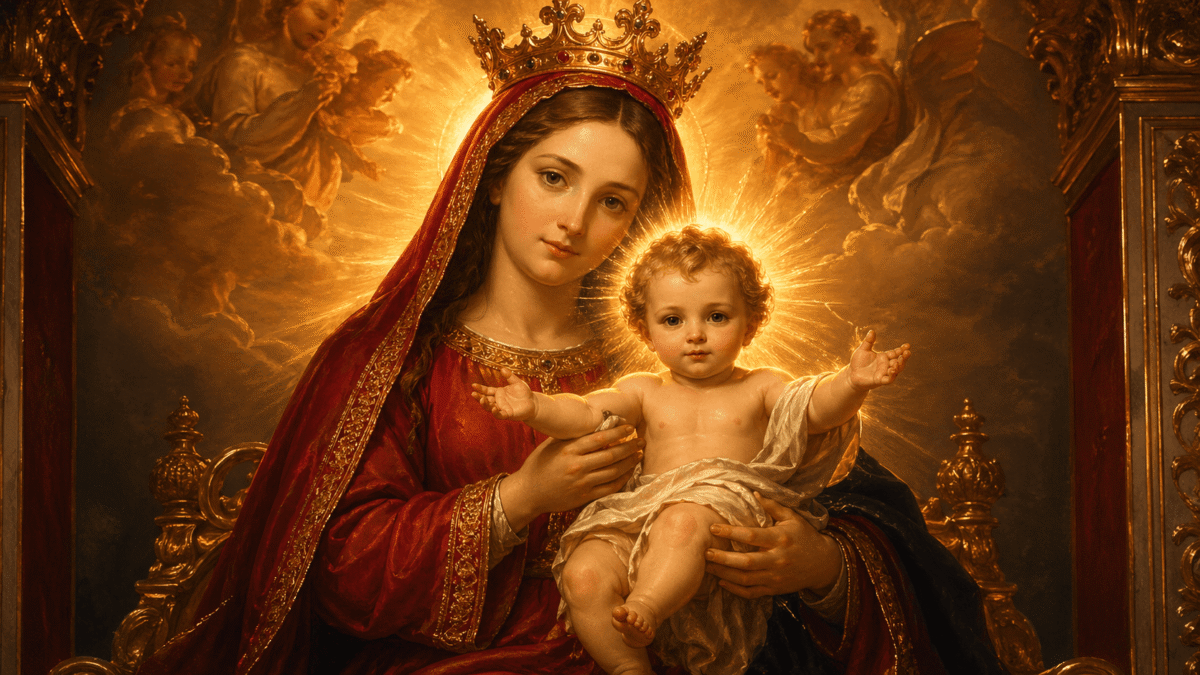
With Him I wasSeat of Wisdom“Throne of Wisdom, in the Loreto Litany, is one of the richest expressions in Marian tradition.”throne“It is not merely the external throne of the King seated, but the place that manifests His presence and His dignity. Mary as…”Seat of Wisdom“Is, in a primordial sense, that in whose womb the Eternal Wisdom dwells”sat“It became concretely, historically, corporally present.”With him I was“In Mary, wisdom becomes a historical presence.”
The application of Proverbs 8 to Mary has roots in patristics. Bernard of Clairvaux, who developed mariology with an intensity of poetry unmatched in medieval Western Europe, meditated at length on Mary as «Seat of Wisdom“and how”temple“Where Wisdom Dwelt. The Wisdom that…”She played before God“Before Creation”He played“In the cradle of Bethlehem, Bethlehem’s cradle was Mary’s arms.”
Iconography of “Seat of Wisdom“, one of the oldest Marian iconographic types, present since the 4th century, depicts Mary seated, frontal, hieratic, with the Son seated on her lap as in a “nursery scene.”throneThis image, brought to the West by the Crusaders and influencing Romanic sculpture (the famous series of Black Madonnas of Auvergne), visually expresses the theology of the title: Mary is not a passive container, she is the “Annunciation” (Anunciacao) and “Coredemptrix” (Corredentora), actively participating in the divine plan of salvation.Throne“Active agent of Wisdom, the place that gave Wisdom its visible and historical form.”
The contemplative dimension of this title has been explored by the female theological tradition: Juliana of Norwich, Hildegard of Bingen, Gertrude of Helfta, all found in Mary “Seat of Wisdom“The model of the contemplative soul that becomes”seat“of Divine Wisdom. Not merely was Mary the”Throne“Through faith and the sacraments, every soul that receives Christ becomes, in a certain sense, wise.”seat“Of Wisdom. Mary is the perfect model of this reception, but it is also an invitation to all to become”throne“Where Wisdom Dwells”
“With Him, I was: the Trinitarian joy and Mary’s joy”
“With him I was: I was created, I was formed as one of his first works.” – Proverbs 8:30-31I was his delight each day, playing before him all the time, playing in his habitable world, and my delight was to be with the children of men.“. The image of Wisdom that ‘ ““Play”» (sahaq (This is a transliteration; the exact meaning depends on context.) In Hebrew, play, dance, laughBefore God“It is one of the most surprising Scriptural revelations: the intratrinitarian life has a dimension of playful joy, of”game» (Game“Proverbs 8 expresses with a rare poetic audacity.”
Hans Urs von Balthasar developed this image of theWisdom that plays“In dialogue with Patristic tradition: the”Eternal game“The Son in the bosom of the Father is the expression of the freedom and joy of trinitarian life. Creation is not a necessity but…”game“a free expression of a joy that overflows. And the Incarnation, the Wisdom that”“Play”“now”habitable world“and”She delights in the children of men.“It is the extension of this”game“To time and history”
Maria participa desta alegria trinitária de modo único. O Magnificat “Behold, I am the handmaid of the Lord” (Luke 1:46)My spirit rejoices in God, my Savior.“is the expression of the creature that received the Wisdom which”“Play”“And she was filled with his joy. This Marian joy is not superficial, but the deep joy of one in contact with the source of all joy: the intratrinitarian love described by Wisdom of Proverbs 8 as eternal.”Delight“. (No translation needed as per instructions)”
The feast of the Most Holy Trinity, which Ordinary Time inaugurates, invites us to contemplate this trinitarian joy as the horizon of Christian life. One does not follow God out of fear, but follows God because the life of God is pure joy,Eternal game“, “DelightMary, who contemplated this joy from close range, who lived with incarnate Wisdom for decades, is the most qualified guide for this contemplation: she whoShe kept and meditated in her heart.(Luke 2:19-51) knew that what was happening to her was fundamentally the continuation of the “Annunciation”Eternal game“From Wisdom to the Time of Human History”
“With Him I was: the Spirit, wisdom, and Mary, Pentecost continues in the Trinity”
With Him I was: The Solemnity of the Most Holy Trinity follows Pentecost immediately, not by chance. The Spirit who descended at Pentecost is the Spirit of the Trinity: the gift of Pentecost is the experiential revelation that God is Father, Son, and Spirit, and that this trinitarian life has been communicated to us.Wisdom“From Proverbs 8, that…”He was with GodBefore creation is the Wisdom that the Spirit of Pentecost communicates to the faithful: the inner intelligence of the mysteries of God, which is the fruit of the trinitarian love.With him I was“From Proverbs 8, the Spirit brings the trinitarian life close to us.”
Mary, who received the Spirit in full Annunciation and which was present at the Pentecost in the Cenacle, is the creature that most fully received the gift of theTrinitarian Wisdom“. Not academic or philosophical wisdom, but the wisdom of love that the Spirit communicates, which enables”to know“God is not from outside but from within, as he who dwells and transforms. This wisdom that Mary received in fullness is what the Litany invokes in the title of ‘…”Seat of Wisdom“: not only the “physical seatWhere Wisdom rested, but theSpiritual throne“of a creature fully inhabited by the Trinitarian life.”
The Solemnity of the Trinity, marking the end of the cycle that began with Advent and passed through Christmas, Easter, and Pentecost, now opens the long Common Time: the time when the trinitarian life is called to penetrate the everyday. Mary, who lived «Common Time“From Nazareth, with the fullness of the Trinity’s wisdom that dwelt in her, she is the model of this…”Trinitarian Daily“: the ordinary life transformed from within by the habitation of the Father, the Son, and the Holy Spirit, which the Wisdom of Proverbs 8 anticipated and which Pentecost realized.
Mary, «Throne of Wisdom“which generated in time the Eternal Wisdom”He played before the Father“, it is the most eloquent icon of the Trinitarian life that flows over creation, and the Common Time is called to live in the everyday.
References
- Vatican Council II Light of the NationsNos. 53-65 (1964)
- H. U. von Balthasar Theologik“Chapter II: «”The Truth of God(1985)
- Bernard of Clairvaux Homily on the Annunciation “Annunciation”He is sent“, IV.”
- R. Brown The Gospel of JohnVolume I (1966)
- Serra The Wisdom and Contemplation of Mary (1990)
Postgraduate Program in Mariology
Would you like to deepen your formation in Mariology? Get to know the Postgraduate Program in Mariology from Locus Mariologicus – an academic formation that combines theological rigor, spiritual life, and the living tradition of the Church.
Would you like to study Mariology seriously?
This article arises from the works in the Locus Mariologicus library. The Postgraduate Program in Mariology takes you to the same sources, with academic guidance: Scripture, the Fathers of the Church, and the Magisterium, from the first dogma to contemporary issues.




Responses