Manete in dilectione mea: Mary and the Dwelling in the Love of Christ
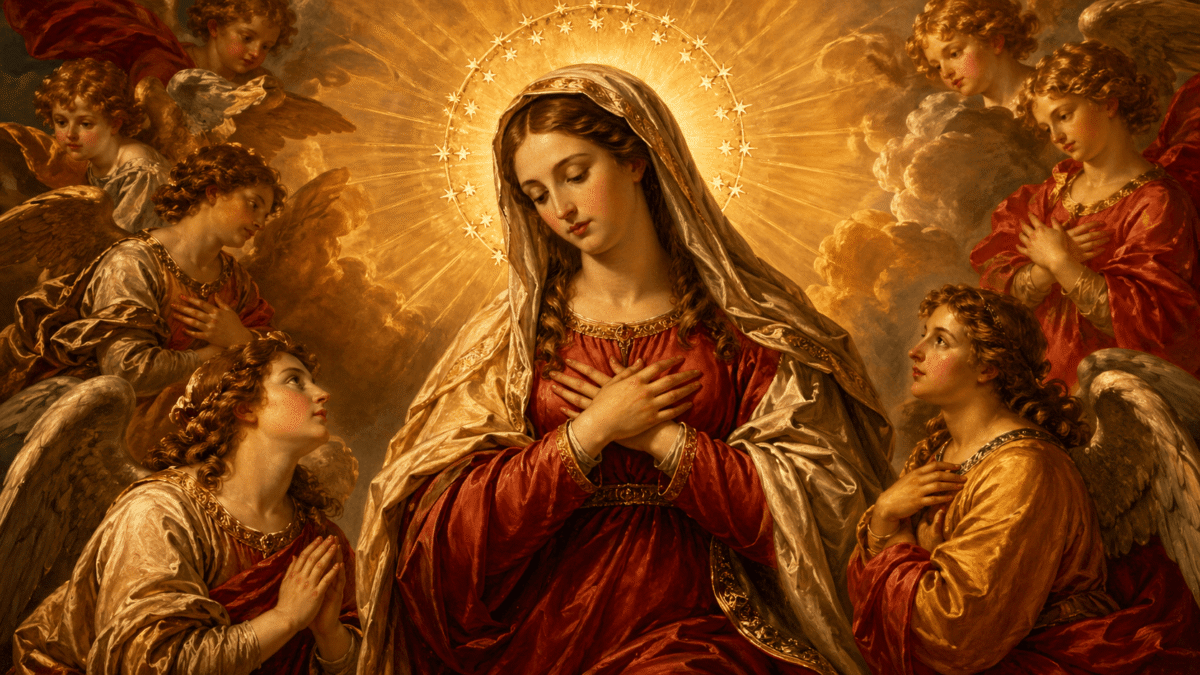
Manete in dilectione mea, sicut et ego Patris mei praecepta servavi et maneo in eius dilectione.
Jn 15:9-10
“Abide in my love, as I have kept my Father’s commandments and abide in His love.” Jn 15:9-10 sets love as the “place” where the disciple is to dwell, not a passing feeling, but a permanent dwelling. Jesus draws the parallel with His own relationship with the Father: He who “abides in the Father’s love” by keeping His commandments is the model of the disciple who “abides in the love of Christ” by keeping His commandments. Mariology finds here its deepest center: Mary abided in the love of Christ more fully than any other human being.
I. “Abiding in love”: the structure of the Christian life
The verb menein, “to abide,” is one of the most characteristic of the Fourth Gospel: it appears 40 times, far more than in the other Gospels. In John, “to abide” is not stasis; it is the quality of a relationship that persists, that is not disturbed by external difficulties, that has a stable center of gravity. “He abides in love” is the description of someone whose life is organized from the love of Christ, who always returns to that center even when circumstances draw him away from it.
The condition for “abiding in love” is, according to Jn 15:10, keeping the commandments: “If you keep my commandments, you will abide in my love.” This condition is not legalistic; it is not an obedience that precedes love and would merit it. It is the obedience that flows from love and deepens it: whoever loves acts according to the will of the beloved. And by acting according to that will, the relationship of love grows deeper. The commandments are the concrete form in which the love of Christ is made flesh in daily life.
The theology of grace has here a fundamental anchoring point: “abiding in love” is not possible by human strength; it requires habitual grace, the state of justification that theologians call “sanctifying grace.” This grace is precisely participation in the intra-Trinitarian love: when the believer is in a state of grace, he is “within” the love of God, he “abides” in it. Mortal sin is exactly the departure from this state, the rupture of the “abiding.”
The distinction between “love” as a feeling and “love” as a state, between affective eros and ontological agape, is crucial for understanding this verse. John does not speak of always feeling affection for Jesus; he speaks of an ontological dwelling in His love that can coexist with affective dryness, the night of faith, the silence of God. Mary, who “abided in love” even on Calvary, when every feeling of consolation had vanished, is the model of this distinction.
II. Mary, she who “abided in love” to the end
The story of Mary’s life can be read as the story of an ever deeper “abiding in love.” Each stage of her life, Annunciation, Visitation, Bethlehem, Nazareth, Cana, public ministry, Calvary, Resurrection, Pentecost, is a new realization of the same “abiding,” in circumstances always different and always more demanding.
The Annunciation is the initial “abiding”: Mary says “fiat” and enters into the love of God with all her freedom. But this initial “abiding” is immediately put to the test: Joseph’s incomprehension (Mt 1:19), the journey to Bethlehem, the birth in conditions of poverty, the flight into Egypt. Each of these circumstances could have shaken a less profound faith. Mary “abided”: not because she did not suffer, but because the center of gravity of her being was the love of the Son, not external circumstances.
The “hidden life” of Nazareth, thirty years of Gospel silence, is the most radical form of the “abiding”: daily fidelity, without visible heroic gestures, without public consecration, without recognition. Mary, who made the bread, sewed, and drew water at the well, “abided in the love” of Christ with the same fervor as at the Annunciation. This daily fidelity is the most difficult of all the forms of “abiding,” and the most necessary for the Church, made up for the most part of “hidden” lives without visible heroism.
Calvary is the summit: when love seemed defeated, when the Son who was the reason for her “abiding” was dying in dishonor, Mary “abided.” Not by force of will, but because the love she had for the Son was stronger than the scandal of the Cross. This “abiding” of Mary on Calvary is the deepest reason for her spiritual motherhood: she who “abided” when all the others fled can sustain her spiritual children in their own crises of faith.
III. “As I have kept”: the Trinitarian model of love
Jn 15:10: “as I have kept my Father’s commandments and have abided in His love.” Jesus establishes a parallel between His relationship with the Father and the disciples’ relationship with Him: “as I… so you.” The Christian life has a participatory structure; it is a participation in the relationship the Son has with the Father. To love “as Jesus loved” is to be admitted, by grace, into the dynamic of the intra-Trinitarian love.
This Trinitarian dimension of Christian spirituality is central to Mariology. Mary was not only faithful to the law of God; she was admitted into the dynamic of Trinitarian love in a unique and unrepeatable way. Her relationship with the Father (as daughter of the Trinity), with the Son (as Mother), and with the Holy Spirit (as the “place” of His action) is a real participation in the life of the three divine Persons.
St. Louis Marie de Montfort, in the Treatise on True Devotion, developed the idea that devotion to Mary is the most perfect form of “abiding in the love of Christ”: because Mary, who is permanently “in the love of the Son,” welcomes those devoted to her into that same space of love. To give oneself to Mary is, in this logic, the surest way to “enter and abide” in the love of Christ. Not because Mary replaces the Son, but because she, who is more deeply “within” that love than any other creature, is the surest guide to dwelling in that love.
Ignatian spirituality, apparently very distant from Montfort’s Marian devotion, shares this Trinitarian structure of love. The Spiritual Exercises of St. Ignatius culminate in the “Contemplatio ad Amorem,” a meditation on the love of God that leads the retreatant to “abide” within a love that precedes him and enfolds him. In the Exercises, Mary is the one who most perfectly realized this “abiding in love,” and for this reason she is invoked at the beginning of each contemplation as model and intercessor.
IV. “That my joy may be in you”: Mary and the joy of love
Jn 15:11: “I have told you these things so that my joy may be in you and your joy may be complete.” “Abiding in love” is not a burden; it is the source of the deepest joy. Jesus promises that whoever “abides” in His love will share in His own joy, the joy of the Son in the love of the Father, which is the joy of the Trinitarian life.
In the tradition, Mary is the figure of Christian joy. The Magnificat is a canticle of joy that springs from “abiding in love”: “My spirit rejoices in God my Savior” (Lk 1:47). This joy is not the easy joy of one who has never suffered; it is the deep joy of one who has suffered much and “abided” in spite of everything. The Mary of the Magnificat and the Mary of Calvary are the same woman: and it is precisely because she “abided” on Calvary that her Magnificat is credible.
The Franciscan tradition, with its emphasis on laetitia (joy) as the fruit of a life according to the Gospel, found in Mary the model of the “perfect joy” that springs not from consolations but from “abiding in love.” St. Francis of Assisi, who composed the Canticle of the Creatures as an expression of this contemplative joy, had in Mary his deepest devotion: she who said “Omnipotens me fecit mirabilia” (Lk 1:49) is the model of the joy that comes from recognizing the wonders of God, not one’s own achievements.
Contemporary spirituality, in particular the charismatic movement and the movements of evangelization, has recovered the dimension of joy as a sign of the Holy Spirit and as Christian witness. Mary, “full of grace” and “full of the Spirit,” is the model of this joy that “overflows” and attracts: the joy that is not superficial happiness but depth of love. She who “abided in the love” of Christ to the end is the guarantee that this love is real, that this joy is possible, that “abiding” is worth it.
Mary, who “abided in the love” of Christ from the Fiat to Calvary and to the Upper Room, is the model and the intercessor for every disciple who wishes to dwell permanently in the love of the Son.
References
- St. Louis Marie de Montfort, Treatise on True Devotion, n. 55-89.
- John Paul II, Redemptoris Mater, n. 17-24 (1987).
- St. Ignatius of Loyola, Spiritual Exercises, n. 230-237.
- H. U. von Balthasar, First Glance at Adrienne von Speyr (1981).
- C. Spicq, Agapè dans le Nouveau Testament, vol. III (1959).
Postgraduate Program in Mariology
Would you like to deepen your formation in Mariology? Discover the Postgraduate Program in Mariology of Locus Mariologicus – an academic formation that unites theological rigor, spiritual life, and the living tradition of the Church.
Would you like to study Mariology seriously?
This article is born of the works in the library of Locus Mariologicus. The Postgraduate Program in Mariology takes you to the same source, with academic guidance: Scripture, the Fathers of the Church, and the Magisterium, from the first dogma to contemporary questions.





Responses