Non veni vocare iustos: Matthew, the Tax Collectors, and Mary refugium peccatorum
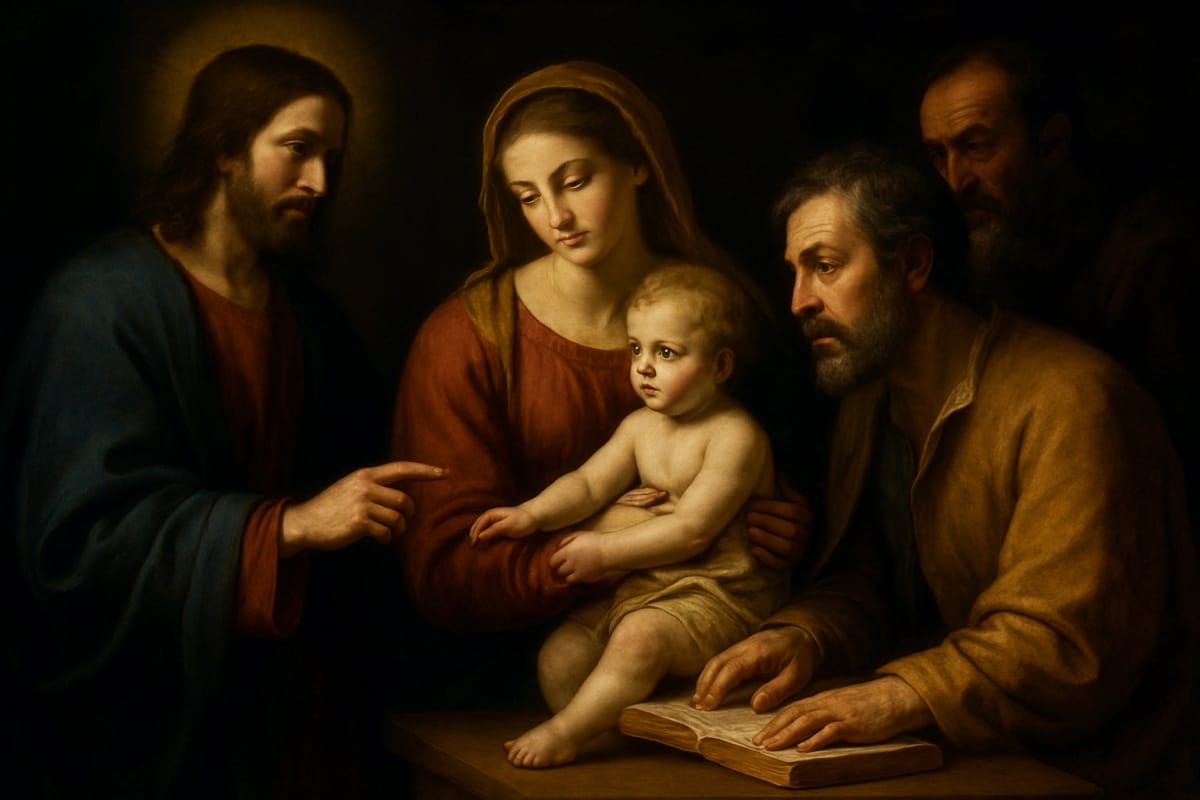
Non enim veni vocare iustos, sed peccatores.
Mt 9:13
The Saturday of the Thirteenth Week in Ordinary Time is, in liturgical tradition, Our Lady’s Saturday, the day of the Marian memorial that medieval devotion made widespread as a day of contemplation of and prayer to Mary. The Gospel pericope of the weekday liturgy for this Saturday, Mt 9:9-13, the calling of Matthew and the banquet with the tax collectors, offers an unexpectedly precise key for the Mariological contemplation of the day: the mercy that calls the excluded, the banquet that opens its doors to those whom the religious system shut out, and Mary as the face of that mercy which never shuts the door.
The calling of Matthew has a very brief and striking structure: Jesus passes by, sees Matthew sitting at the tax office, says, “Follow me,” and Matthew “rose and followed Him” (Mt 9:9). No hesitation, no process of discernment described, no explanation. Jesus’ “Follow me” immediately produces the “rose and followed.” This swiftness of response has in Matthew its own autobiographical commentary: the Gospel that narrates this calling was written by the hand of the same Matthew who rose and followed. The Good News we proclaim was written by a converted sinner, and that says something about the nature of the Good News.
I. The Tax Collector Who Rose: Vocation as Rupture
Matthew was a publican, a tax collector in the service of Rome. This profession made him impure according to Jewish law (contact with Gentiles, the possibility of fraud, collaboration with the occupier) and socially excluded him from the religious community. In rabbinic casuistry, tax collectors were placed in the same category as “sinners,” those who lived in a permanent state of estrangement from the covenant. That Jesus should call a tax collector into the group of the Twelve was, from the standpoint of Jewish religious sensibility, an institutional scandal: disciples ought to be drawn from among the pure, not from among the impure.
Matthew’s “rose and followed Him” parallels the “rose and served” of Peter’s mother-in-law (Mt 8:15): Jesus’ healing/call immediately produces service, movement, new life. The bed that the paralytic carried as he left (Mt 9:7) and the tax office that Matthew abandons as he leaves (Mt 9:9) are the “plows” that are burned, the instrument of the former life left behind without hesitation when Jesus calls. Vocation is not a slow process of interior deliberation culminating in a difficult decision: it is an immediate response to an immediate call, with the rupture it entails.
The banquet that follows, “while Jesus was at table in Matthew’s house, many tax collectors and sinners were at table with Jesus and his disciples” (Mt 9:10), is the gesture of incorporation into the new community. Matthew does not keep his conversion as a private matter: he opens his house, invites his friends (other tax collectors and sinners), and the banquet becomes the space where the new covenant begins to take shape. Matthew’s table anticipates the Eucharistic table: the place where the excluded are welcomed, where the distinction between pure and impure is overcome by the love that invites all.
Mary’s Visitation to Elizabeth has the structure of Matthew’s calling: Mary received the call (the Annunciation) and “arose and went” (Lk 1:39, “anestousa”). Like Matthew, who rose from the tax office, Mary rose from her house in Nazareth. Like Matthew, who brought Jesus to the house and the table of the excluded, Mary brought Jesus to Elizabeth’s house and to the “banquet” of the Visitation, the encounter in which John leapt for joy in Elizabeth’s womb. The structure of immediate following, without hesitant deliberation, is common to Matthew and to Mary.
II. “Why Does Your Teacher Eat with Tax Collectors?”: The Scandal of Mercy
“Why does your Teacher eat with tax collectors and sinners?” (Mt 9:11): the Pharisees’ question to Jesus’ disciples reveals the social code that Jesus was violating: a shared table implies communion. Eating with the impure makes impure the one who eats with them. The Pharisees were not wrong within the internal logic of the purity system; they were wrong to apply that system to Jesus, whose contact with the impure purifies them instead of contaminating Him (as we have already seen with the leper in Mt 8:3).
“Those who are well have no need of a physician, but those who are sick” (Mt 9:12): Jesus’ reply to the implicit accusation is a maxim of wisdom: physicians are where the sick are, not where the healthy are. The logic of Jesus’ mission inverts the logic of ritual purity: it is not the healer who must keep away from the sick in order to remain pure. It is the healer who must go where the sick are in order to heal them. This inversion is the principle of the Incarnation: God did not remain apart from humanity in order to keep Himself “pure” of human contamination. He entered humanity in order to heal it from within.
“Go and learn what this means: it is mercy I desire, and not sacrifice” (Mt 9:13, quoting Hos 6:6): the quotation from Hosea is programmatic for Jesus’ ethics in Matthew. The “sacrifice” that Hos 6:6 contrasts with “mercy” is not liturgical sacrifice as such; it is ritual observance that becomes an end in itself, disconnected from the love of neighbor it ought to express. Jesus did not abolish ritual. He abolished the ritualism that uses ritual as a defense against the excluded. The “mercy” that Hosea calls for is the Hebrew hesed, the loyal love that does not abandon.
Marian devotion to “mercy” has its Gospel foundation in this text: Mary is “full of grace” (Lk 1:28), filled with the hesed of God, and as such she can offer the refuge that the “Pharisees” of every age refuse. Those who come to Mary are often those whom the formal religious structure has made feel excluded: the divorced, those who have stopped practicing, those who feel unworthy to enter through the main door. Mary is the side door that welcomes when the main door seems shut, not because the main door ought to be shut, but because her mercy imposes no prior conditions.
III. Mary refugium peccatorum and the Marian Saturday of Mercy
“Refugium Peccatorum,” Refuge of Sinners, is one of the titles of the Litany of Loreto that most directly captures the role that Marian devotion has attributed to Mary over the centuries. The “refugium” is the space of welcome before judgment, like the “cities of refuge” of the Old Testament (Num 35:11-15), which protected the one who had killed unintentionally until judgment. Mary as “refuge” is the one who welcomes the sinner before he is able to present himself to the Sacrament, the space of transition between the state of estrangement and formal reconciliation.
The Marian Saturday as a day of reflection on sin and mercy has a long devotional history. The practice of the “Five First Saturdays” (promoted by devotion to the Immaculate Heart of Mary after Fatima) links the Marian Saturday to the examination of conscience, to confession, and to Communion of reparation. This practice, when rightly understood, is not ritualism; it is the weekly structure that invites the Christian to examine where he has been this week, like Matthew at the tax office, and to “rise and follow” Christ anew.
Matthew’s table, open to tax collectors and sinners, is the anticipation of the Sunday Eucharistic table. The Marian Saturday is the day of preparation for that table: the day to “go and learn what mercy means” (Mt 9:13) as a disposition for receiving the Eucharistic gift of Sunday. Mary, who was present at the Last Supper (according to tradition) and in the Upper Room (according to Acts 1:14), is the model of this preparation: the one who reached the Sunday of the Resurrection and the Sunday of Pentecost by way of Holy Saturday, the day on which mercy was not yet visible but was already real.
“I came not to call the righteous, but sinners”: this saying of Jesus remains one of the most liberating texts of the New Testament for those who feel excluded. Mary, who sang, “he has filled the hungry with good things and sent the rich away empty-handed” (Lk 1:53), understood this logic from the beginning: those who come with hands full of their own righteousness have no room to receive. Those who come with empty hands have all the room. The Marian Saturday is the day for emptying one’s hands, for acknowledging one’s own spiritual poverty, so as to be ready to receive the Sunday gift of the Eucharist and of the Gospel that Jesus brings to the table of sinners.
Postgraduate Program in Mariology
Would you like to deepen your formation in Mariology? Discover the Postgraduate Program in Mariology of Locus Mariologicus, an academic formation that unites theological rigor, spiritual life, and the living tradition of the Church.
Would you like to study Mariology seriously?
This article grows out of the works in the Locus Mariologicus library. The Postgraduate Program in Mariology takes you to the same source, with academic guidance: Scripture, the Fathers of the Church, and the Magisterium, from the first dogma to contemporary questions.





Responses